
[ad_1]
Joshua Scheer
More than fifty-five years after they first met during an anti-Vietnam War march in Los Angeles, Robert Scheer and Vietnam veteran Ron Kovic reunite for a deeply personal conversation about friendship, war, trauma, and hope. Kovic reflects on the wounds he has carried since being paralyzed in Vietnam, the lifelong cost of war borne by veterans and civilians alike, and why he believes ordinary people—not politicians—remain the greatest force for democratic change. At a time of renewed global conflict and growing political division, Kovic offers a powerful reminder that the struggle for peace is never over and that, in his words, “the best days… are ahead of us.”
As this conversation airs on July 4, it also marks a milestone for Ron Kovic, who celebrates his 80th birthday on the very day that has defined much of his life. Born on Independence Day and immortalized through his memoir Born on the Fourth of July, Kovic has spent decades challenging Americans to live up to the ideals the holiday represents. After volunteering to serve in Vietnam, returning home paralyzed, and becoming one of the nation’s most influential anti-war voices, his life has become a testament to both the costs of war and the enduring promise of democracy. His message is not one of cynicism, but of hope: that ordinary people, through courage, compassion, and collective action, can still build a more just America.
We also want to extend our heartfelt thanks to our newest editor, Carlotta Escala Boehm, for their exceptional work on this video. Filmed on Robert Scheer’s birthday and released as we celebrate Ron Kovic’s 80th birthday and Independence Day, it is a fitting reflection on the kind of nation we aspire to be—even as we often fall short of expectations.
If you haven’t already, be sure to read and download Ron Kovic’s latest reader, An American Anthem: A Declaration for the Republic at 250 Years, a powerful reflection on patriotism, democracy, and the unfinished promise of America.
Ron Kovic: “This Is Our Time” — A Conversation with Robert Scheer on War, Peace, and Democracy Transcript:
Robert Scheer: He’s probably the most significant person I’ve met in my life—not just in terms of what he went through, but who he became.
Let me just cut to the chase. I met Ron before the movie Born on the Fourth of July was made. He can tell that story. He was very active then, but he was also dealing with a reality most people do not understand.
Because we no longer have a draft, we forget what war is. We do not have a stake in it, and we do not understand the cost. Ron’s life is at risk from a common cold. If he gets a scratch on his hand, he has to go to the Veterans Administration hospital.
Through Ron, I have been inside the Long Beach spinal cord injury center. I have seen people coming back from Iraq. These wars are not video games. There are victims—the civilian population, the people on the other side, and the GIs.
What I learned from Vietnam is that if you do not have a draft, everybody will go along.
Ron, I want you to begin by describing our first meeting.
Ron Kovic: Bob and I met for the first time 55 years ago in Westwood. I was leading Vietnam Veterans Against the War. I had been wounded and paralyzed from my mid-chest down for several years.
I was shot in Vietnam on January 20, 1968, during my second tour of duty as a United States Marine. I believed in the war. I had volunteered to go over a second time. I felt it was my patriotic duty.
But on that day on Wilshire Boulevard, we were marching against the war. I had turned against the war.
The Bronx VA hospital in New York was a shock to me. I was living among paraplegics, among some of the most catastrophic wounds of the Vietnam War, every single day. That was a tremendous education for me—living with this at 21 years old and realizing I would have to live with it for the rest of my life.
Bob was there covering the march as a reporter. We were marching to the Westwood Cemetery. So you could say Bob and I met for the first time at a march and in a cemetery.
There were many Vietnam Veterans Against the War there, and hundreds of others. It was one of many marches I would be part of for many years until that war ended, and I would continue to march.
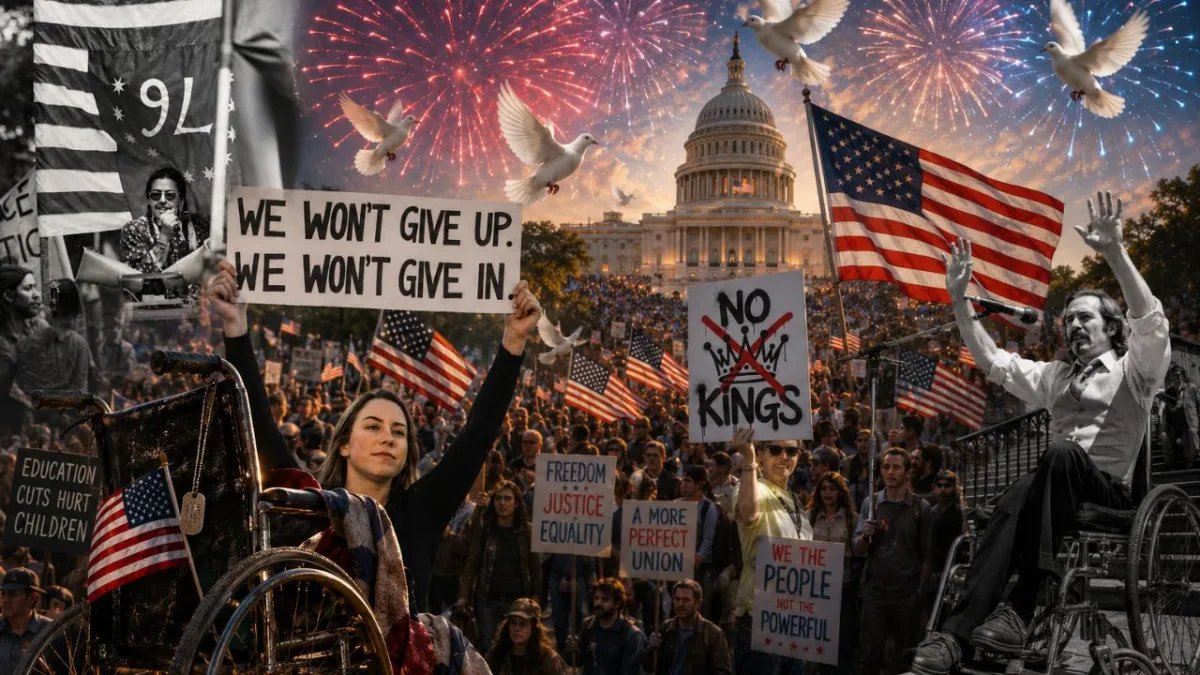
I was at the No Kings march on Saturday. I will turn 80 on the Fourth of July, 2026. Born on the Fourth of July will turn 50, still in print after 50 years, and it will be my 80th birthday.
I was wounded when I was 21 years old. I have been in this wheelchair, dealing with this every day since 1968. And I am happy to be alive. I am proud and grateful. I am grateful to know you. You have influenced my life tremendously, inspired me, given me strength, given me hope.
And I really feel—don’t laugh at me when I say this—that the best days for us, here in this country and in this world, are ahead of us, not behind us.
I remember when we got to the cemetery. A bunch of the veterans were there for a while, and we talked. Many of them left as the afternoon went by and evening came on. Then it was just you and me. Bob and I were in the cemetery together—a good place to begin a friendship.
We talked for a couple of hours, and I was very grateful that he was listening to me.
Yes, it is true: I was troubled during those times. I was hurting. I was having nightmares, as many young men did who survived that war and came home and survived the VA hospitals. We suffered from nightmares and anxiety attacks. I would have anxiety attacks during the daytime. When the sun went down, I had a feeling I was going to die. My heart would start beating. It was a very difficult time for me.
I do not know how I made it through those early years after I came home. I was 21 years old and had lost three-quarters of my body. I had been traumatized in the war. I had killed people in the war. I had nightmares that would not leave me for many, many years.
Many people suffered because of those foreign policy decisions—not just Americans, but Vietnamese as well. These wars are so senseless, so useless, so unnecessary, so counterproductive.
We were in that cemetery, and I remember they were burying people there. There were fresh graves. Someone told me several of the graves were young men who had died in the Vietnam War several weeks before. They had come back home and were being buried in the ground in that Westwood cemetery.
The gravediggers were there just before it became dark. That is how we met for the first time.
Robert Scheer: And I invited you to speak in my class many times.
Ron Kovic: Every single year, yes. At least once, sometimes two or three times.
Robert Scheer: And you’re not the only person. I also bring John Kiriakou now, who was the only one who went to prison for the torture program because he revealed it. I bring Ray McGovern and Michael.
The difficult thing with teaching—and this is what the challenge to academic freedom is all about—is they do not want us talking about this reality. That is the whole thing: shut up and go along.
They solved the problem by not drafting people. They tell you that you are not going to pay a price. Then they promise war will not take anything away, that we will make more money and get all the oil.
The real cynicism now is that Trump is openly talking about seizing the oil. The old imperialism did not pay off, so now it is back to the old-fashioned way: grab it, exploit it, take the oil in Venezuela, take the oil in Iran, and cut people in—not as much as the billionaires and the war industry, of course.
So I want to ask you the question: What is to be done? You have been a real warrior for peace. Do you think we have a chance? What should we be doing? How do we reach people? Why do you keep fighting?
A lot of people, as they get older, say to the younger generation: “It’s your turn now. We did the best we could.” But that is not what is going on right now.
Ron Kovic: Whether you are 19 or 90 years old, you have got to go to the streets. You have got to commit yourself to nonviolence, to peaceful, nonviolent protest. That is where the big changes in this country are going to happen—in mass protests in the streets.
We had 8 million people on Saturday in the No Kings protest. I was there in downtown Los Angeles, and it was inspiring.
It has been done in so many other places: in the Philippines, in Czechoslovakia, with Mandela, and in all the places where people come together.
Yes, I think we are entering a dark period of time right now. It is a dark period of time, but there will be light. I think we will win this fight. We will emerge from this time. We have got to believe that.
I would have given up a long time ago, with all that I have had to deal with every day—and I am not complaining. This has not been easy. This is challenging. This is difficult every day.
But because I never gave up, because I never quit, I feel like I became stronger. I can feel it inside of me right now. I feel like this is my time.
I am so glad I did not give up in the early years. I am so glad I decided to keep living and not die and not quit. Because this was impossible at times—difficult, painful. I cannot begin to tell you. But I knew there was something at the end of this.
I personally believe, and it may sound crazy, that this time I am in right now feels so right and so proper. It feels like this is my time. This is why I went through this—because I want to be one of the many leaders of this time.
Not the only leader, of course, but one of the many leaders. I want to move this country. I want to save this democracy. I want to bring this country back to Saturday. And I will do that. I swear to you today, and I promise you today, I will be right up front.
I do not care whether I am paralyzed, whether I am 80 or 90. You will be with me. Every one of you will be with me. We are not going to give up.
We are not going to stop until we take back this country, until we take back this democracy. They are not going to stop us. They are not going to intimidate us. They are not going to push us around.
This is our country. This belongs to us. This is our time.
We are not going to say, “It is your time, you take over. We did our part.” No. Now we must all do our part. We must all join together. We must all be united.
We are more powerful than they are. Once we realize that, once we recognize that, once we awaken to the fact that we are the real power in this country—the people, of the people, by the people and for the people—that is what they wrote. That is what they meant. That is who we are.
So please, please try to remember that.
[ad_2]
Source link
