
[ad_1]
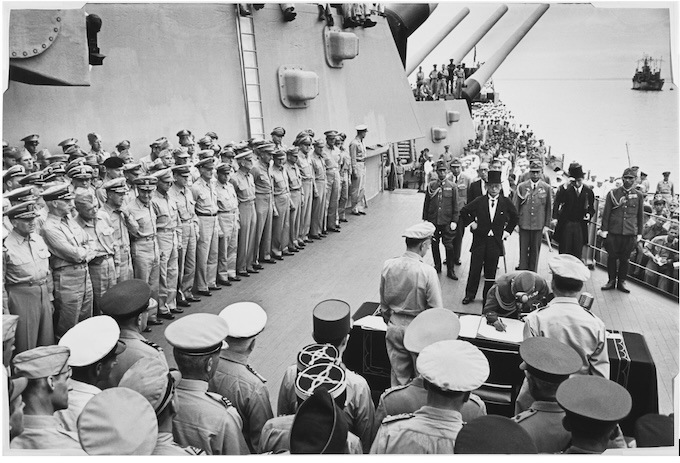
Carl Mydans, The Japanese Surrender on the USS Missouri in Tokyo Bay. September 2, 1945. Gelatin silver print. General Douglas MacArthur stands at the lower right, back to the viewer. General Yoshijirō Umezu leans over the table, signing the document of surrender. Courtesy Amon Carter Museum of American Art, Fort Worth, Texas, Gift of the artist. P1985.27.106. © Carl Mydans/LIFE Magazine, Time Inc.
Eyeworm
When President Trump, supported by Israeli Prime Minister Natanyahi, launched a war against Iran four months ago, he did so with an image of enemy surrender stuck in his head like a catchy tune, an earworm. It was probably the photo above by Carl Mydans, reproduced and widely distributed for decades after the war, of Japanese military and civilian officials gathered on the deck of the USS Battleship Missouri in Tokyo Bay, to sign the document of surrender ending war in the Pacific. General Douglas MacArthur, Supreme Commander for the Allied Powers, stands in front of a microphone to the right, with his back to the viewer.
Mydans’ viewpoint was from the front-right of a wooden platform built atop a gun turret, as can be seen in a photograph taken a few minutes earlier by another (unknown) photographer. The bag behind the dark haired, un-hatted Mydans was likely his kit, which included a spare 35 mm camera, Zeiss 50 mm telephoto lens, film, and a Rolleiflex.
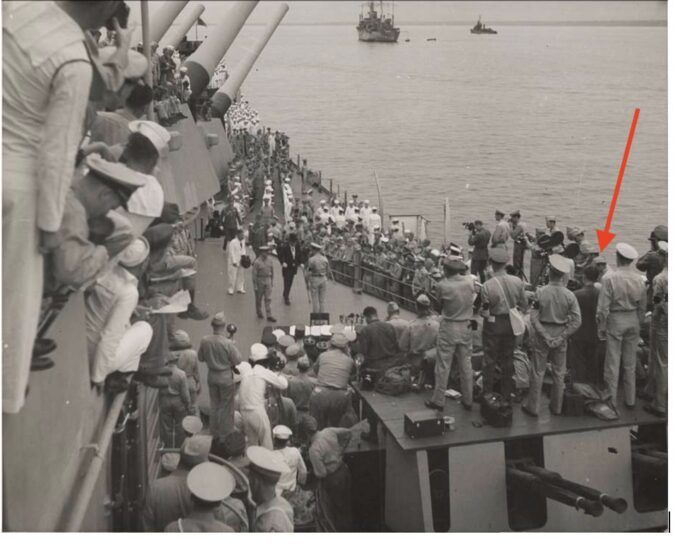
Photographer unknown, The Japanese Surrender on the USS Missouri, Sept. 2, 1945, Wikimedia Commons.
Mydans was an excellent photographer. He worked for the Farm Security Administration in the 1930s, along with Walker Evans, Ben Shahn, and Dorothea Lange, and then for more than 30 years at Life, where his photo of the surrender was first published. Japanese Foreign Minister Mamoru Shigemitsu, Chaplin-esque in his morning coat, top hat and cane, stands at center right in Mydans’ picture. At left, a diagonal line of naval officers leads the eye past two pairs of protruding ventilation cowls, crisply linear naval rifles, and hundreds of uniformed seamen, extending almost to the horizon. The guns establish a second set of diagonals that direct us toward the upper right margin of the image and another battleship, probably the USS Iowa. Of course, Mydans didn’t choreograph the scene. He only shot what was in front of him, but he knew enough to stand in the correct place, point his camera in the best direction, and press the shutter at the right time. The result is an image of Japanese abjection and U.S. invincibility.
Trump’s war on Iran on the other hand, did not end in enemy surrender. The president’s pal Steve Bannon put the best spin he could on the ceasefire deal, telling The New York Times:
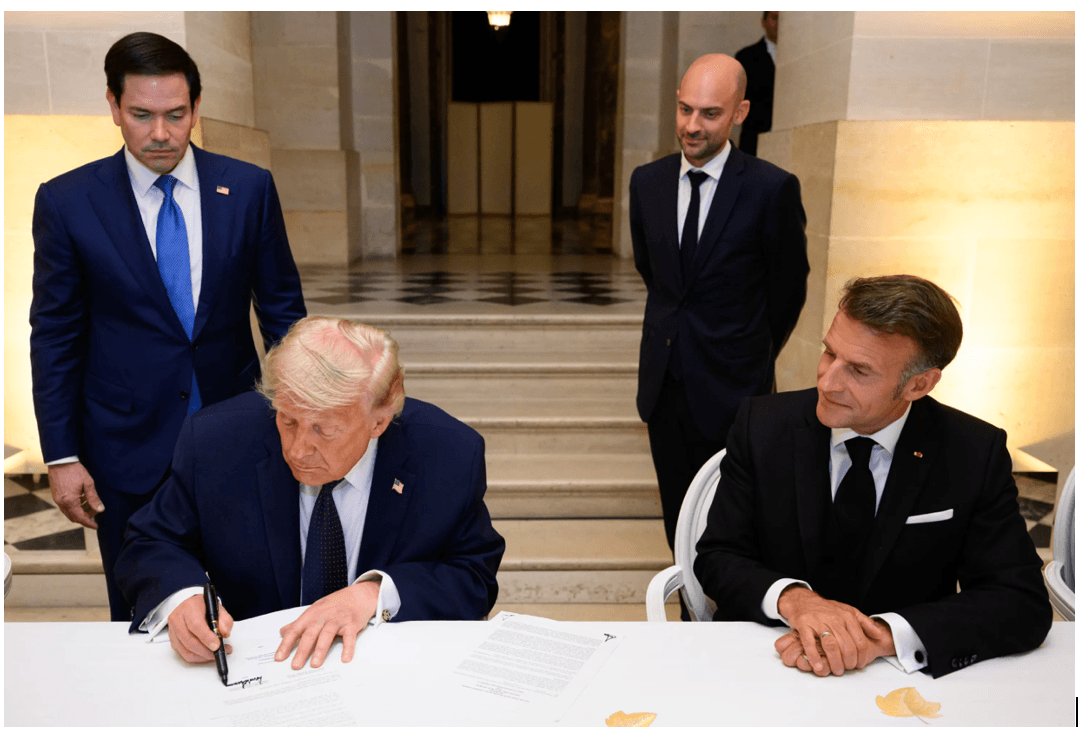
“[Trump is] a deal maker and a pragmatist;” he knows “he is not having a surrender ceremony on the battleship Missouri.” If anything, it’s Trump who offered at the Palace of Versailles the “unconditional surrender” he earlier demanded of his Iranian foes. Didn’t anyone tell him it was there, in 1919, that Germany formally capitulated to the Entente powers? Not even his confident, black, Sharpie signature on the “Memorandum of Understanding” — or the protective gaze of Marco Rubio – could lessen the appearance of defeat. Just a year and a half before, things were different. Following his inauguration, the same Bannon described the tech billionaires Elon Musk, Mark Zuckerberg and Jeff Bezos as “supplicants” bowing before the president. Bannon said to reporters: “I view this as September of 1945 – the Missouri – and you have the Imperial High Command … and he (Trump) is like Douglas MacArthur.”
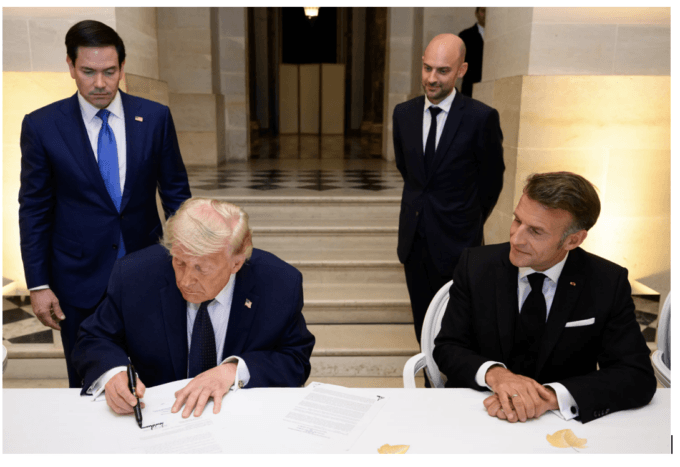
President Donald J. Trump, seated beside French President Emmanuel Macron, signs a Memorandum of Understanding between the Islamic Republic of Iran and the United States at the Palace of Versailles, France on June 17, 2026. Above the presidents at left and right are Secretary of State Marco Rubio and French Foreign Minister Jean-Noël Barrot. Photo: The White House.
The atmosphere at Versailles was anything but triumphant. For one thing, the Iranians didn’t show. Without them (they’d already signed electronically), the whole affair seemed a tad onanistic – Trump was the only player. And then there were the terms of the MOU: Both parties agreed to a 60-day ceasefire followed by negotiations that could be extended indefinitely. Iran regained control of its oil sales and frozen assets, won the right to continue uranium enrichment at a yet undetermined level, kept control over the strait of Hormuz (no tolling authority, but fees for services), and got to maintain a stockpile of ballistic weapons. Sounding like an indulgent father, Trump told reporters: “If other countries have [ballistic missiles], it’s a little bit unfair for them not to have some.” Same for uranium enrichment: “It’s a little hard when other people have it, other adjoining states have it…You have to use a little common sense.”
Just as Trump started to sign the document, he interrupted himself for a moment and admitted to nobody in particular, “That was not easy, I can tell you.” Did Mydan’s image of Japanese surrender flash through his mind? Perhaps instead of the Mydans photo, he remembered close-up film footage of Japanese General Umeza signing the surrender document. He’d seen that on television as a child and adolescent in his parent’s big house in Jamaica Estates, Queens. “Did you ever see ‘Victory at Sea’?” the president asked reporters in January 2026, while proposing a new “Trump-class” of battleships. “What a great thing that is to watch!”
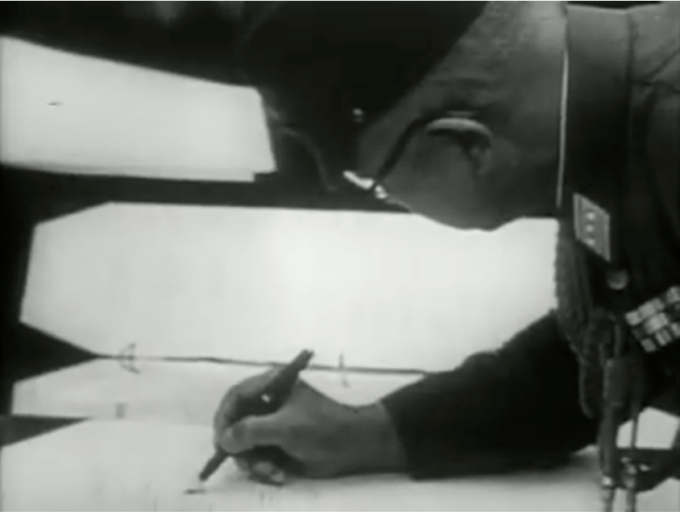
General Yoshijirō Umezu signing the document of surrender. Victory at Sea, NBC Television, episode 26, broadcast May 3, 1953, (not copyright protected).
Trump was referring to the Emmy-winning American television documentary shown on NBC TV from October 1952 to May 1953. The last episode of Victory at Sea showed the Japanese surrender, including the profile close-up of General Umeza above. The series was conceived and produced by Henry Salomon, a Naval Lieutenant Commander in World War II and former research assistant to the famous historian, Samuel Eliot Morrison, author of Admiral of the Ocean Sea, a biography of Christopher Columbus (1942). The production was amply funded by NBC and received the full cooperation of the U.S. Navy, which likely saw it as a way to raise public support for a massive Congressional increase in military expenditure. In the two years following the outbreak of war with Korea in 1950, overall U.S. military spending increased from $13.5 billion to over $50 billion. Much of the money was used to reactivate hundreds of mothballed WWII battleships, as well as refurbish and rearm the Missouri.
Victory at Sea set the standard for subsequent compilation documentaries. Each 30-minute episode deployed hundreds of archived film clips, was narrated by actor Leonard Graves and scored by composer Richard Rogers. Segments were first broadcast on Sunday afternoons at 3:00 p.m; it was shown in syndication for decades. I first saw Victory as a child in Forest Hills, Queens, in the mid 1960s. It was by then an “evergreen” for WPIX (channel 11) in New York City, broadcast both during regularly scheduled slots and whenever there was an unexpected gap in programming. I remember watching it before and after New York Yankees baseball games, for example, if a contest was delayed or shortened by rain. Trump, a decade older than me, may have seen the culminating episode 26, documenting the Japanese surrender, when it was first broadcast in 1953, but certainly in the decades thereafter. It’s still available on YouTube.
During his first term, Trump indirectly recalled his youthful engagement with Victory. On February 27th, 2017, after announcing a supplemental increase in defense spending, he said to reporters: “We have to start winning wars again. I have to say, when I was young, in high school and college, everybody used to say we never lost a war. We never lost a war, remember?” He couldn’t have been remembering the actual wars of his lifetime – the Korean War was fought to a draw, and the Vietnam War was a notable U.S. defeat. He was thinking instead of World War II, the conclusion of which he repeatedly saw on WPIX television in Queens, and then again for decades after. Consider the following: An 80-year-old president was likely spurred to war against Iran by recollection of an 81-year-old photograph and a 73-year-old television documentary. God save us.
Symptom and symbol
Trump knows little about World War II beyond what he has seen on TV or in the movies, and even less about art, but he knows what he likes: images of domination. In Mydans’ photograph and Victory at Sea, he saw diminutive Japanese men made to walk slowly across the steel deck of the Missouri, flanked by rows of U.S. seamen chosen for their height. The presence of hundreds of other seamen, many leaning over upper decks, plus dozens of reporters, photographers and cameramen increased the spectacle of American power. The Japanese participants themselves described the oppressive impact of the signing ceremony.
Bending over the table on the USS Missouri must have felt to the Japanese like bowing before a superior. To deploy the terminology of the art historian E.H. Gombrich, the “symbol,” in this case signing the document of surrender, was barely distinguishable from the “symptom,” bending down, the natural manifestation of subordination. In other words, when Trump saw films and photographs of the surrender, he saw not only the completion of a contract – like the real estate deals closed by his father — but one group of men physically and psychologically dominating a second group. And domination – bullying – is for Trump the ultimate aphrodisiac.
Elision of symbol and symptom is surprisingly rare in historical images of surrender, except when the goal is to show the stronger power destroying the dignity of the weaker. For example, on the Column of Trajan (113 C.E) in Rome, the defeated Dacians are seen kneeling before the victorious emperor Trajan, who is seated on a raised tribunal. Dacian shields are cast aside while the Romans carry signa, military standards that represent unit cohesion and past victories.
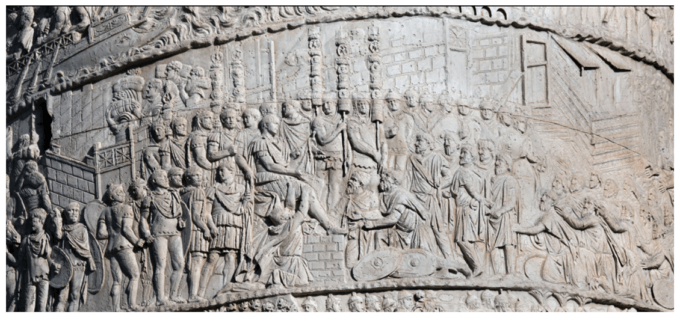
“Surrender of the Dacians,” scene 75, Column of Trajan, 113 CE, Rome.
The idea was to represent the Dacians as barbarians (barbari) lacking the language, costume, culture and even hairstyles (they are all bearded) of civilized Romans. They are depicted as subservient, dependent upon the mercy (clementia) of the emperor.
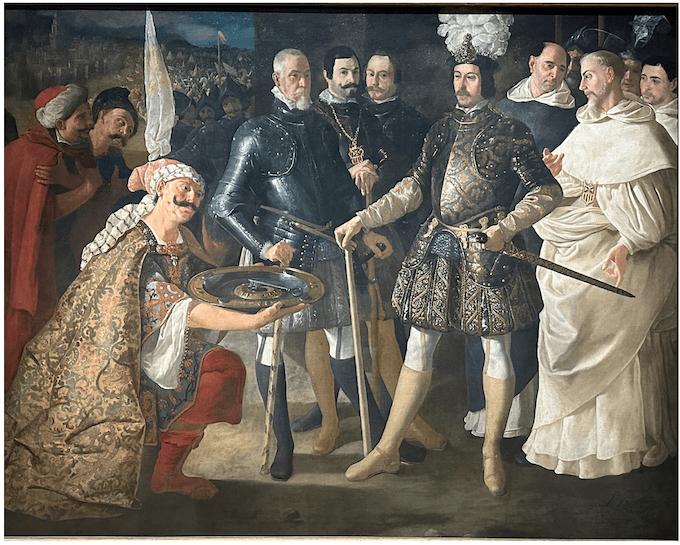
Francisco de Zurbaran, The Surrender of Seville (1634). Private collection. Photo: The author.
European medieval and early modern monarchies and absolutist states mostly eschewed such imagery. There’s little glory in defeating an unworthy foe. In addition, when geographically dispersed kings and queens have ties of blood or marriage, it’s foolish to utterly demean a nation with which you might one day wish to form an alliance. Wealthy merchants too were increasingly international in early modern and industrial Europe – why foreclose a future deal by dint of bad blood? Thus, Francisco de Zurbaran’s The Surrender of Seville (1634) depicts the Muslim governor of Seville, Achacaf, surrendering his shield and keys of the city to King Ferdinand III of Castile in 1248. Though kneeling, the Muslim ruler is resplendent in his brocaded robes. The reconquest of Spanish land, according to this painting, finally accomplished in 1492, was a legal transfer between kings, knights and friars; let’s all be friends.
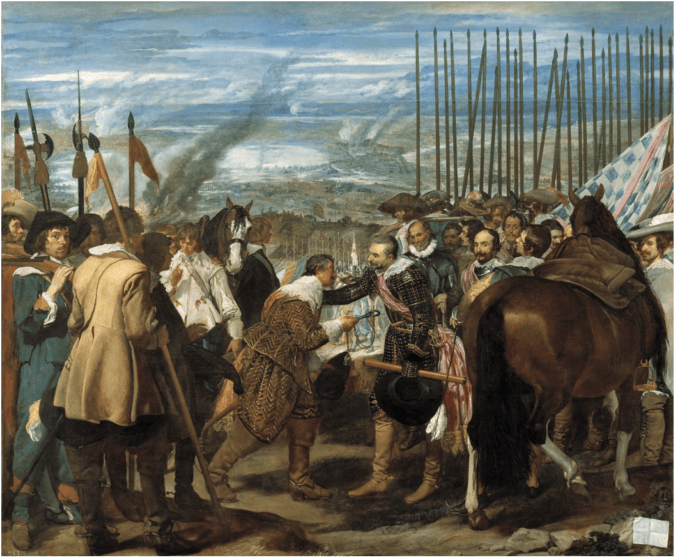
Diego Velazquez, The Surrender at Breda, 1635. Prado Museum.
Diego Velazquez’s The Surrender at Breda marks the artistic apotheosis of this live-and-let-live war iconography. Inspired by Zurbaran’s contemporaneous Surrender (the two artists were friends and compared notes), Velazquez’s picture shows the Dutch leader at left, Justinus of Nassau, handing over the keys of the besieged city of Breda to the Spanish Ambrogio Spinola. At right, the victorious Spanish soldiers hold their lances erect, like the signia held by the Romans in the “Surrender of the Dacians” on the Column of Trajan. Only here, the victorious side forfends the losing side’s abjection. “No need to bend, my dear friend,” Spinola seems to say to Justinus, “you fought bravely and we accept the keys to Breda in a spirit of reconciliation.” Never mind that 13,000 out of 17,000 Dutch civilians and soldiers died during the nine-month siege. The survivors were permitted to march out of their city with their weapons and standards.
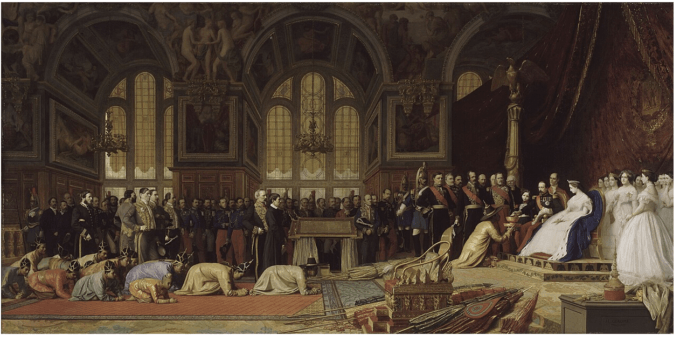
Jean-Léon Gérôme, Reception of the Siamese Ambassadors at Fontainebleau (1861-64). Musée National des Châteaux de Versailles et de Trianon, Versailles.
More to Trump’s liking, one suspects, would be French Salon painter Jean-Léon Gérôme’s Reception of the Siamese Ambassadors at Fontainebleau (1861-64). The giant canvas is an unconcealed effort by the artist both to ingratiate himself with his patron, the dictator Napoleon III, and to affirm the military as well as racial superiority of the French over the Siamese (Thai) nation. Seated at the far right beside the Empress Eugenie, Napoleon receives tribute from the first in a double line of Siamese ambassadors seen crawling in obscene supplication before their French master and mistress. The ambassadors’ gifts, rendered with painstaking exactitude, are piled up in the right foreground like the shields in the “Surrender of the Dacians” from the Trajan Column. Though the French Emperor hoped to seduce his guests to ally with France rather than Britain in the contest for colonies, there was no chance he would suspend his claimed superiority for reasons of state. The White House Oval Office is increasingly functioning like Louis Napoleon’s Fontainebleau Salle du Bal.
The Nazis, naturally, understood the practice and imagery of domination. Hitler made sure France’s 1940 surrender took place in the same Compiègne Wagon as the initial German surrender to France and the Entante powers in 1918. The Fuhrer has just left the train car, stationed a tall SS officer in the gangway, and told Field Marshall Wilhelm Keitel (tried for war crimes, convicted and executed at Nuremberg) to ensure French officials were in every way humiliated. Keitel is shown handing the document of surrender to Huntziger who appears to lower his head to receive it – symbol becomes symptom.
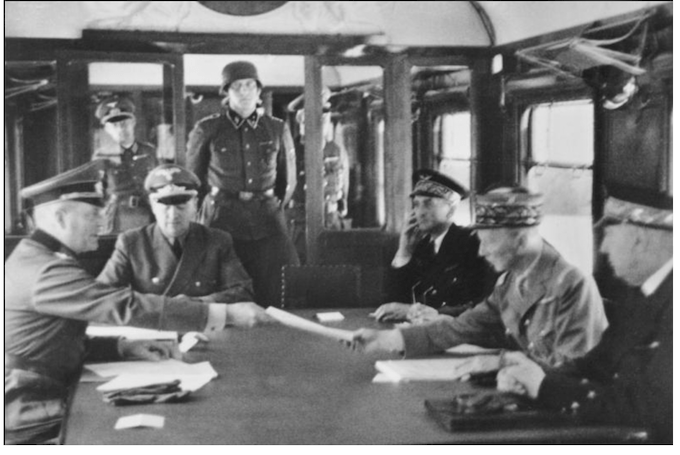
Photographer unknown. Signing of the Armistice in the Compiègne Wagon. Compiègne, France, June 22, 1940. At the left is General Wilhelm Keitel and on the right is the French delegation with (left to right) General Jean Bergeret, General Charles Huntziger, and Vice Admiral Maurice Le Luc. Photo: Wikipedia Commons.
U.S. surrender images
In the post-war decades, surrender, whether imposed with closed fist or invited with open hand, has rarely concluded armed conflict. The Chinese communists led by Mao defeated Chiang Kai-shek’s Nationalists in 1949, but lacking an air force or navy, failed to take Taiwan. After that, the island was protected by the U.S. and its own considerable armed forces. The Korean War ended with cessation of armed hostility followed by division of territory, a demilitarized zone, and long-term, mutual antagonism. The American wars in Vietnam, Iraq, and Afghanistan ended “gradually and then suddenly,” to quote Hemingway. Invasion and destruction was followed by insurgencies followed by withdrawal. Israel’s wars against its neighbors (and vice versa) have mostly ended on former’s terms. But victory then became the platform for more Israeli war, occupation, apartheid and now genocide. There have been other genocides too – including in Cambodia, Bosnia, Bangladesh, Guatemala, and Rwanda.
When it comes to very large states, internal politics and raison d’etat, simply don’t permit surrender. U.S. presidents are loathe to accept defeat, regardless of the cost, because to do so would suggest weakness or that the cause was unjust. The lies that underly the American wars against Vietnam, Afghanistan, Iraq and now Iran are open secrets, but unacknowledged by U.S. presidents. To do so would be to shatter governing myths of moral exceptionalism. And most Americans, lacking access to adequate healthcare, housing, education, transportation, and a healthy environment, are reluctant to surrender their ideology.
Surrender images today, therefore, don’t look like the old ones. The end of the war in Vietnam is marked by the Dutch photographer Hubert van Es’s famous photo of civilians boarding a CIA helicopter to evacuate Saigon. The last withdrawal of American forces from Afghanistan was memorialized by Alexander Burnett’s night-vision photo of Major General Chris Donahue, boarding a C-17 transport aircraft at Hamid Karzai International Airport. (For his troubles, Donahue has just been cashiered by Secretary of Defense Pete Hegseth.)
Under Trump, unfiltered photographic images from the Iran and other conflicts are difficult to obtain because these battles are mostly fought remotely or surreptitiously, with missiles, bombing runs, drones and special forces. The current administration has also taken active steps to prevent the photographic disclosure of damage to American military bases in the Middle East, going so far as to demand that Planet Labs—one of the largest U.S.-based commercial satellite imagery providers —withhold aerial photographs of Iran and surrounding Middle Eastern conflict zones. Finally, Trump himself, his White House minions, and corporate allies dominate social media with their own, self-serving narratives, aka lies.
But social media is a double-edged sword. And for now, at least, alternative narratives are available there and growing in number. The story of the American surrender in Iran and failure at home is visible in myriad inages by unaffiliated photographers, videographers (using phone cameras), digital artists and techno-activists. The Iranian government has supplied a few and so, inadvertently, has the White House. Those are topics for other columns, but by way of conclusion, here’s a small suite of contemporary surrender images:
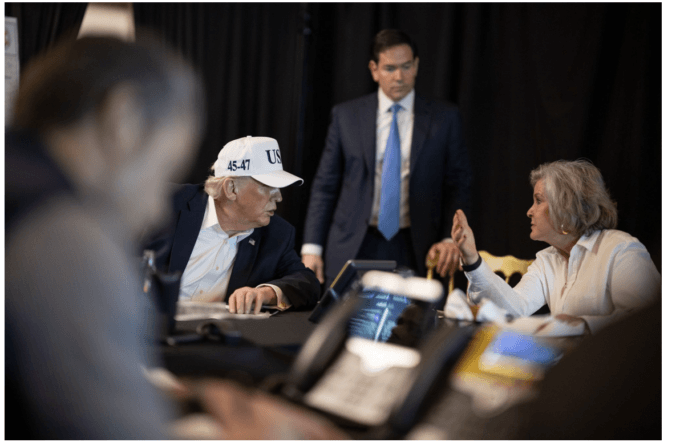
President Donald Trump, chief of staff Susie Wiles and Secretary of State Marco Rubio monitor US military operations in Iran from the president’s Mar-a-Lago resort in Florida. U.S. bombs killed 150 children the day before in Minab, Iran. Photo: The White House.
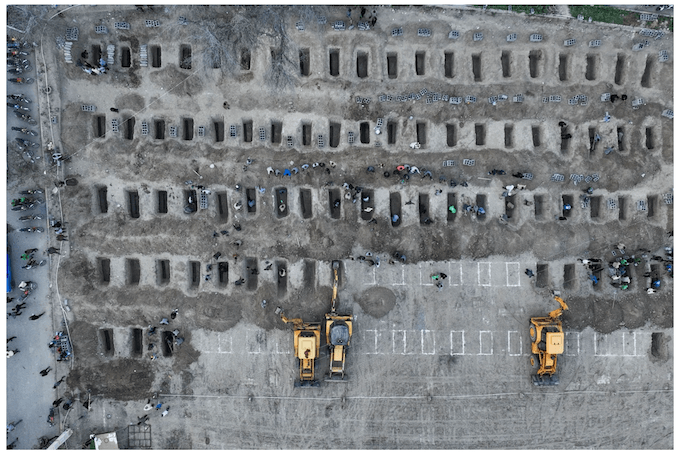
Mourners dig graves during a funeral in Minab, Iran, on Tuesday, March 3, 2026. Iranian Press Center, released for press distribution.
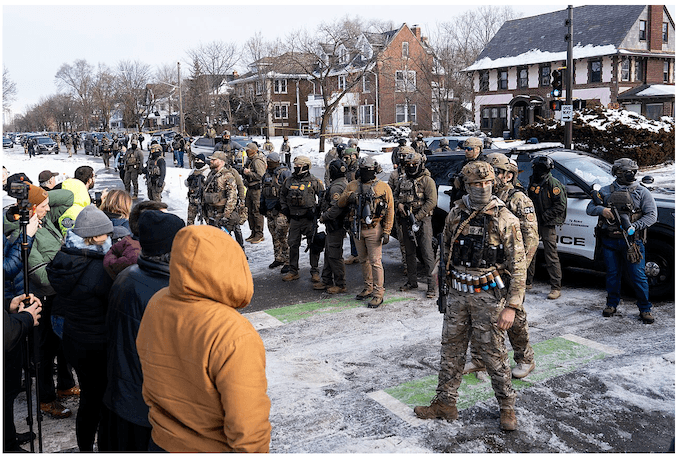
Chad Davis, ICE agents and bystanders in Minneapolis after the January 07, 2026 shooting of Renée Good. Wikimedia Commons.
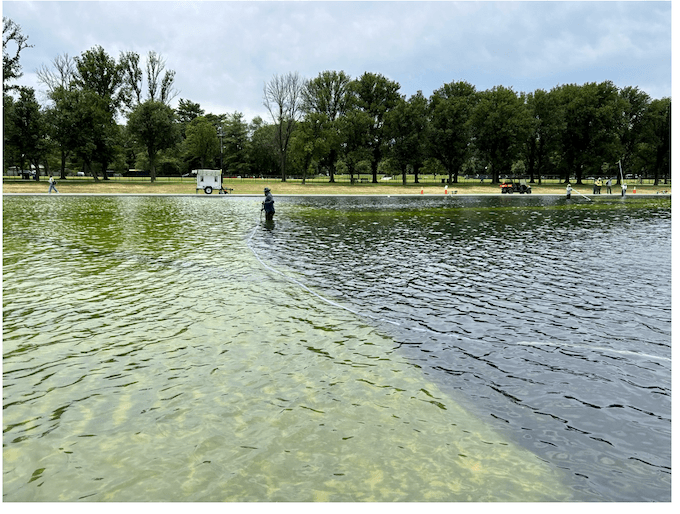
Joe Flood, Reflecting Pool Looks Like a Rothko Painting Now, Flickr, used under CC BY-NC-ND 2.0.
[ad_2]
Source link
