
[ad_1]
Plaintiff Accountability Now is an unincorporated association that holds a permit from the NPS [National Park Service] to conduct “a demonstration near the George Meade Statue on Constitution Avenue in Washington, D.C.” “Volunteers maintain the demonstration twenty-four hours a day, seven days a week” at which they “engage in face-to-face conversations with members of the public[] to call attention to the rise of fascism in the United States and [to] demand the impeachment of President Trump.” Plaintiff’s “current permit was issued on April 13, 2026, and is valid through August 12, 2026[,]” and Plaintiff “intends to obtain another permit when the current permit expires, at the same or another location on NPS-managed land in the District of Columbia.”
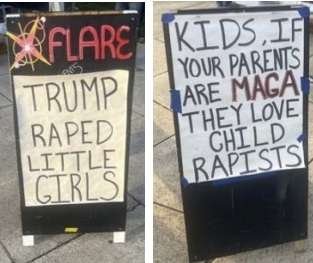
On February 24, 2026, in response to reporting “that the Justice Department was withholding more than 50 pages of FBI interviews with a woman who had accused Donald Trump of sexually abusing her when she was a minor[,]” Plaintiff began to display two new signs at the demonstration. One sign reads: “TRUMP RAPED LITTLE GIRLS.” The other reads: “KIDS, IF YOUR PARENTS ARE MAGA, THEY LOVE CHILD RAPISTS.” According to Plaintiff, “[t]he display of those signs has engendered numerous conversations between volunteers and passersby regarding President Trump’s behavior, morality, and fitness to continue in office.” … [Plaintiffs allege that] NPS agents requested that the two child rape signs be taken down, although it is not clear whether the NPS officials provided a reason for the request during the conversation…
Under the well-known standard articulated in Miller v. California (1973), speech is obscene if (1) “the average person, applying contemporary community standards would find that the work, taken as a whole, appeals to the prurient interest,” (2) “the work depicts or describes, in a patently offensive way, sexual conduct specifically defined by the applicable state [or federal] law,” and “the work, taken as a whole, lacks serious literary, artistic, political, or scientific value…. Understandably, Defendants have now conceded that the two signs at issue are not obscene as to adults. Indeed, to argue otherwise would be to suggest that virtually every news outlet in the country violates the obscenity laws every time it refers to allegations of rape or rape of a minor.
Nor can one plausibly maintain that the First Amendment affords no protection to those who accuse high ranking government officials of having committed sex crimes, including the rape of a child. Allegations of rape, standing alone, do not appeal to any prurient or unwholesome interest in nudity, sex, or excretion; they do not describe sexual conduct in a patently offensive way, and, indeed, do not describe a particular sex act at all; and they do not lack all serious political value. To the contrary, “‘[o]bscene antigovernment’ speech, … is a contradiction in terms: If expression is antigovernment, it does not lac[k] serious … political … value’ and cannot be obscene.”
Recognizing the futility of arguing otherwise, Defendants do not argue that the two rape signs are obscene in general, but, rather, only obscene as to minors. Because “States have a specific interest in protecting children from sexually explicit speech,” the government “may prevent children from accessing speech that is obscene to children,” in a manner subject only to rational basis review “even though [that speech may] encompass speech that is ‘not obscene for adults.'” Free Speech Coal., Inc v. Paxton (2025). [“]A State may prevent minors from accessing works that (a) taken as a whole, and under contemporary community standards, appeal to the prurient interest of minors; (b) depict or describe specifically defined sexual conduct in a way that is patently offensive for minors; and (c) taken as a whole, lack serious literary, artistic, political, or scientific value for minors.” Id. (emphases in original). And although the restriction on children’s access to such material is subject only to rational basis review, “[t]o the extent that [the restriction] burdens adults’ rights to access such speech” incidentally, the restriction is “subject to intermediate scrutiny.”
Here, it is far from clear that either of the signs at issue is properly evaluated under the obscene-as-to-minors standard. Defendants hang their entire argument on the fact that one of the two signs opens with the salutation, “KIDS,” before stating “IF YOUR PARENTS ARE MAGA, THEY LOVE CHILD RAPISTS[,]” The other sign at issue omits any such salutation and merely asserts: “TRUMP RAPED LITTLE GIRLS.” As to that sign, counsel for the government conceded at oral argument that “viewed in isolation, … the second sign would be neither obscene nor obscene as to minors” but urged the Court to “view these signs as … one integrated message,” the second of which merely “elaborate[d] on the other.” Although Defendants acknowledge that “incidental viewers from a particularly vulnerable class—like children—do not wield a veto over speech that is suitable for the public at large,” they maintain that this case is different because “Accountability Now’s speech, on its own terms, was not directed to the public at large—it was directed at and tailored to ‘KIDS.'”
That characterization of the speech is a stretch. As Carey explains in her uncontroverted declaration, the message is far broader than Defendants contend. It is clearly “directed at all the people who visit [the] demonstration,” and it invites parents to “think about what lessons their children are learning if they see their parents” supporting the President. Notably, the sign was displayed as part of a demonstration calling for President Trump’s impeachment and removal from office, and the demonstration is located on a busy street in front of a federal courthouse. The demonstration is not at or near a school or playground, where children are often unaccompanied by their parents. Nor were the signs included in children’s television programing or online or at a place that young children can often access without their parents’ knowledge. Although children “sometimes visit [the] demonstration site,” the government offers no evidence that it considered whether or how often children might see the sign before acting—or, indeed, that it was aware that a single child had seen the signs.
Defendants’ regulation of these publicly visible signs, moreover, is a far cry from the sorts of regulations targeting the direct distribution of sexual content to minors …. The Court is, therefore, unpersuaded that Defendants’ actions are reasonably characterized as the direct regulation of “sexual material harmful to minors” that has “only an incidental effect on” “adults’ rights to access such speech.” …
But even putting that threshold difficulty aside, Defendants’ contention that the two signs are obscene as to minors fails for multiple reasons:
First, the signs, “taken as a whole, and under contemporary community standards,” do not “appeal to the prurient interest of minors.” “[P]rurient interest[s]” are “shameful or morbid interest[s] in nudity, sex, or excretion.” … Defendants maintain that this factor is satisfied because Plaintiff’s signs “predominantly invoke[ ] in minors a ‘shameful or morbid interest’ in violent and unlawful sex,” and “piques minors’ ‘shameful and morbid interest’ in a particularly repugnant and criminal category of sex.”
Their argument borders on the absurd. Accusations of rape—and, in particular, rape of a child—are undoubtedly disturbing. But they do not pique a shameful or morbid interest in that repugnant and criminal act. Here, moreover, Plaintiff’s signs unequivocally condemn “child rapists” or those who “raped little girls.” They do not, by any stretch of the imagination, “deal[ ] with sex in a manner appealing” to minors’ shameful interest in child rape or pedophilia. To be sure, rape involves sexual contact of some form. But that is the extent of it, and “[s]ex and obscenity, … as the Supreme Court has held, are not synonymous.”
Second, Plaintiff’s signs do not “depict or describe specifically defined sexual conduct in a way that is patently offensive for minors.” Patently offensive materials “go[ ] substantially beyond customary limits of candor and affront[ ] contemporary community standards of decency.” As with prurient appeal, patent offensiveness may be measured by the standard that prevails in the state or forum community. Defendants’ claims with regard to this factor are even further afield. They contend that the signs “accost[ ] children with a graphic description of violent sexual crimes” and “explicitly refer to a sexual act and use the term ‘RAPE’ in its ordinary criminal sexual sense.” Neither sign, however, includes any description of the alleged sexual crimes, much less a “graphic” one. Indeed, neither sign “depicts or describes” any sexual contact at all, beyond conveying that it was non-consensual (perhaps due to force, or perhaps due to the age of the alleged victims) and that the victims were minors. By Defendants’ logic, To Kill a Mockingbird, The Color Purple, A Tree Grows in Brooklyn, Tess of the d’Urbervilles, Leda and the Swan, The Rape of the Sabine Women, and the biblical story of Dinah and Shechem (Genesis 34) would all fail this prong of the obscene-as-to-minors test. That, of course, is not the law.
Finally, Defendants do not—and cannot—show that the two signs lack any “serious … political … value” for minors. The signs constitute a direct response to current events: news reporting that “the Justice Department was withholding more than 50 pages of FBI interviews with a woman who had accused Donald Trump of sexually abusing her when she was a minor.” The signs “ha[ve] engendered numerous conversations between volunteers and passersby regarding President Trump’s [alleged] behavior, morality, and fitness to continue in office,” id., topics that are plainly a “matter[ ] of political concern.” Although Defendants maintain that the signs “frustrate [healthy political discussion] by explicitly accusing many parents of loving child rapists,” it is neither the government’s nor the Court’s role to distinguish healthy from unhealthy debate and discussion of topics of national importance. The same is true of Defendants’ contention that because the signs fail to “explain that they are mere rhetoric or innuendo,” minors will not “understand their veiled meaning, related conspiracy theories, or the broader political context to which the signs vaguely allude.” In pressing this argument, Defendants concede that the signs constitute political discourse, and they appear to acknowledge that the signs were not, in fact, targeted at children—a contention at odds with their vehement assertion that children are “the target audience” of these signs. But most problematically, Defendants incorrectly suggest that the NPS may exercise its permitting authority to police the content of speech and to ensure that it is not misleading—at least as to minors. Emphatically, that is not the role of the government or the Court.
Along similar lines, Defendants characterize the signs as raising sexual misconduct allegations that are “frivolous[ ]” and that propagate “conspiracy theories.” But if anything, those assertions undermine the government’s defense; the government lacks authority to regulate the content of political speech, particularly political speech that is critical of the government or senior government officials, based on the belief that the speaker has it wrong….
{Defendants do not contend that the speech at issue is libelous under the actual malice standard applicable to public figures, see New York Times Co. v. Sullivan (1964), nor would the NPS have authority to take an enforcement action based on such a theory.}
For all of these reasons, the Court concludes that Plaintiff’s signs are protected speech, not obscene as to minors…..
The Court, accordingly, concludes that Defendants’ conduct violates Plaintiff’s First Amendment rights with respect to the two signs at issue and will grant summary judgment in Plaintiff’s favor with respect to its First Amendment claim challenging the NPS’s direction that it remove the two signs under threat of revocation of its permit.
The court also held that an “86-47” flag displayed by the protesters was constitutionally protected, for reasons similar to those the court gave a month ago when issuing a temporary restraining order (see this post). Arthur Spitzer, Aditi Shah, and Laura Follansbee (ACLU D.C.) represent plaintiff.
[ad_2]
Source link
