
[ad_1]
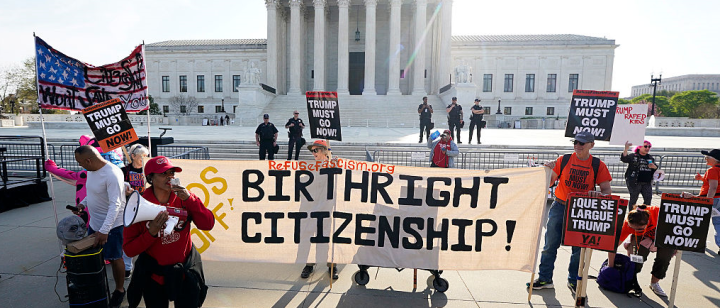
After the Supreme Court struck down President Donald Trump’s executive order seeking to end birthright citizenship, the president called on Congress to end it through legislation, saying a “long and unwieldy” constitutional amendment was not necessary. But constitutional and immigration law experts disagree.
These experts say the majority opinion from the Supreme Court — which interpreted the 14th Amendment as providing citizenship to anyone born in the country, with very limited exceptions — indicated that a constitutional amendment would be needed.
Shortly after the Supreme Court’s ruling on June 30, Trump wrote on Truth Social, “The Supreme Court upheld Birthright Citizenship, which is too bad for our Country, but we can easily make it up in Congress through Legislation, with the support of the President, that has now been determined during this process. No long and unwieldy Constitutional Amendment is necessary! Congress should start TODAY to work on ending expensive and unfair to our Country, Birthright Citizenship. They will have my Complete and Total Support!”
Trump is right about the significant hurdle constitutional amendments present. They must be supported by a two-thirds majority in both the House and Senate, and then need to be ratified by three-fourths of the states.
But constitutional scholars, and even some Republican supporters of ending birthright citizenship, say that’s now the path to end it.
According to the 14th Amendment, ratified in 1868, “All persons born or naturalized in the United States, and subject to the jurisdiction thereof, are citizens of the United States and the State wherein they reside.”
On the first day of his second term, Trump issued an executive order to deny birthright citizenship to children born to parents in the country unlawfully or who are in the country lawfully but only on temporary visas. It never went into effect, though, because lower federal courts blocked it.
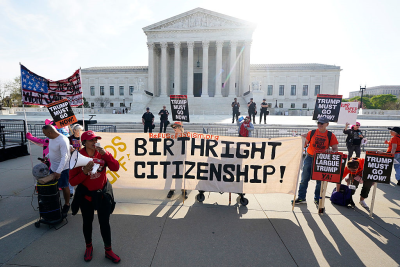
The case Trump v. Barbara made its way to the Supreme Court and in the majority opinion on the case, Chief Justice John Roberts wrote: “Citizenship, then and now, was the right to have rights— to freely participate in our political community. The Framers of the Fourteenth Amendment extended that promise to ‘every free-born person in this land.’ … We keep that promise today.”
That includes “children born of parents unlawfully or temporarily present in the United States,” Roberts wrote for the majority. “Under the Constitution,” he said, “they are citizens at birth.”
According to constitutional scholars we interviewed, that leaves no wiggle room for doing away with birthright citizenship through normal legislation. Legislators have been trying for years to end birthright citizenship for children of people in the country illegally, though no bill has ever passed. Now, many experts say, it is clear that any such legislation would be struck down by the courts.
“Trump is grasping at straws,” Garrett Epps, a professor of practice at the University of Oregon School of Law and a constitutional expert, told us via email. “There is no language in the majority opinion in Barbara that suggests Congress could change the birthright citizenship rule of the Fourteenth Amendment by statute.”
While the court’s 6-3 decision struck down Trump’s executive order, Justice Brett Kavanaugh concurred with the majority only in part. He wrote in a separate opinion that he disagreed that Trump’s order violated the 14th Amendment. He said Congress alone has the authority to “enact new legislation establishing exceptions to birthright citizenship for children born to foreign citizens unlawfully or temporarily in the country.”
Although three justices voted against the majority opinion, Kavanaugh’s was “the only voice of the nine that raises that possibility” of reversing birthright citizenship through legislative action, Epps said.
“Nothing—nothing—in the majority opinion suggests that Congress has the power to limit or abolish” birthright citizenship, Epps said. “Maybe—maybe—the three other dissenters would agree; but they do not say so in writing. Meanwhile, there’s no indication from any of the five in the majority that they are basing their decision on statutory grounds. As of today, there are five votes on this court to hold that the Citizenship Clause establishes a clear constitutional rule that cannot be overturned by act of Congress, any more than the Equal Protection or Due Process Clauses could be.”
Muzaffar Chishti, a lawyer and senior fellow at the Migration Policy Institute, told us via email that Trump is “wrong” to say birthright citizenship could be reversed by legislation.
“He lost this one plain and simple!” Chishti, director of the MPI office at the New York University School of Law, said.
“Unfortunately for the President, the majority of Justices (5-4) did not support his position,” Chishti said on the day of the ruling. “The majority, in an extraordinarily strong opinion by the Chief Justice, ruled that only a constitutional amendment can reinterpret the current understanding of the 14th amendment: that every child (with the minor exceptions of children born to diplomats and enemy aliens) are citizens at birth. So, the only way that can now be changed after today’s decision is either a constitutional amendment or by the Supreme Court overruling today’s decision.”
Jorge Loweree of the American Immigration Council agreed.
“The Supreme Court did not say Congress can end birthright citizenship through legislation,” Loweree told us via email. “The majority held that the Citizenship Clause of the Fourteenth Amendment protects citizenship for nearly everyone born in the United States, relying on more than a century of precedent. While several dissenting Justices argued that the Clause should be interpreted more narrowly, those views did not prevail.”
“If Congress enacted a statute that conflicted with the Court’s interpretation of the Fourteenth Amendment, it would face immediate constitutional challenges,” Loweree added. “Unless the Supreme Court changes its interpretation in a future case, Congress cannot override the Constitution by statute.”
At least two prominent Republicans, both lawyers who oppose birthright citizenship, also agree it would now take a constitutional amendent.
“This was not a decision on procedural grounds (ie, POTUS can’t do this through executive order but Congress could legislate it); it is a substantive decision that says the 14th amendment requires citizenship for those born to, among others, birth tourists or those unlawfully present in the country,” Florida Gov. Ron DeSantis wrote on X. “Will need either a constitutional amendment or a future court to overrule this.”
Sen. Mike Lee of Utah also saw the decision as a call to pursue “the long fight” for a constitutional amendment.
“Neither the Founding Fathers, nor the authors of the 14th Amendment, nor the millions of Americans who fought and died for their country through the ages intended to establish a nation whose citizenship could so easily be purchased, whether through birth tourism of China’s communist party members or a vast border invasion enabled by faithless presidents,” Lee wrote on X. “This is the cheap and cheated citizenship the Supreme Court upholds today. The long fight for a constitutional amendment begins now. We must explicitly exclude foreign nationals who break our laws, violate our borders, or exploit loopholes to make their families American citizens.”
Birth tourism refers to pregnant women coming to the U.S. on tourism visas in order to obtain birthright U.S. citizenship for their newborn children.
Andrew Arthur, a resident fellow in law and policy at the Center for Immigration Studies, an organization that favors low immigration, told us there are “any number of actions that Congress could take that would address the issues that the president is raising.”
For example, he said, the government could restrict the nonimmigrant entry of pregnant women, crack down on birth tourism, or limit the ability of birthright citizens to petition for family members to be admitted to the U.S.
“Not to say that any of those are good or bad ideas (except for cracking down on birthright tourism, which most agree with)– but they are steps Congress could take,” Arthur said.
As we have written, there is no direct government data on the scope of birth tourism in the U.S., though the Center for Immigration Studies estimates it could be over 20,000 births per year. And it is against the law for those who purposely enable it. There have been some high-profile arrests of people accused of running birth tourism operations.
“There are means, short of tampering with the Constitution, to tackle what is without doubt immigration fraud and a misuse of the immigration system,” Michelle Mittelstadt, director of communications for the Migration Policy Institute, told us, referring to cracking down on birth tourism. In fact, she said, the Trump administration has already taken some steps.
Arthur, of the Center for Immigration Studies, also believes it may still be possible for Congress to narrow the definition of who would be eligible for birthright citizenship.
But Samuel Breidbart, counsel in the Democracy Program at the Brennan Center for Justice, said any such narrowing of who would qualify for birthright citizenship would not stand unless a future Supreme Court reversed its opinion.
“There are five votes that said firmly, unequivocally that birthright citizenship is part of the Constitution, and that’s the law,” Breidbart said. “Now, is it true that a 5-4 outcome might be an invitation to the conservative legal movement to keep trying? I’m sure that’s how they’re thinking about this. I’m sure that they’re thinking that they can pursue future litigation. … But right now the law is as it has always been, that there’s birthright citizenship for all who are born here, and we require a constitutional amendment to change that. What the court did yesterday did not open the door to Congress legislating.”
Evelyn Cruz, a professor and director of the immigration clinic at Arizona State University’s law school, told us via email that Kavanaugh’s suggestion that Congress could amend who is eligible for birthright citizenship “stands on thin ice.”
But there may be political gain to such an effort, she said.
“Whether Justice Kavanaugh’s suggestion is legally sound or not, the fact that he has opened the door to a potential way for Congress to delineate access to birthright citizenship, even if the legislation is later ruled unconstitutional, leaves the birthright citizenship issue viable for political purposes,” despite the court’s unequivocal decision, Cruz said.
Lori Robertson and Justine Weng contributed to this article.
Editor’s note: FactCheck.org does not accept advertising. We rely on grants and individual donations from people like you. Please consider a donation. Credit card donations may be made through our “Donate” page. If you prefer to give by check, send to: FactCheck.org, Annenberg Public Policy Center, P.O. Box 58100, Philadelphia, PA 19102.
[ad_2]
Source link
