
[ad_1]
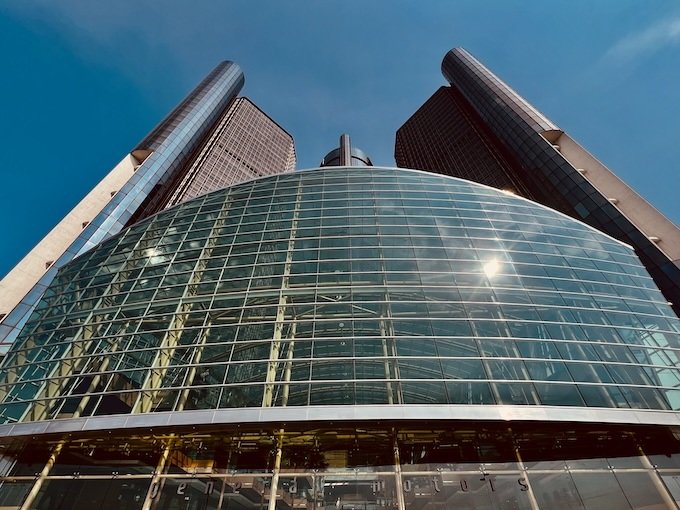
General Motors headquarters, Detroit. Photo: Jeffrey St. Clair.
Earlier this month, Hawaii became the first state in the country to pass legislation aiming to get corporate money out of elections by using the law of business organizations. The groups supporting this innovative approach see it as part of a broader Corporate Power Reset movement. They want to stop artificial entities created by the law “from spending money or contributing anything of value to influence candidate elections or ballot measures.” They say that corporate charters, which are a state-granted special privilege, should not contemplate a right to interfere in electoral politics.
The legal theory is this: corporations are creatures of state law. States create corporate charters and define the powers corporations possess. Rather than directly regulating election spending, proponents argue states can instead rewrite their corporate codes to clarify that corporations were never granted the authority to engage in electoral spending in the first place.
But the real importance of the Hawaii legislation and the Corporate Power Reset movement, as I see it, goes far beyond elections and campaign contributions. It goes to a fact at the heart of our political and economic system: the state is the author of corporate power. And if the corporate form is the product of the state, it is worth asking what other powers and privileges have been concocted by political power on behalf of economic power. This movement therefore invites a much broader and deeper reconsideration of the corporate economy as a whole. If this corporate system and its history were better understood, the billionaire and trillionaire ruling class would no longer be able to take cover under the benign language of liberalism.
Contemporary political conversations talk a lot about the problem of money in politics, but they almost never acknowledge that modern corporate power did not arise from a system of liberal rights and open competition. Even the basic corporate privilege of limited liability is far from a natural right. The state-capital complex is fundamentally a system for the manufacture of asymmetric relationships and material inequalities. The Corporate Power Reset movement restarts a long-running conversation about where power is actually located and encountered. One of the under-discussed features of our system, whatever its name, is the formal state’s delegation of much of the coercive governance of day-to-day life. Americans today most often encounter the power of the state in their relationships with their employers. The power of corporations within this system is not a withdrawal of political power, and it should not be mistaken for one. It is a highly effective obscuring of political power within the language of law.
The corporate form is designed to be anti-competitive, to create special advantages. The origins of the corporation lie in state-created monopolies and in colonial violence and extraction, and the modern corporation arises alongside several other similar legal fictions created to concentrate capital and insulate its holders from liability or accountability to the public. The corporation was born of explicitly anti-liberal and anti-democratic special privilege. Prospective blanket limits on personal liability for the harms you’ve caused others does not seem very “free market.” In fact, this kind of moral hazard undermines the economists’ whole series of rationales for today’s system. Historically, the modern state and the corporation extend through each other’s power, co-creating each other and the world we live in today. The formal state has grown its own power in partnership with corporations, and the corporations’ whole position owes to gifts of common wealth and license from official power.
This binary model itself has never been consistent with events. The state and capital are not two free-floating, independent entities that enter into an agreement; they are historically co-produced, and the whole idea of a clear-cut binary and apparent separation is among the monumental ideological achievements of this system. The idea of political power withdrawing to open a free market is not the story of capitalism. The U.S. government today functions largely as a de facto private organization, designed to extract wealth from the popular masses and to redirect it to an ever-shrinking group at the top. Washington operates more and more openly in this way, as the administrative body of a system designed to concentrate wealth for elite club members, and, as importantly, to corral us for their benefit.
The sociologist Carly Knight asks, “How, then, did the image of the corporation as a ‘creature’ or a ‘creation’ of the state come to be replaced with an understanding of the corporation as a ‘pure creature of the market’?” What relationships are behind the concepts and terms we turn to so uncritically? Many early liberal thinkers looked askance at the corporation as an extension of the power of the state. They noticed the tendency of the corporation, with perpetual succession and limits on personal liability, to reintroduce the structures of aristocracy on behalf of capital. Anti-monopoly activist and writer William Leggett (1801-1839) wrote,
These are our aristocracy, our scrip nobility, our privileged order of charter-mongers and money-changers! Serfs of free America! bow your necks submissively to the yoke, for these exchequer barons have you fully in their power, and resistance now would but make the burden more galling. Do they not boast that they will be represented in the halls of legislation, and that the people cannot help themselves? Do not their servile newspaper mouth-pieces prate of the impolicy of giving an inch to the people, lest they should demand an ell?
Times have changed and we forget what we once knew well. But as we enter a stage in which the true relationship between the state and capital is more apparent, it will be increasingly difficult for polite defenders of the “scrip nobility” to defend this system in the terms of liberal democracy, choice, and the rule of law.
We have entered a “new era of corporate governance,” as the three largest asset management companies are now the largest shareholders in almost 90 percent of the S&P 500. While this position gives them enormous power, the lack of transparency as to their decision-making processes raises once more the question at the heart of the corporate system: given that our corporate economy is an extension of state power and functions in practice as one of our society’s dominant forms of governance, do massive corporations have any duties to the popular masses? The asset management cartel is just one of many examples. Common ownership at such scales has created a structure of governance within the corporate economy that has no historical precedent. We are talking about a problem much bigger than lobbying or campaign donations.
Massive scale requires the state in at least two senses and directions. As we’ve seen, the corporation extends out of the state directly, as it is state power that creates the legal and institutional privileges that make possible accumulation at such massive scales. These are not “natural” market outcomes in any sense; they are entangled with and structured by the state from the beginning. Capital never leaves the state behind. Once corporations achieve these scales, becoming central structural fixtures in society’s rulemaking processes, the state is even more structurally obligated to and intertwined with them. We see this in the “too big to fail” problem. The state has a structural inability to allow the failure of its children, the continuation and stability of which are key to its own fiscal and monetary health.
It is too seldom pointed out in the U.S. how much of the actual governance of society takes place within these sites of outsourced state authority, corporations. It is not even correct to see the co-creation and co-dependence of the state and capital as involving symmetrical relationships that run in opposite directions. The relationship is dynamic and recursive. The state lays the preconditions for the rule of accumulated wealth, and then the interests and desires of capital constrain and shape state action. And this ongoing process further concentrates and entrenches the “private” interests involved, thus further constraining the state. Neither of the two supposed spheres (and notice that the higher up you go, the easier it is to pass back and forth between them) is prior, and neither ever enters a moment of true separation from the other. Even in the case of the formal state’s work, much is conducted by nominally private corporations. And here, too, in its capacity as a buyer, the state creates immense privileges for its favorites. Over the past few years alone, private contractors have received trillions of dollars in public money, much of which has gone to aggressive, illegal wars, causing crises around the world. Today, there are more than two private contractors for every federal government employee, meaning that much of the U.S. government’s work is completed by private corporations that are a black box for the public.
The modern corporation never leaves the place of privilege and protection next to government; it is not subject to the same kinds of competition and resource pressure, because it has rights you don’t have and that are in no way natural to a free and open system of market exchange. But this recursive state-capital dynamic is the defining structural reality of our entire social system. And it is an authoritarian system, not a liberal one, which is why America is so heavily policed, her prisons so overflowing with poor and minority populations our ruling class wants to control. Beyond the domestic frontier, the violence at the core of the corporate system shows itself in the military empire that is necessary to enforce its values and rules. The state-capital complex arose precisely as a technology of global empire and resource extraction. Our form of politics is impossible without empire. Ours is a precariously balanced system of oligarchy and empire, not a liberal democracy.
Within such a system, the law is inverted, turned away from its stated purpose, holding in place a system of power and special privilege. It is the key infrastructure of the violence and injustice of the political and economic system. We have likewise inverted our value system, putting abstractions like the blessed limited liability company above human beings and their communities. We’ve emptied the concepts of their normative justification and placed the dead husk above justice: the government as a criminal cartel, and the law as an instrument of injustice.
We create these abstractions and legal artifacts at first to aid our efforts in the direction of positive social goals. But we have flipped the system and its goals on their head by severing the concepts from their original social justification. Without the critical capacities of earlier liberals, we have taken the corporation to be a self-justifying feature of all free societies, subordinating actual human beings to a fiction. This is how authoritarianism has been able to recreate itself in systems with so many different names and stated ideologies. Despite the insistence that this is what economic freedom looks like, we can see that earlier generations of Americans were correct to fear the corporation system as a path to a new aristocracy.
Thanks is owed to the Corporate Power Reset project for bringing a creative and critical spirit to the question of money in politics. Following their thinking to its conclusion would get us to a deep and fundamental shift in the way we think and talk about power and politics. This kind of critical approach forces a confrontation with the fact that the structural relationship between capital and political power is far from the localized corruption of an otherwise sound liberal society. The relationship between money and politics is the design of the system and its normal operative mode. It is not that political power and wealth left each other at some point and have reintegrated, but that they have always been intertwined and the supposed public-private divide is incomplete to the point of being false.
[ad_2]
Source link
