
[ad_1]
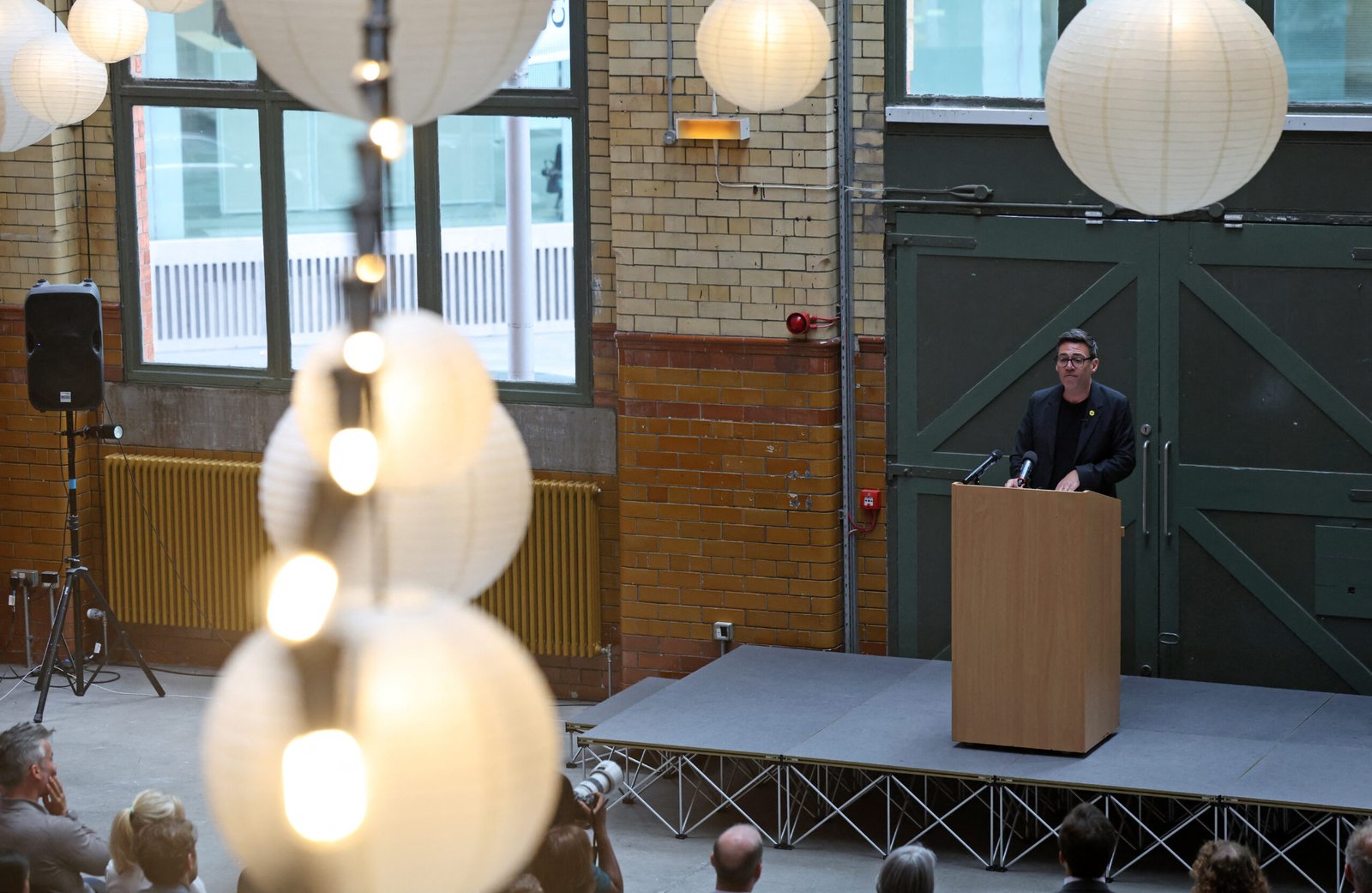
Andy Burnham, the presumptive prime minister, hasn’t even measured the curtains in Number Ten yet and already he is promising to relocate it. His first Big Speech on the economy Monday in, where else, Manchester, promised to set up a “Number Ten North” in, where else, Manchester. This will be the driving force, he says, of a new devolved UK of the regions. “The nerve centre of a new, rewired Britain.”
Burnham refused to take questions after his speech so journalists were unable to ask exactly what this all meant. The former mayor of Greater Manchester’s speech was a compendium of generalities like “the politics of place” and taking “biggest rebalancing power our country has ever seen”.
Burnham’s project seems to involve sending government departments, or some of them at least, out of Whitehall and placing them in northern cities. The obvious question is how this would not lead, first of all, to duplication of effort and then to incoherent administration.
Take education and skills, one of the themes of his speech. If you have miniature education departments in every region or locality, how can you have a nationwide policy? And who holds the ring when these provincial bodies start squabbling among themselves about resources?
Briefings on his speech said that one of his ideas was to devolve powers over income tax to regional mayors. But could the UK Treasury really allow a free-for-all on tax? The Scottish government has income tax–raising powers, and it is currently drowning in debt because of the Scottish National Party’s penchant for funnelling cash to client groups like public sector workers and welfare recipients.
Burnham is not wrong in saying that the UK is over-centralized in congested London—a city where no one earning less than £100,000 per year can afford a decent house or even a family-sized flat. But that is a phenomenon that afflicts most capital cities across the world. It is not entirely clear how a peripatetic national government can function any better.
The rhetoric was all about economic revival, building homes, delivering jobs, increasing earnings in the so-called “left behind” towns and cities that have been turning to Nigel Farage’s populist Reform UK. But regional devolution doesn’t necessarily address the central problem here. Namely that decades of low business formation and profligate spending have denuded the economies of large cities like Liverpool which used to be powerhouses of entrepreneurial dynamism. “Entrepreneur” does not appear to be part of Burnham’s lexicon.
Moreover, devolving power to the regions has been a theme of almost every government, Tory and Labour, for the past 45 years, since the Tory Chancellor Michael Heseltine set up the Merseyside Development Corporation in 1981.
Twenty years ago Tony Blair proposed legislative devolution to the North West and North East of England. The policy was dropped after a referendum in the North East rejected it overwhelmingly. It turned out that no one wanted elected regional authorities on top of their existing councils.
More recently the former Labour Chancellor Gordon Brown in 2022 chaired a Labour constitutional commission and produced a report called “A New Britain: Renewing our Democracy and Rebuilding our Economy.” He called for the House of Lords to be scrapped and replaced by a new elected Senate of the Nations and Regions.
The then-leader of the Labour Party, Keir Starmer, promised to implement the report and deliver “the biggest-ever transfer of power from Westminster to the British people.” Not a lot has been heard of it since—until that is today when the phrase appeared almost word for word in Burnham’s speech. He somehow forgot to mention Brown’s work.
In every iteration of devolutionism the untested assumption has been that sending power and resources to the regions will stimulate economic growth—or “good growth,” as Andy Burnham put it Monday, presumably to distinguish it from bad, capitalist growth. But there is little concrete evidence that this is actually the case. The Scottish government has had wholesale legislative and economic devolution for over 25 years without any measurable increase in growth, good or bad.
Subscribe Today
Get daily emails in your inbox
The preoccupation with process and the structure of government is mostly irrelevant to Britain’s current productivity and growth crisis, which is largely a result of business-killing taxes, excessive regulation and an over-reliance on cheap migrant labor instead of technological innovation and capital investment. There was nothing in Burnham’s speech about immigration, AI, or taxes—which everyone knows from his earlier remarks are going to go up when he takes over in three weeks’ time.
Tinkering with the constitution is something all politicians advocate in opposition because it sounds radical but means very little. It is the kind of project beloved of academic think tanks and policy institutes like the IPPR and the Institute for Government, because they can organize conferences with headings like “Reimagining the State.”
Burnham resorted to some classic rhetorical imagineering in his peroration: “Imagine good growth in every postcode and hope in every heart.” And a chicken in every pot and a pie in every sky.
[ad_2]
Source link
