
[ad_1]
Joshua Scheer
Birthright Citizenship Survives—for Now. The Project to Redefine Who Belongs Continues.
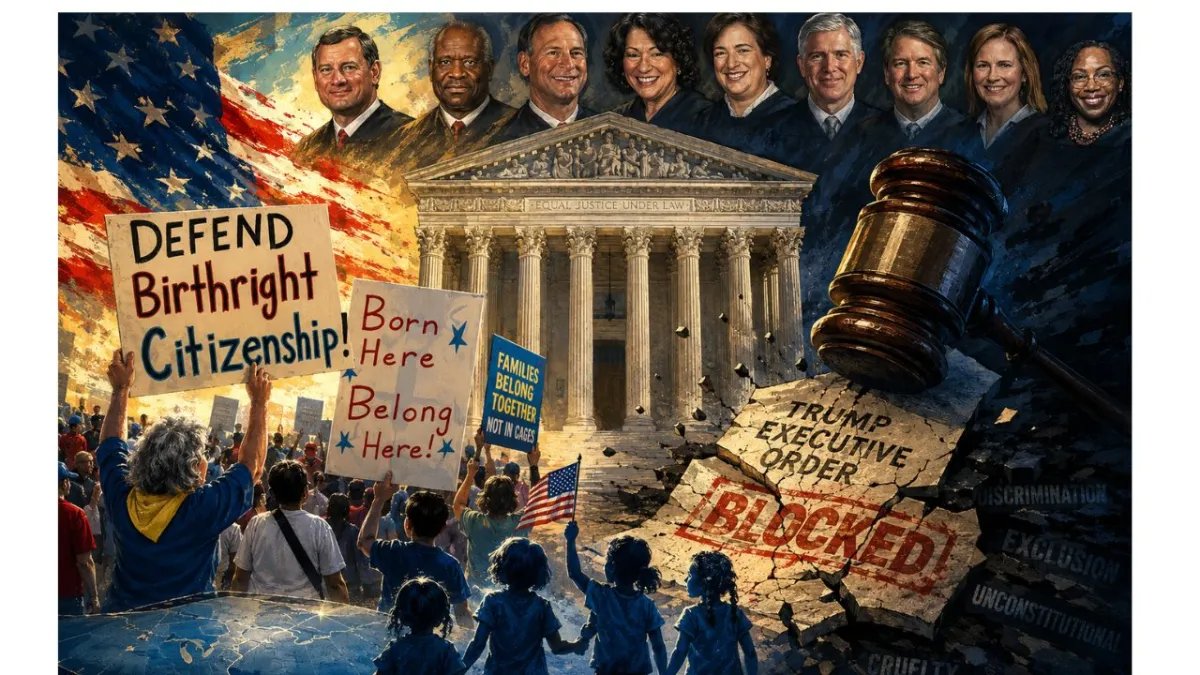
In a 5–4 decision issued on June 30, 2026, the Supreme Court ruled that the Fourteenth Amendment guarantees U.S. citizenship to nearly all children born on American soil, regardless of whether their parents are in the country legally or only temporarily. The Court struck down President Donald Trump’s Executive Order 14160, which sought to deny citizenship to children born in the United States if their parents were undocumented immigrants or temporary visa holders.
Chief Justice John Roberts, writing for the majority, concluded that the Constitution’s Citizenship Clause has always followed the principle of jus soli (“right of the soil”), inherited from English common law and reaffirmed after the Civil War through the Fourteenth Amendment. The Court found that the phrase “subject to the jurisdiction thereof” refers to being subject to U.S. law—not to the immigration status or legal residence of one’s parents.
The majority relied heavily on the landmark 1898 decision United States v. Wong Kim Ark, which held that children born in the United States to foreign parents are citizens at birth. Roberts wrote that the historical record, the debates surrounding the Fourteenth Amendment, and more than a century of precedent all point to the same conclusion: birthright citizenship extends to virtually everyone born on U.S. soil except for narrow exceptions such as children of foreign diplomats or members of sovereign tribal nations under the historical legal framework.
The Court rejected the administration’s argument that citizenship depends on whether parents owe “primary allegiance” to the United States or are lawfully domiciled here. The majority said the Constitution contains no references to a child’s parents’ immigration status, citizenship, or legal residency and warned that adopting such a rule would create uncertainty and conflict with the plain language of the Fourteenth Amendment.
Justice Ketanji Brown Jackson filed a concurring opinion emphasizing that the Reconstruction Amendments were intended to establish broad, equal citizenship rather than a narrow remedy limited only to formerly enslaved people. Several conservative justices dissented, arguing that the Citizenship Clause should be interpreted more narrowly and that birthright citizenship should not automatically extend to children whose parents lack permanent legal ties to the United States.
The ruling preserves the long-standing constitutional interpretation that any child born in the United States is a U.S. citizen at birth, regardless of whether their parents are undocumented immigrants, temporary visitors, or lawful permanent residents, with only a few historically recognized exceptions. The decision leaves the constitutional doctrine of birthright citizenship intact and blocks the executive order from taking effect.
The idea that Speaker Mike Johnson presents himself as a constitutional lawyer while expressing disappointment that the Supreme Court upheld the plain text of the 14th Amendment deserves close scrutiny.
Speaking just after the Court’s decision, Johnson acknowledged that if birthright citizenship is to be changed, it would likely require a constitutional amendment—then said he was “very disappointed” with the ruling. In the same remarks, he argued that birthright citizenship has been “grossly abused” and pointed to concerns about so-called “birth tourism.”
After hearing what I hear as mildly fascistic rhetoric coming from Speaker Mike Johnson, we now hear from the ultimate troll, Stephen Miller, once again pontificating that America is “for Americans”—a slogan he leaves deliberately vague while using it to advance a hardline nationalist agenda.
This is also the same Stephen Miller who has argued that Venezuela’s oil should effectively belong to the United States. Taken together, these statements reflect what I see as a politics rooted in exclusionary nationalism at home and American entitlement abroad.
How can someone claim to be a libertarian while rejecting one of the principles that has historically drawn many people to libertarianism: freedom of movement and, for many libertarians, open borders? Instead, it often seems they want the labor immigrants provide without extending the same rights, freedoms, or dignity to the people themselves.
That isn’t a philosophy of liberty. It’s a selective version of libertarianism, where freedom and autonomy are reserved only for those considered deserving.
The official response from the White House.
Although the Court ultimately reaffirmed the plain language of the Fourteenth Amendment, the margin tells its own story. Four justices were prepared to embrace an interpretation that would dramatically narrow one of Reconstruction’s most transformative guarantees. Their willingness to revisit settled constitutional doctrine reflects a broader movement that has spent decades attempting to redefine citizenship through the lens of nationalism rather than equality.
The Fourteenth Amendment was not written as an immigration policy. It was written after the Civil War to destroy forever the logic of Dred Scott—the idea that government could decide entire classes of people simply did not belong. Its Citizenship Clause established a revolutionary principle: birth under the jurisdiction of the United States, not race, ancestry, wealth, or political favor, determines citizenship.
For more than a century, that principle has been understood to include nearly everyone born on American soil. The only narrow exceptions involved diplomats, invading armies, and members of sovereign tribal nations whose political status was recognized as distinct from the United States. As the Court recognized again today, undocumented immigrants do not occupy that category. They are fully subject to American law—they can be arrested, prosecuted, detained, deported, and taxed. That is precisely what being “subject to the jurisdiction” of the United States has always meant.
But from a radical perspective, the legal question is only part of the story.
The repeated attacks on birthright citizenship arise alongside efforts to criminalize migration, militarize the border, expand detention, weaken labor protections, and divide workers according to legal status. These policies serve powerful economic interests by creating a population whose labor is essential but whose political rights remain precarious.
Capital benefits from workers who harvest food, build homes, clean offices, and care for children while lacking the security to organize, demand higher wages, or challenge exploitation. Restricting citizenship helps preserve that imbalance.
Seen this way, the fight over the Fourteenth Amendment is inseparable from the struggle over labor, democracy, and economic power.
There is also a deeper historical irony. The United States has repeatedly expanded its territory, intervened abroad, and shaped migration through military and economic policies, only to insist that those displaced by those policies remain permanently outside the political community. The same government that projects power across the globe increasingly seeks to narrow the definition of who belongs within its own borders.
But of course, that is the point: to create masters out of some and servants out of others. People are expected to work, harvest crops, build homes, and sustain the economy, yet are denied the security of knowing their children will have an education, equal rights, or a future.
The benefits of today’s global economic order flow overwhelmingly to those who already hold wealth and power, while millions of others are displaced by war, exploitation, climate change, and economic policies that leave them with little choice but to migrate. Too often, they are then treated as refugees, criminals, or disposable labor rather than as human beings with equal dignity.
As long as freedom of movement is reserved for capital, corporations, and the wealthy—but denied to ordinary people—we cannot honestly claim to live in a free world. Until people enjoy the same freedom to move across borders that money and goods already do, liberty will remain unequal, and freedom will remain incomplete.
Today’s ruling therefore represents an important victory—but hardly the end of the campaign.
As Speaker Mike Johnson himself suggested after the decision, opponents of birthright citizenship are already discussing constitutional amendments and legislative strategies to achieve what the Court would not.
And let’s not forget the broader hypocrisy. Too many politicians champion freedom only when it benefits them or the people they identify with. They defend expansive gun rights, yet often support limiting those same rights for groups they fear. They preach individual liberty, yet deny it when it comes to immigration, bodily autonomy, or the freedom of others to build a life for themselves and their families. Freedom, in this worldview, becomes a privilege for the favored rather than a universal principle.
Stephen Miller’s nationalist politics are explicit enough that there is little ambiguity about where he stands. But the responsibility does not end there. Democratic administrations have also contributed to displacement, instability, and failed policies—from interventions abroad to inadequate responses to crises such as Haiti—that have helped create the very migration they later struggle to address. If we are serious about justice, we have to confront the failures of both major parties rather than pretending that only one bears responsibility.
A politics that celebrates liberty while denying it to others is not a politics of freedom. It is a politics of hierarchy, where some are entitled to rights, opportunity, and security while others are expected to remain invisible, exploitable, and excluded.
The conflict was never simply about legal interpretation.
It is about competing visions of democracy itself: one grounded in universal constitutional guarantees, the other in increasingly restrictive definitions of national belonging.
For now, the Fourteenth Amendment survived. The political movement seeking to narrow it has not disappeared.
There is no easy endpoint to this struggle. Real change requires permanent organizing, resistance, and, ultimately, a continuous democratic revolution against systems of domination. One court decision, however important, does not fundamentally alter the structures that produced this conflict in the first place.
Even some voices on the political right have suggested that the Court left the door open for future challenges. At the same time, public faith in institutions has reached historic lows. Perhaps that is not entirely a bad thing. From the United Nations to the Supreme Court and countless other institutions, many people no longer believe these bodies are capable of delivering justice on their own.
Ultimately, ordinary people are not the problem. Americans, and people around the world, have far more in common with one another than they do with the political and economic elites who govern them. As I was reminded by something I read the other day, perhaps what we need is a society built less around hierarchical leaders and more around democratic participation from below—where communities, rather than entrenched power, shape their own future.

If you want to here you can read and download the full Supreme Court decision
The Court’s ruling spans centuries of constitutional history, examining the origins of the Fourteenth Amendment, the legacy of Dred Scott, English common law, and more than a century of Supreme Court precedent. To fully understand the majority’s reasoning—as well as the concurring and dissenting opinions—read the complete decision below.
Editor’s Note: At a moment when the once vaunted model of responsible journalism is overwhelmingly the play thing of self-serving billionaires and their corporate scribes, alternatives of integrity are desperately needed, and ScheerPost is one of them. Please support our independent journalism by contributing to our online donation platform, Network for Good, or send a check to our new PO Box. We can’t thank you enough, and promise to keep bringing you this kind of vital news.
You can also make a donation to our PayPal or subscribe to our Patreon.
Please share this story and help us grow our network!
[ad_2]
Source link
