
[ad_1]
As the United States marks its 250th anniversary, Florida officials highlighted a nickname for the state with a Revolution-era ring: “the 14th colony.”
The moniker, used by academics and historians for years, appeared in an “America 250” exhibit at the state Capitol this spring. Gov. Ron DeSantis, who has unveiled statues honoring founding fathers in their namesake Florida counties, has used the term, too.
It doesn’t mean that Florida was the 14th U.S. state — that was Vermont. Florida became the 27th state on March 3, 1845.
So what is this “14th colony” idea all about?
Turns out, the nickname has been used to refer to Florida for decades — and also other British territories outside of the 13 colonies, historians said.
“The phrase has been out there to refer to different places for different reasons for at least the past 50 years, but all to mean the same thing: There’s some extra to the story in our area that’s not part of the original geographic area of the 13,” said historian Mike Bunn, author of “Fourteenth Colony: The Forgotten Story of the Gulf South During America’s Revolutionary Era.”
British territories fluctuated, with the country controlling 25 to 35 colonies in the Americas — from Quebec to Grenada. Britain didn’t assign numbers to the lands, which were swapped often, and considered the American territories a disjointed group among its other scattered territories in the region.
Americans popularized the phrase “13 colonies” in the 1770s to explain the rebellious founding of the U.S., historians said. The symbolic “14th colony” nickname came later, appearing in several publications in the 1950s and ’60s around the U.S.’ bicentennial anniversary in 1976, Bunn said.
Florida was much larger in the colonial era, stretching into the present-day Gulf region. Counter to the Revolutionary spirit remembered today, Florida didn’t share the rebellious streak of the northern colonies.
Britain divided Florida into two territories
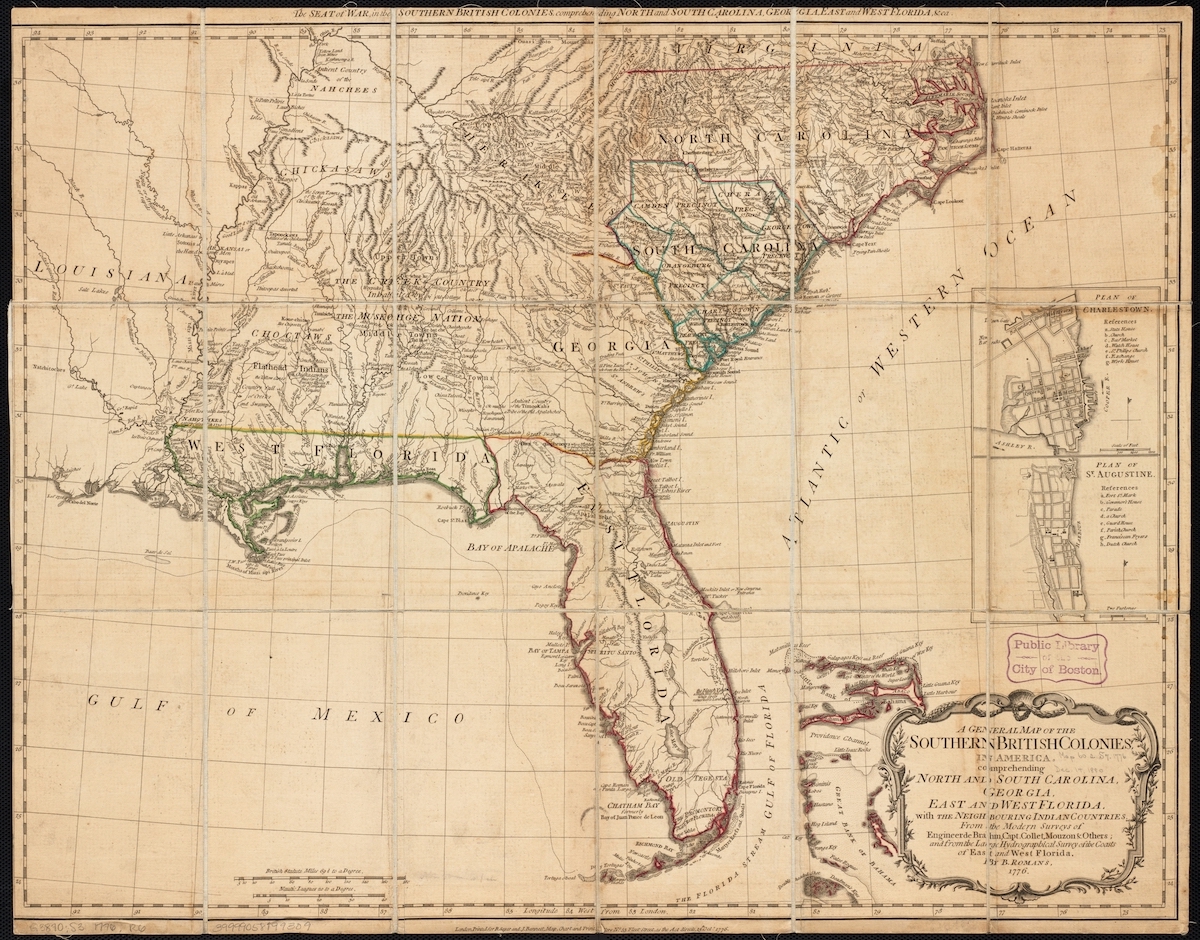
Vintage map of Southern British Colonies, showing detailed regions of Georgia, East Florida and West Florida and Carolina. (Shutterstock)
Roger Smith, author of “The 14th Colony, The American Revolution’s Best Kept Secret,” compared the frequent land swaps of the time to a game of three-card monte.
“They would trade colonies back and forth constantly, bringing in three, giving up two, and so on,” Smith, a historian and University of Florida adjunct professor, said..
Britain acquired Florida with Grenada, Nova Scotia and Quebec as part of a 1763 treaty that ended the Seven Years’ War.
“After Spain relinquished Florida in 1763 to Great Britain in exchange for Havana, Cuba, the first thing the British did was decide it was too big and divided it into two,” Smith said.
Great Britain split Florida into two territories — East Florida and West Florida. Unlike the colonies to the north, both East Florida and West Florida sided with the British during the Revolutionary War and wanted little to do with independence from the crown.
West Florida comprised parts of present-day Louisiana, Alabama, Mississippi and the Florida panhandle, with Pensacola as its capital. East Florida comprised most of the Florida peninsula, extending east and south from the Apalachicola River to the Atlantic seaboard, with its capital in St. Augustine.
Because Britain acquired the group of four colonies on the same day, Smith said he counts them alphabetically — making East Florida No. 14 and West Florida No. 15.
“When people refer to the whole state as the 14th colony, I think that’s incorrect,” he said.
Bunn said he doesn’t believe the order of East Florida and West Florida is very consequential since they joined the same day, but agreed that referring to both as one colony isn’t quite right; the territories had separate British governing bodies.
Why did East Florida and West Florida side with Britain during the Revolutionary War?
East Florida and West Florida rejected American independence, partly because the territories were underpopulated and, unlike many of their northern neighbors, heavily reliant on British government funding.
Settlers depended on the British military to protect them from local Native American tribes and potential Spanish invasion.
Florida eventually became a haven for British loyalists fleeing the northern colonies during the war. St. Augustine’s population swelled with people who hated the American rebels, experts said.
When the Continental Congress in Philadelphia invited the other North American colonies to join the rebellion in 1774 and 1775, East Florida and West Florida refused.
While West Florida eventually fell to Spanish forces, East Florida successfully repelled multiple Continental Army invasions between 1776 and 1780, experts said, with the Union Jack (the United Kingdom’s national flag) continuing to fly over St. Augustine until 1783, when Britain officially ceded both Florida territories back to Spain.
“When news of independence came to St. Augustine in 1776, a huge crowd showed up with effigies of Samuel Adams and John Hancock that they hung up and burned in the public square,” Smith said.
Great Britain handed Florida back to Spain following the 1783 signing of the Treaty of Paris that ended the war. Spain ceded Florida to the U.S. in 1819.
Floridians voted in a referendum in favor of statehood in 1838 and approved a state constitution in 1839. Florida’s statehood became official in 1845, after Congress’ approval.
[ad_2]
Source link
