
[ad_1]
The original American covenant passed down from the Pilgrims and the Puritans provided roughly seven generations of Americans with an identity of responsibility leading to great achievements unprecedented in human history. That covenant was for self-management of individuals, families, and communities—for government of the people, by the people, and for the people.
It lost its credibility under assault from postmodernism and its viability with the rise of the Overclass.
It was a birthright covenant of citizenship made by and to be faithfully executed by inner-directed citizens of both sexes and all ages and was open for implicit subscription by new arrivals from across the seas who accepted its terms, promises, and obligations.
There was an unwritten cultural covenant, a construct called American exceptionalism, America aspiring to become a city upon a hill, Americanism as an ethos of assimilation. Its cultural symbolism included songs—“The Star-Spangled Banner” and “America the Beautiful”; speeches by George Washington, Abraham Lincoln, and John F. Kennedy; pledging allegiance to a flag; pastimes—baseball and football, summer family picnics, holidays with parades in small towns as on the Fourth of July, and eating turkey on Thanksgiving; images—Washington crossing the Delaware, Grant Wood’s American Gothic, soldiers running up Omaha Beach, Normandy, France, on D-Day 1944, Norman Rockwell’s heartwarming Four Freedoms, and Martin Luther King Jr. speaking before the Lincoln Memorial; and a house in the suburbs with a yard.
That cultural covenant has lost its appeal. It no longer governs our commitments to one another and to a beloved community. Too few Americans have time for covenantal responsibilities or recognize themselves as signatories to any such agreement.
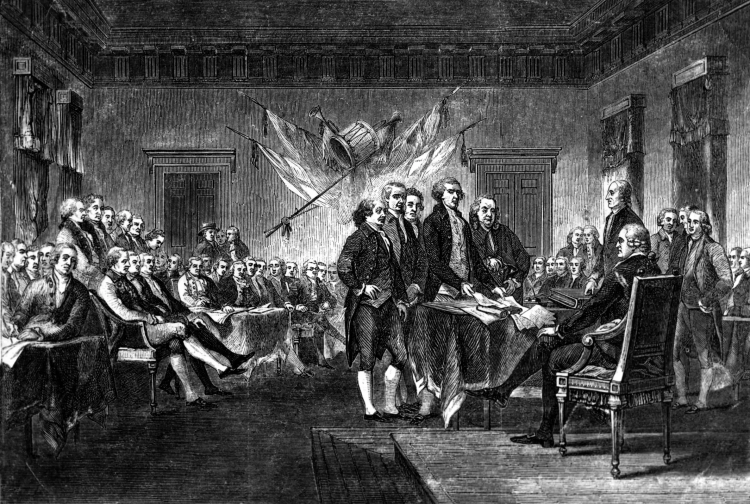
The amorphous cultural covenant was supplemented by a governing covenant adopted by representatives elected by the people in the several colonies upon their winning independence from the British Crown and assuming national sovereignty under the accepted conventions of the Law of Nations.
The purpose of that written covenant was expressed rather well by Gouverneur Morris when he wrote the Preamble to the Constitution of 1787.
We the People of the United States, in Order to form a more perfect Union, establish Justice, insure domestic Tranquility, provide for the common defense, promote the general Welfare, and secure the Blessings of Liberty to ourselves and our Posterity, do ordain and establish this Constitution for the United States of America.
The traditional American covenants—cultural and constitutional—were community covenants more than oaths of obligations taken by individuals in good faith on their personal honor.
Today the dysfunctions brought upon us by the Overclass, by other-directed managers of our culture and society, and by identity dysphoria— dysfunctions that have laid a foundation for a future of gloom, anxiety, and subversion of our republic—need to be corrected.
If politics is not up to the task, then individuals must take over the work of reviving covenantal inner-direction. Those men and women with inner-direction need to come forward in families, religious communities, local governments, education, media, and business to reboot our moral heritage of respect for one another, hard work, and proud self-discipline.
It is not managers we need but leaders, those with charisma, those who will not shy away from decision-making and the assumption of personal responsibility.
In this new American covenant, we choose ourselves—not the Overclass—to set the course for our nation.
Just as in the Abrahamic tradition, where Jesus brought forth his new covenant for individuals, one by one, to pledge their faith in God’s ministry and commit themselves to vocations of service in his earthly kingdom as stewards of the common good, so too can Americans, one by one, pledge themselves to serve their national commonwealth.
The terms of the new American covenant must insist on privileging the moral sense that resides in each of us, on politics and economics being centered and balanced, on avoiding the chaotic entropy implicit in ideologies.
Very importantly, the new American covenant will not exclude the descendants of slaves. The new Moses for African-Americans will appear as a charism in each and every individual African-American who accepts Covenantal responsibilities.
Such acts of covenanting need not exclude anyone of faith—whether Jew or Muslim, Confucian or Buddhist, atheist or indigenous.
A general covenant for all Americans could be drafted and presented for signature in every town and city. More specialized covenants could also be drafted for ethnic communities, political parties, companies, social clubs and fraternal organizations, and sports teams.
Making personal commitments with individual charisma behind them would be the dawn of a new and better day for the United States of America.
Ask not what your country can do for you—
ask what you can do for your country.
John F. Kennedy
— — —
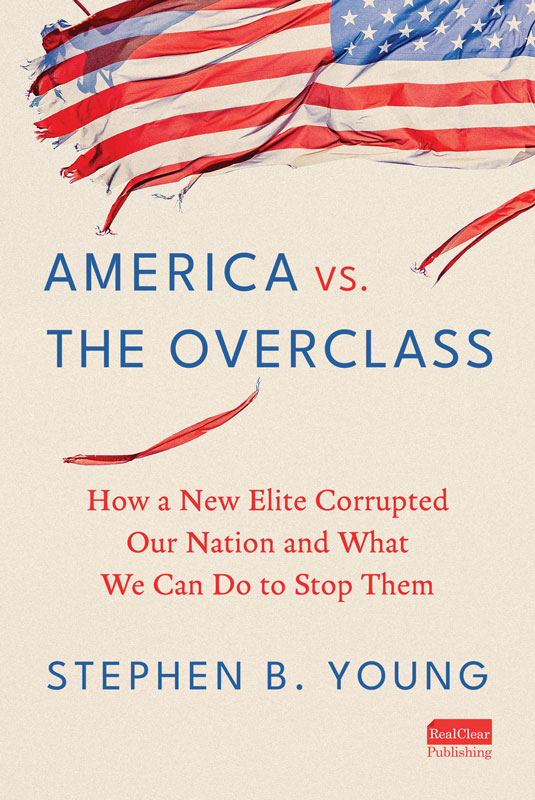
For more information on America vs. the Overclass visit www.americanoverclass.com . Purchase your copy via Amazon.
Stephen B. Young is global director of the Caux Round Table for Moral Capitalism. He was an assistant dean at the Harvard Law School and later dean and professor of law at the Hamline University School of Law.
[ad_2]
Source link
