
[ad_1]
Austin D. Sarat ScheerPost
The Supreme Court’s MAGA majority has done almost all it can to turn the First Amendment’s guarantee of religious freedom into one of the Constitution’s most important provisions. It has been used to override claims for equal treatment by gays and lesbians, to insist that employers provide accommodations for religious practices, and to protect the religious rights of people being executed.
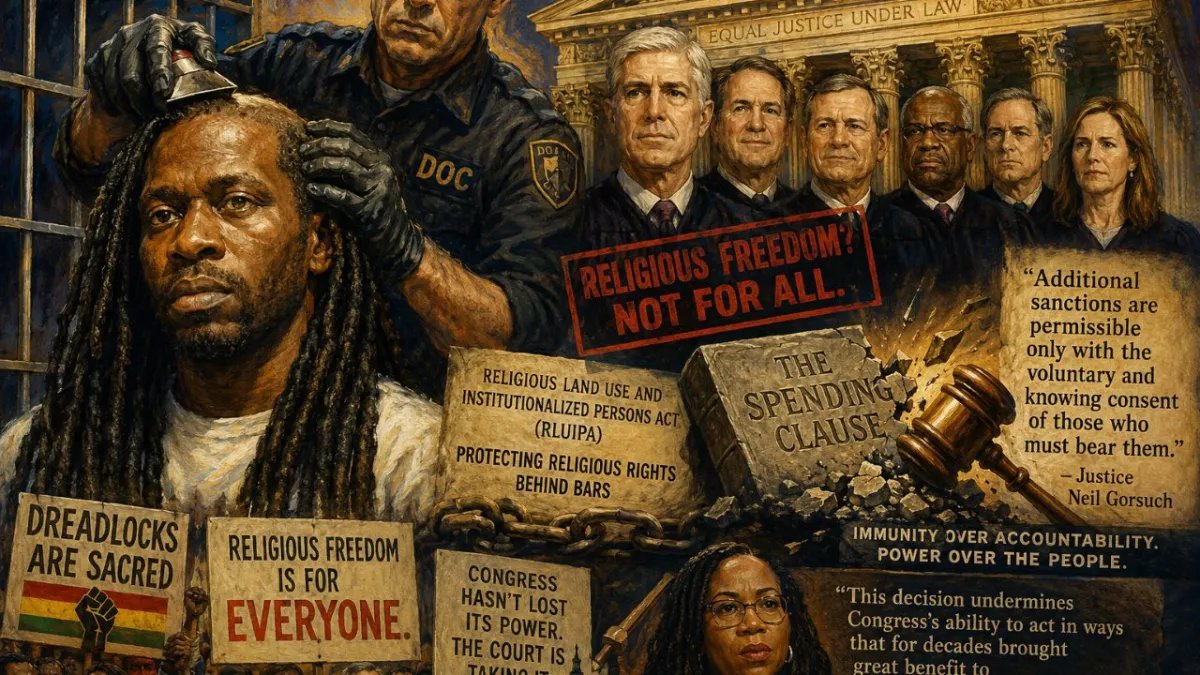
That’s why it was so surprising when, on June 23, the Court turned its back on a claim of religious freedom brought by a former prisoner. The case Landor v Louisiana Department of Corrections was brought by a Rastafarian, whose religious practices many find exotic to say the least.
Landor alleged that his sincere religious convictions were callously disregarded by guards in one of the facilities in which he was incarcerated. They ignored the well-documented practice of wearing dreadlocks and shaved his head, a clear assault on religious freedom.
The Court declined to hear Landor’s claim for damages under a federal law designed to protect incarcerated people’s religious practices. Why?
It could be because the Court favors religious freedom, but only for some religions. Rastafarians might not be worthy of the same protections the Court has extended to mainstream religions.
Still, in this case, the Court was after a bigger target. It used the case to further its project of insulating government officials from accountability, weakening Congress’s power, and undermining democracy.
First, religious liberty.
In a November 2020 speech to the Federalist Society, Justice Samuel Alito sounded the alarm about what he saw as growing hostility to religious freedom. He pointed out that “in certain quarters, religious liberty is fast becoming a disfavored right….”
Alito used that speech to denounce COVID-inspired “restrictions that blatantly discriminated against houses of worship” and to lay out an agenda for the Court to protect “religious liberty…(from the) danger of becoming a second-class right…”
And since then, the Court has risen to the challenge.
For example, in 2022, it decided in Kennedy v. Bremerton School District, that the First Amendment protected a high school football coach’s right to pray on the 50-yard line after games. The Court called it “private religious expression.”
A year later, it ruled that the government had to respect the decision of an evangelical Christian postal worker who refused to work on Sundays. As Justice Alito explained, an employer could only deny an employee’s request for a religious accommodation if it could “show that the burden of granting an accommodation would result in substantial increased costs in relation to the conduct of its particular business.”
And, in 2025, the Court sided with parents who argued that requiring their elementary school children to participate in instruction using LGBTQ+-inclusive storybooks, without notice or the opportunity to opt out, substantially burdened the parents’ right to direct the religious upbringing of their children. Alito again wrote the majority opinion, saying that “Government schools, like all government institutions, may not place unconstitutional burdens on religious exercise.”
These decisions and others indicate, as the Center for American Progress explained, that “a majority of current Supreme Court justices now champion a vision of religion that diverges significantly from that of the founders…repeatedly finding that the government must follow or even fund certain religious activities.”
But not for Rastafarians. Damon Landor found that out in 2020, when correctional officers ignored the fact that Rastafarians are forbidden from cutting their hair. “To the Rastafari,” an article in Time observes, “dreadlocks are a sacred marker of one’s devotion to… (God)…”
In Landor’s case, the officers “handcuffed him to a chair, held him down, and shaved his head anyway.”
Landor sued them, claiming that they violated his religious liberty and that, as a result, he was entitled to monetary damages. Ladon based his suit on the Religious Land Use and Institutionalized Persons Act, enacted by Congress in 2000, to protect the religious rights of incarcerated individuals
So, on the face of it, and given the Court’s track record on religious freedom cases, one might have assumed that Landor would win. However, that was not to be.
The central question was not whether Landor’s religious rights had been violated, but whether Congress had clearly authorized individuals to recover money damages from state employees under the statute.
The Court, Justice Neil Gorsuch writing for a six-judge majority, decided that Congress exceeded its power under the Constitution’s Spending Clause, which allows it to “pay the Debts and provide for the common Defense and general Welfare of the United States.” Commentators have rightly called the Spending Clause “among Congress’s most important powers.”
“The Clause,” they say, appears first in Article I, Section 8’s list of enumerated legislative powers….” It is the basis for a wide variety of “federal programs as varied and consequential as Social Security, Medicaid, and federal education programs… as well as statutes prohibiting discrimination on certain protected grounds.”
Gutting the Spending Clause, as the Court did inLandor v. Louisiana Department of Corrections, delivers a real blow to Congress’s power to ensure that the conditions it attaches to grants of federal money can be effectively enforced and damages democracy in so doing. Slate’s Alexis Romero and Mark Joseph Stern note that “Justice Neil Gorsuch’s majority opinion did not deny that these guards ran afoul of RLUIPA…. Instead, he held that the guards had not ‘consented’ to be sued for damages, so Landor could not recover a dime from them.”
In a strange twist, Gorsuch treated the RLUIPA as a “contract,” not as an exercise of a constitutional power allocated to Congress. He acknowledged that the Spending Clause authorizes Congress to spend money to promote the General Welfare and protect rights, but he insisted it does not “endow Congress with any power to regulate conduct.”
The only remedy available to it, if a recipient of federal funds does not abide by the specified conditions, is that Congress can terminate its agreement to provide the funds. “Additional sanctions,” Gorsuch wrote, “are permissible only with the voluntary and knowing consent of those who must bear them.”
Weird. How many corrections officers, like those who violated Landor’s rights, are likely to agree to be sued?
Gorsuch’s opinion is another step in the Court’s campaign to grant broad immunity to government officials, from the president to prison guards.
Romero and Stern are right to observe that, before its decision in the Landor case, “correctional officers at each facility might have still respected the inmate’s rights out of fear that they could be sued for damages. Now they have one fewer incentive to follow the law. “
Beyond that, “Gorsuch,” they continue, “did maximum damage to congressional power, undermining its authority to impose meaningful regulations under the Constitution’s spending clause.”
Without that authority, the people’s representatives lose a powerful tool with which to enforce the people’s will. That’s why what the Court did to Landor was not only a loss for one Rastafarian and a retreat from its zealous protection of religious liberty.
It is a loss for all of us. As Justice Ketanji Brown Jackson put it in her dissent in Landor v Louisiana, the Court’s decision undermines Congress’s ability to act in ways that for decades brought “great benefit… (to) the American people.”
Austin D. Sarat is the William Nelson Cromwell Professor of Jurisprudence and Political Science at Amherst College. He is an internationally renowned scholar whose interdisciplinary work examines law in relation to culture, violence, and the liberal arts. His academic foundation includes a B.A. from Providence College (1969), an M.A. (1970) and Ph.D. (1973) from the University of Wisconsin, and a J.D. from Yale Law School (1988). He has also received honorary degrees, including an LL.D. from Providence College (2008) and an A.M. from Amherst College (1984). Sarat has also been awarded the Jeffrey B. Ferguson Memorial Teaching Prize at Amherst in 2022 and the Ronald Pipkin Service Award as well as many others
Editor’s Note: At a moment when the once vaunted model of responsible journalism is overwhelmingly the play thing of self-serving billionaires and their corporate scribes, alternatives of integrity are desperately needed, and ScheerPost is one of them. Please support our independent journalism by contributing to our online donation platform, Network for Good, or send a check to our new PO Box. We can’t thank you enough, and promise to keep bringing you this kind of vital news.
You can also make a donation to our PayPal or subscribe to our Patreon.
Please share this story and help us grow our network!
[ad_2]
Source link
