
[ad_1]
The Iranian schoolhouse in Minab stands as a warning that goes beyond a single strike, or company, or war. It warns of a future in which technological power advances faster than public accountability.
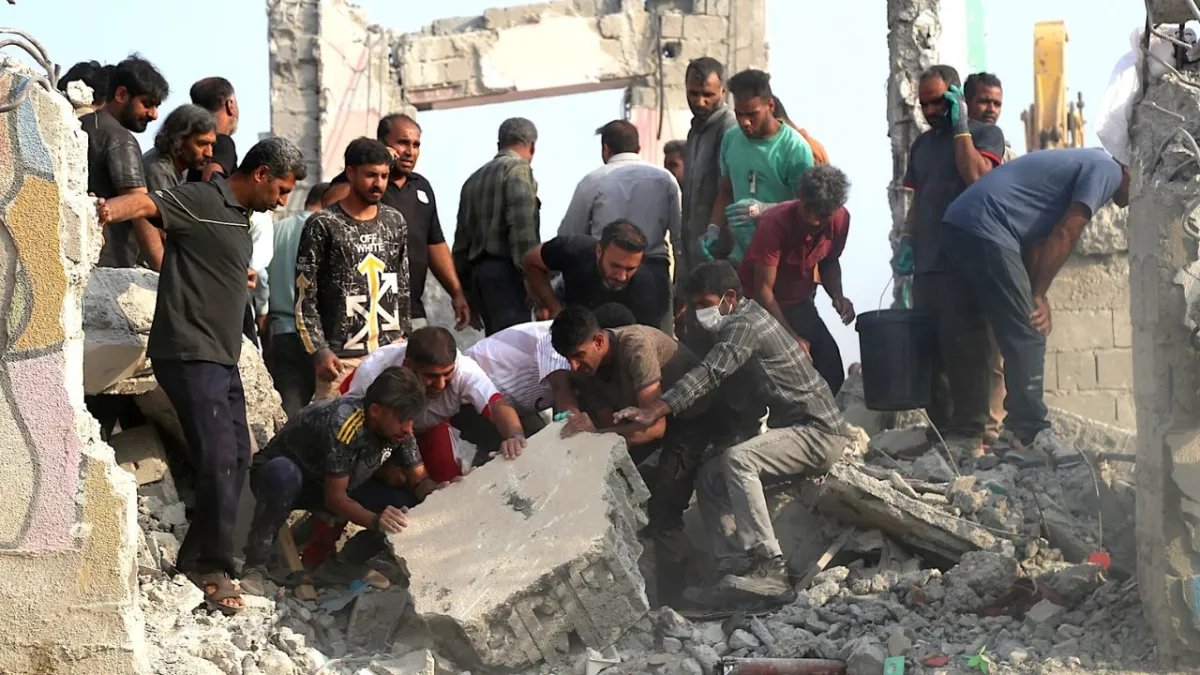
In the southern Iranian city of Minab, where the heat rises from the earth in shimmering waves and the reality of imperialism lingers in every port and military installation, a missile struck a school on Feb. 28.
The strike killed 156 people, notably 120 schoolchildren, which the Iranian government immediately called a “blatant crime.” The United Nations called the attack “a grave violation of humanitarian law.”
The names of the murdered children have not circulated through the centres of global power with the same force as the names of generals, weapons systems and technology platforms.
The dead Iranians remain largely anonymous to those who debate the future of artificial intelligence (AI), which was used by the United States — as it turns out — on this strike.
The murder of the children has opened a window into one of the central questions of our age: who bears responsibility when a machine enters the chain of violence?
What role AI played remains unclear. Press reports indicate that the U.S. military’s Maven Smart System, which incorporates AI tools including Anthropic’s Claude model, was involved in military operations against Iran.
Investigators continue to examine whether AI-assisted systems contributed in any way to the targeting process. The available evidence remains incomplete.
What is remarkable is that the leaders of the AI industry are no longer standing outside the machinery of war. They are inside it. When asked about the strike, Anthropic’s CEO Dario Amodei said that he did “not know exactly” how Claude had been used in this strike, which he described as “mistakes” that are “really, really terrible.”
Anthropic’s Amodei at a technology conference in 2023. (TechCrunch /Wikimedia Commons/CC BY 2.0)
However, Amodei reiterated, the attack on the school was “a use case that doesn’t even violate our red lines.” This was because a human warrior ultimately made the final decision to strike the school.
Amodei’s answer deserves careful attention.
For decades, the architects of technological power have developed a language that distributes responsibility so broadly that it dissolves.
The engineer builds the tool, the contractor integrates the system, the military analyst reviews the output, the officer authorizes the strike and the politician approves the war.
The result is a chain in which everyone participates, and no one is accountable. The language of “human in the loop” belongs to this tradition.
Of course, humans make the final decisions. Humans also made the final decisions during the Western colonial wars that devastated Asia and Africa. Humans made the final decisions when the United States bombed villages in Vietnam.
Humans made the final decisions during the illegal U.S. invasion of Iraq. The presence of a human signature at the end of a process does not tell us much about the structure of power that produced the outcome.
The more important question is this: what role does AI play in shaping the field of decisions available to those humans?
Modern military systems are not merely calculators. They organize information, prioritize possibilities, identify patterns, generate recommendations and shape attention. They influence what commanders see and what they do not see.
Even when a human retains formal authority, the architecture of perception may already have been constructed by machines. This is why the discussion cannot end with the phrase “a human made the final decision.”
President Donald J. Trump oversees the start of Operation Epic Fury attacks on Iran at Mar-a-Lago, Palm Beach, Florida, on Feb. 28. (White House/Daniel Torok / Public Domain)
The crime in Minab arrives at a moment when technology companies increasingly present themselves as guardians of ethical boundaries. Anthropic, in particular, has cultivated an image of caution (this is evident in the Constitution of Claude).
It has spoken about safety, alignment, and limits. It has distinguished itself from more aggressive visions of technological deployment. Yet every institution eventually reveals itself not through its principles but through the situations in which those principles are tested. The deaths of children at a school represent such a test.
If a company cannot determine how its technology was used in a military operation, what does oversight mean? If executives lack visibility into deployment, then claims about safeguards become difficult to evaluate.
If a system contributes to military processes whose consequences include mass civilian casualties, can responsibility be confined solely to the final human actor? These are not questions for Anthropic alone. They confront the entire emerging alliance between Silicon Valley and the U.S. national security state.
Throughout history, periods of technological transformation have produced new partnerships between capital and military power. Railways, telegraphs, aviation, nuclear physics and digital networks all followed this path.
Artificial intelligence is now walking the same road. Its advocates promise precision, efficiency, and fewer mistakes. Yet every generation hears similar promises.
The 20th century was filled with claims that new technologies would make war cleaner, more rational, and more humane. The historical record offers little support for such optimism. Technology often expands the scale and speed of violence even as it promises to restrain it.
The children of Minab did not encounter AI as a philosophical debate. They encountered it as part of a military system whose consequences arrived in the form of explosive force.
Whether Claude played a significant role, a minor role, or no role at all in the targeting process remains to be determined. Investigators must establish the facts, journalists must continue asking difficult questions and citizens must demand transparency.
But even before those facts are fully known, the episode reveals something important about our political moment. The question is no longer whether AI will be integrated into war. That integration is already underway.
The question is whether societies will permit decisions about life and death to be increasingly shaped by systems that even their creators struggle to monitor, explain, or control.
The schoolhouse in Minab stands as a warning, not only about a single strike, or a single company, or a single war. It warns of a future in which technological power advances faster than public accountability.
And in that future, the distance between the engineer and the battlefield grows ever smaller with AI and drones, even as responsibility becomes harder to find amongst the humans who send the machines out to kill for them.
Vijay Prashad is an Indian historian, editor and journalist. He is a writing fellow and chief correspondent at Globetrotter. He is an editor of LeftWord Books and the director of Tricontinental: Institute for Social Research. He is a senior non-resident fellow at Chongyang Institute for Financial Studies, Renmin University of China. He has written more than 20 books, including The Darker Nations and The Poorer Nations. His latest books are Struggle Makes Us Human: Learning from Movements for Socialism and, with Noam Chomsky, The Withdrawal: Iraq, Libya, Afghanistan and the Fragility of U.S. Power.
This article from Z Network was produced by Globetrotter and No Cold War.
Editor’s Note: At a moment when the once vaunted model of responsible journalism is overwhelmingly the play thing of self-serving billionaires and their corporate scribes, alternatives of integrity are desperately needed, and ScheerPost is one of them. Please support our independent journalism by contributing to our online donation platform, Network for Good, or send a check to our new PO Box. We can’t thank you enough, and promise to keep bringing you this kind of vital news.
You can also make a donation to our PayPal or subscribe to our Patreon.
Please share this story and help us grow our network!
[ad_2]
Source link
