
[ad_1]
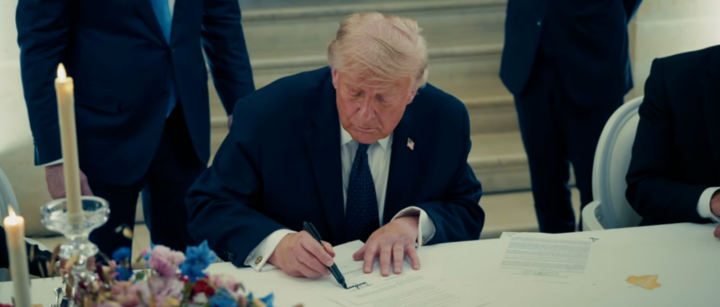
President Donald Trump signed a preliminary agreement to end the war with Iran on June 17. The 14-point memorandum of understanding outlines the conditions under which the U.S. and Iran have initially agreed, and gives them 60 days to negotiate additional terms.
But some of what is included in the framework — or not — is at odds with what Trump said about a potential deal prior to approving the memorandum of understanding last week.
For example, in an NBC News interview earlier in June, Trump said that he would not “unfreeze any Iranian assets” or “lift any sanctions” against Iran “upfront” as part of a deal to end the conflict. But the agreement says that the U.S. Treasury Department will “immediately” grant waivers permitting Iran to resume exports of crude oil and other petroleum products, allowing Iran to make billions of dollars in revenue. A schedule for potentially billions of dollars in additional sanctions relief is to be worked out over the next two months.
Also, Trump initially called news reports that the agreement included a $300 billion reconstruction fund for Iran “false.” However, the fund is mentioned in the memorandum of understanding, and Reuters, citing an unnamed source, has reported that “more than half” of that money “has already been committed” by private-sector investors around the world, including in the U.S.
Furthermore, the agreement says little about the future of Iran’s nuclear program — a key source of contention between the two countries, and part of Trump’s justification for launching airstrikes on Iran in February. During his first term as president, Trump withdrew the U.S. from a nuclear deal with Iran, called the Joint Comprehensive Plan of Action, that was negotiated and implemented during the Obama administration.
For years, Trump has lambasted the Obama-era pact as “horrible,” “defective” and one of the “dumbest” ever. But Trump’s current agreement says Iran “reaffirms that it shall not procure or develop nuclear weapons” just as former President Barack Obama’s deal said Iran “under no circumstances” would “ever seek, develop or acquire any nuclear weapons.”
Sanctions Relief, Unfreezing Assets
In a June 5 interview on NBC’s “Meet the Press,” Trump said “no” when asked if he would “unfreeze any Iranian assets or lift any sanctions upfront as a part of any deal” with Iran.
“If they behave, if they do a good job, we start talking,” Trump said about future negotiations.
But Trump didn’t completely stick to that promise.
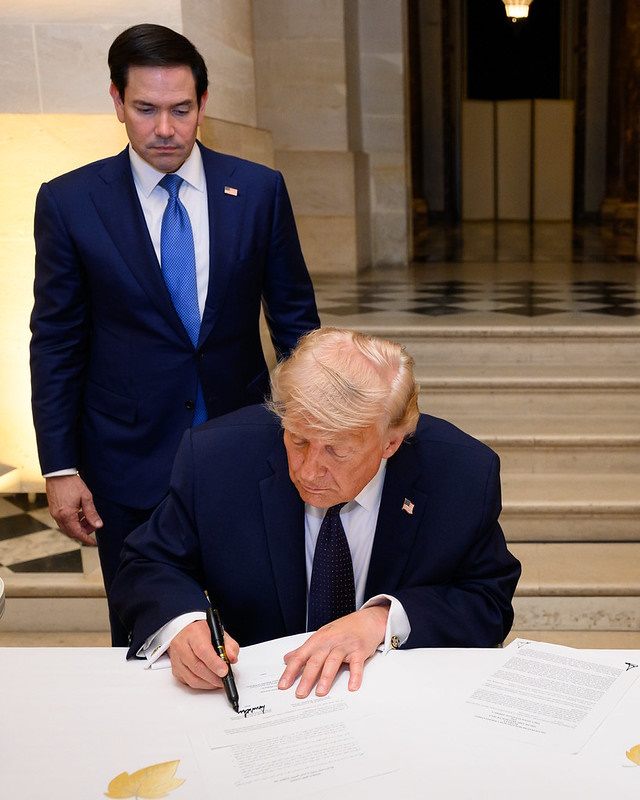
The memorandum of understanding that he signed has lifted U.S. sanctions that were limiting how much crude oil and other petroleum products Iran could sell on the global market. The agreement says the U.S. “undertakes that immediately upon the signing of this MoU, and until the termination of sanctions, the U.S. Department of Treasury will issue waivers for the export of Iranian crude oil, petroleum products, and derivatives, and all associated services including banking transactions, insurances, transportation, etc.”
The Wall Street Journal reported that Iran could now make $60 billion per year from oil and fuel sales at current prices, assuming that it returns to pre-war production levels. Iran could earn $8 billion in just the first two months under the deal, the Journal said, according to estimates from Richard Nephew, a senior research scholar with Columbia University’s Center on Global Energy Policy and a former U.S. deputy special envoy for Iran in the Biden administration.
In addition, the agreement says, “The United States of America undertakes to make fully available for use, the frozen or restricted funds and assets of the Islamic Republic of Iran upon the implementation of this MoU.” Iran has tens of billions of dollars in frozen assets around the world, including an estimated $20 billion to $50 billion in China, according to the Wall Street Journal, which said Iran’s “priority is to unblock an initial $24 billion in phases.”
As for the timing of the release of those assets – which a senior administration official reportedly said was contingent on “good behavior” from Iran – the agreement says, “The United States of America and the Islamic Republic of Iran will mutually agree on the procedures related to the release of these funds during the negotiations.”
“We have taken their money, it’s not our money, it’s their money, and we froze it,” Trump told reporters at a June 17 press conference during the summit of G-7 nations in France. “At a certain point in time, I guess we’re going to have to give it back.”
But in November 2015, while campaigning in Iowa, Trump criticized billions of dollars of Iranian assets that were unfrozen as part of the Obama administration’s nuclear deal with Iran.
“I would have never given them back the money,” Trump said. “I would have said, “The money is off the table. Let’s start negotiating.’”
Also, the agreement that Trump signed says that the U.S. “undertakes to terminate all types of sanctions against the Islamic Republic of Iran,” including “all unilateral U.S. sanctions … in an agreed upon schedule as part of the final deal.”
It remains to be seen which sanctions will be removed and when.
$300 Billion Fund
The agreement further says, “The United States of America undertakes, with regional partners, to develop a definitive mutually agreed plan with at least USD 300 Billion, for the reconstruction and economic development of the Islamic Republic of Iran. The mechanism for the implementation of this plan will be finalized as part of final Deal within 60 days.”
But Trump initially denied that the fund was part of the deal during a June 17 press conference with the Egyptian president in France.
“Well, it’s false,” Trump said in response to a reporter who asked about the $300 billion fund, which was mentioned in a draft of the memorandum of understanding that had been leaked to members of the press.
“It’s false. People, you can invest if you want. What am I going to do, say nobody’s ever allowed to invest? We’re not invest[ing]. We’re not putting up 10 cents. People can decide to do that, but that’s up to them,” Trump said. “We are not investing in it, and we do not have a fund.”
While the memorandum of understanding says that the U.S. will help develop the plan for the $300 billion, and grant all “required licenses, waivers and permissions needed for the relevant financial transactions,” Trump and Vice President JD Vance have insisted that none of the money intended for Iran’s reconstruction and economic development will come from U.S. taxpayers.
“We’re not investing any money,” Trump said in a June 16 meeting with the emir of Qatar. “We didn’t pay for it like Obama did. He paid billions of dollars. He paid 1.7 billion from an airplane, all green cash. It was crazy.”
In an exclusive on June 16, Reuters – citing an anonymous source familiar with the negotiations – reported that “more than half” of the $300 billion “has already been committed and that it will be comprised entirely of private-sector funds.” Private companies in the U.S., the Gulf Arab states, Asia, South America and Africa have already agreed to commit financing, a source told Reuters, adding that no government money or grants would be included.
As for the $1.7 billion that Trump has repeatedly said Obama “paid” to Iran in 2016, we’ve written that that was to formally settle a decades-old dispute over Iran paying the U.S. $400 million for military equipment that was never delivered. The U.S. refused to provide the equipment after the Shah of Iran was overthrown during the Iranian Revolution in 1979.
The $1.7 billion that Iran received, all in cash, but not in U.S. currency, included the original $400 million and an additional $1.3 billion for interest.
The $1.7 billion is sometimes conflated with the sanctions relief that Iran received for complying with the Joint Comprehensive Plan of Action negotiated under Obama.
As we’ve written, as part of that deal, the U.S., China, France, Germany, Russia, the United Kingdom and the European Union agreed to lift sanctions on Iranian assets that were frozen and being held mostly in foreign banks. In a September 2015 op-ed about Obama’s deal, Trump claimed that the U.S. had given Iran “a windfall of $150 billion, which will no doubt fund terrorism around the world.”
But the U.S. Treasury Department estimated that Iran would end up with a lot less – about $50 billion in “usable liquid assets,” according to 2015 testimony from Adam Szubin, who was then the acting under secretary of treasury for terrorism and financial intelligence.
Iran’s Nuclear Program
Trump has repeatedly derided the JCPOA, claiming that it would have put Iran on “a path to a nuclear weapon.” (We have written about that before.) By comparison, Trump said his deal would be “a wall to a nuclear weapon.”
“The Obama deal was one of the dumbest deals I’ve ever seen; it was a road to a nuclear weapon,” Trump said on June 17, referring to the JCPOA, which he pulled out of in 2018. “My deal is a wall to a nuclear — you’re not going to have it, it’s a wall to a nuclear weapon.”
But that remains to be seen. The memorandum of understanding says only: “The Islamic Republic of Iran reaffirms that it shall not procure or develop nuclear weapons.”
That closely mirrors the language in the JCPOA, which stated, “Iran reaffirms that under no circumstances will Iran ever seek, develop or acquire any nuclear weapons.”
The current agreement goes on to say, “The Islamic Republic of Iran and the United States of America have agreed to resolve the disposition of stockpiled, enriched material pursuant to a mechanism that will be mutually agreed upon … with the minimum methodology to be down-blending on site under the supervision of the [International Atomic Energy Agency],” which is a reference to Iran’s enriched uranium, up to 60%, according to the IAEA just before the bombing of Iran’s nuclear sites last year. Uranium enriched to 60% is just short of weapons grade material.
“The two parties also agreed to discuss the issue of enrichment and other mutually agreed matters related to the Islamic Republic of Iran’s nuclear needs, based on the statutory framework being agreed upon in the final deal,” the memorandum of understanding states. “The final deal will confirm the provisions of this paragraph. The Islamic Republic of Iran and the United States of America acknowledge the critical importance of the nuclear issues above mentioned, and express their intention to immediately address these issues in the negotiation in order to achieve mutual agreement on them.”
While Trump stated on June 15 that “the main thing is that Iran will not have a nuclear weapon,” and that Iran “fully agreed to that, with strong policing powers,” there are no details at all in the agreement about Iran agreeing to “strong policing” of their nuclear program, or what that might entail.
The details of what the two countries will agree to regarding Iran’s nuclear program are to be determined over the course of the 60-day negotiation period, Kelsey Davenport and Daryl G. Kimball, of the Arms Control Association, explained in June 22 brief. “The MOU is, fundamentally, a non-nuclear deal that leaves key nuclear issues unresolved,” they wrote.
Similarly, Nephew, the international and public affairs scholar at Columbia University, told us in an email, “The JCPOA had detailed, specific requirements for verification and what Iran would do. The closest this has is that Iran agrees to keep its nuclear program static, in exchange for static sanctions, but there is no verification and there is no specificity.”
“Everything else is to happen in the future as part of a longer term deal,” he said. “I suppose you could say that this longer term deal already has a forward looking commitment on managing Iran’s enriched uranium stocks, but everything else is ‘for discussion.’”
So, until firmer details are negotiated with Iran regarding its nuclear program, it’s premature for Trump to claim his deal is “a wall to a nuclear weapon,” particularly when it lacks verification requirements that were in already place with JCPOA, prior to any new conflict with Iran.
Editor’s note: FactCheck.org does not accept advertising. We rely on grants and individual donations from people like you. Please consider a donation. Credit card donations may be made through our “Donate” page. If you prefer to give by check, send to: FactCheck.org, Annenberg Public Policy Center, P.O. Box 58100, Philadelphia, PA 19102.
[ad_2]
Source link
