
[ad_1]
U.S. Sen. Susan Collins, R-Maine, said she doesn’t regret voting to confirm Supreme Court Justice Brett Kavanaugh, even though he became essential to the court’s majority ruling that overturned the federal right to abortion.
“Obviously, I’m disappointed in that decision, which turned abortion issues back to the states,” Collins said June 12. “It has not had an impact on the state of Maine in that Maine actually expanded its law.”
Seeking to tie Collins to President Donald Trump, Senate race challenger Democrat Graham Platner has criticized Collins’ 2018 pro-Kavanaugh vote as evidence she’s not bipartisan. Trump nominated Kavanaugh during his first term. Planned Parenthood Action Fund also cited Collins’ support of Kavanaugh in its June 22 endorsement of Platner.
Collins, who supported Roe v. Wade, usually votes in support of Trump but has taken some high-profile positions against the president.
Collins is correct that Maine expanded its laws in support of abortion, but critics say that took work. In response to the ruling, Maine’s state lawmakers and Democratic Gov. Janet Mills scrambled to protect abortion access and spent years strengthening its laws. The Trump administration and Maine are at odds over abortion care.
Maine passed several laws to protect abortion access
In 2022’s Dobbs v. Jackson ruling, the U.S. Supreme Court upheld a Mississippi law that banned abortion after 15 weeks, with the majority opinion saying, “the Constitution makes no express reference to a right to obtain an abortion.” The decision reversed Roe v. Wade, ending nearly 50 years of federally protected access to abortion and returned power to states to set their own laws.
Mills and Maine lawmakers responded by enacting laws from 2023 to 2025 to protect and expand abortion access.
State law previously said that abortion was legal up to the point of viability, when a fetus can typically survive outside a uterus. In 2023, Maine updated its law to say that abortion could occur after viability if it was deemed necessary by a physician.
“We are affirming that Maine people, guided by their medical professionals, their families, their personal and spiritual beliefs, that they will make decisions about their reproductive health care,” Mills said when she signed the bill. “They will do so and not politicians.”
Lawmakers passed several other bills that shielded abortion providers from prosecution or discipline, including if they attended patients from other states; prohibited private insurers from imposing certain costs for abortion; let providers not have their names appear on abortion pill bottles; and prevented cities from passing abortion restrictions.
The Guttmacher Institute, which supports abortion rights, considers Maine as “very protective” of abortion rights, one notch below “most protective.”
The number of abortions in Maine has remained relatively consistent in recent years before and after the Supreme Court ruling, Guttmacher Institute’s data shows. Clinicians provided 2,370 abortions in Maine in 2020 and 2,390 in 2023, the first full year after the ruling. There were 2,750 abortions in 2025. (Guttmacher said it did not have 2021-22 data.)
Did abortion providers in Maine notice any effects?
Although state lawmakers protected abortion access after the Dobbs ruling, abortion providers said there were still some effects.
“Mainers have worked tirelessly to mitigate the harm caused by Susan Collins’s vote for Justice Kavanaugh,” Planned Parenthood Votes said in a statement to PolitiFact.
In 2024, the state house building was evacuated due to a bomb threat as a bill to protect providers and gender-affirming care was moving through the legislature. The threat claimed bombs were placed in some lawmakers’ homes and the Maine Democratic Party. No explosives were found.
There was confusion and fear about the legality of abortion care in Maine right after the Dobbs ruling, said Aspen Ruhlin, community engagement manager at Mabel Wadsworth Center, a reproductive health care provider in Bangor. “We received many panicked calls and emails from people thinking that the SCOTUS ruling that struck down Roe made abortion illegal in all states.”
Collins’ remarks were specifically about Maine, but the Supreme Court’s ruling overturning Roe v. Wade had broad effects: By late 2025, 23 states enacted near-total bans or strict limits at 22 weeks gestation or less.
Our ruling
Collins said that the Supreme Court’s 2022 ruling on abortion “has not had an impact on the state of Maine in that Maine actually expanded its law.”
If we interpret Collins’ statement as referring to abortion care access, she is correct. Following the ruling, state lawmakers passed several laws to protect patients and providers and said abortion could occur after viability if deemed necessary by a physician.
Abortion providers pointed to other effects, such as a bomb threat at the capitol while lawmakers were considering an abortion-related bill, and fear and confusion among the public immediately after the ruling.
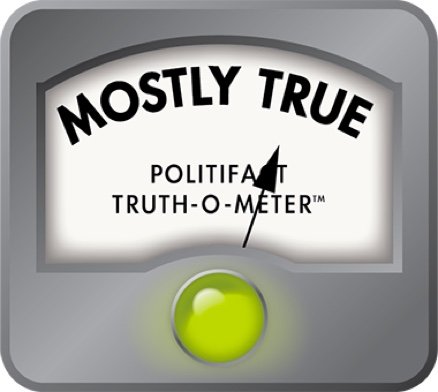
We rate this statement Mostly True.
RELATED: All of our fact-checks in the 2026 Midterms including Maine
RELATED: All of our fact-checks about abortion
[ad_2]
Source link
