
[ad_1]
Contradiction has struck East Asia: the countries most deeply integrated into China’s vibrant economic system are also drawn into military preparations to confront it.

(Via Tricontinental Institute)
By Vijay Prashad
Tricontinental: Institute for Social Research
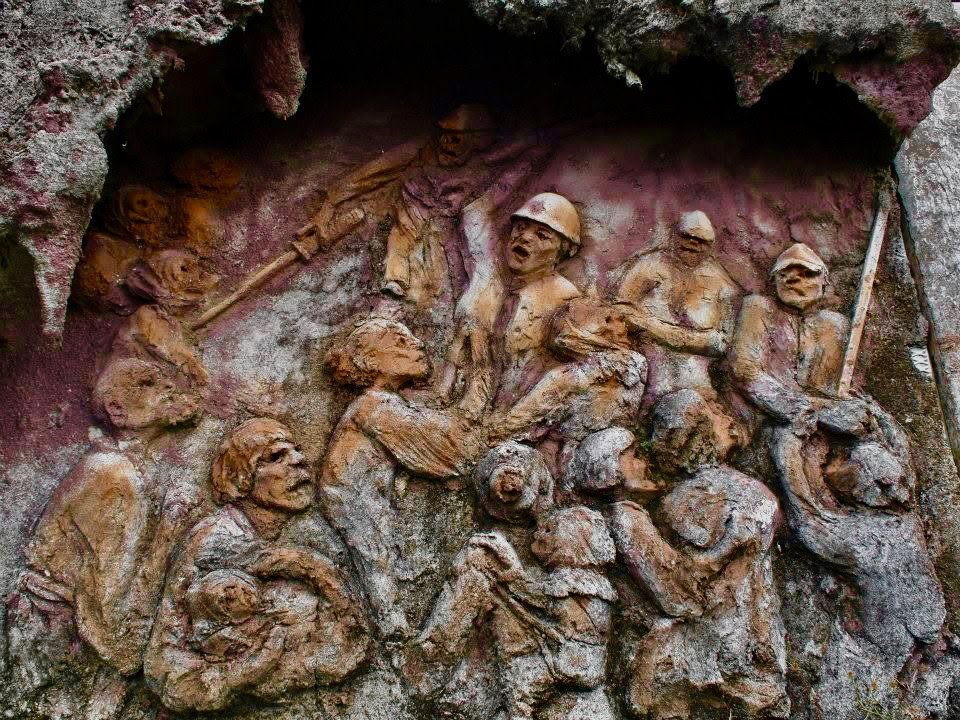
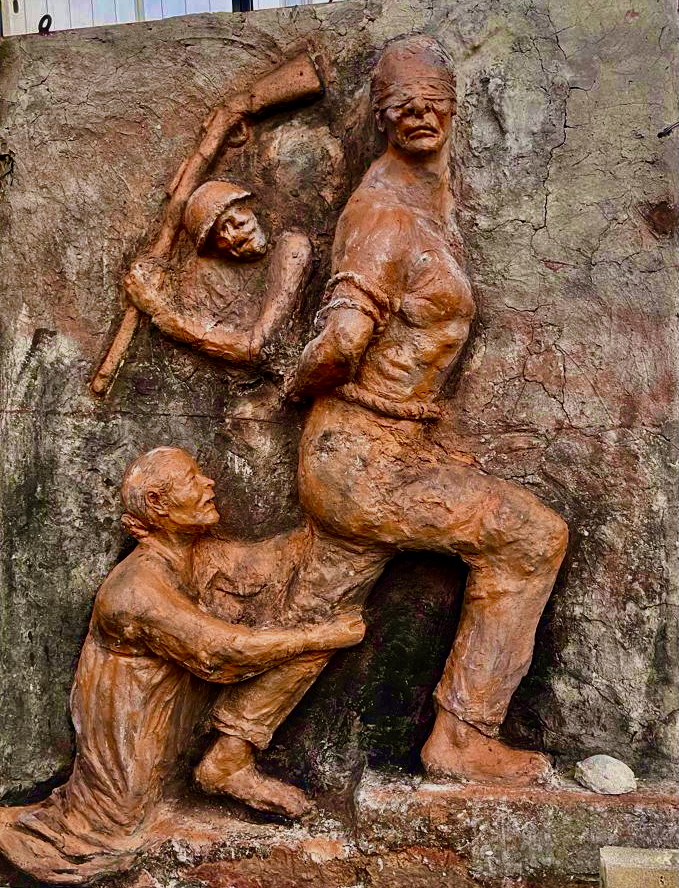
 The Okinawan artist Kinjo Minoru is haunted by the tragedy of the 1945 Battle of Okinawa and the military occupation that has marked the island ever since.
His art is informed by that sensibility; his sculptures seem to emerge from the earth itself. Human figures struggle outwardly through stone and concrete, their bodies marked by war, occupation and memory.
Kinjo works with the same materials today being poured into Okinawa’s coast to build yet another U.S. military base. His sculptures aren’t merely monuments to the past. They’re a warning to the present.
For this reason, Tricontinental‘s dossier, “East Asia’s Double Bind: Contradictions and Possibilities in the New Cold War,” turns to Kinjo’s sculptures to frame the dangers now taking shape across the region.
They warn us about the concrete drying across East Asia: new missile systems, military exercises, bases, naval fleets on patrol in contested waters and military budgets that soar as social budgets stagnate.
East Asia, one of the great engines of global economic and technological development, is being transformed into a frontline of a dangerous New Cold War.
A contradiction has struck the heart of the region: the countries that are most deeply integrated into China’s economic dynamism are simultaneously being drawn into military structures designed to confront China.
(Via Tricontinental Institute)
For decades, the dominant economic story in East Asia has been one of integration: factories, railways, and ports have linked the region’s countries into dense networks of production, trade, supply chains and markets.
As early as 1993, the World Bank published a report called “The East Asian Miracle,” which acknowledged that high growth in the region was not simply the result of free markets but of state intervention that produced “higher and more equal growth.”
Twenty years later, the World Bank published “China 2030“ (2013), which recognised that China’s system — marked by state-owned banks, strong state intervention and controls on interest rates — had been “remarkably successful in mobilising savings and allocating capital to strategic sectors during China’s economic take-off.”
In other words, even the World Bank had to concede that East Asia’s rise depended on planning, public investment and regional integration rather than on the free-market prescriptions usually imposed on the Global South.
Today, China is the motor of growth in the region and entire industries and millions of jobs depend on the East Asian states’ relationship with China. Yet while economic gravity pulls the region towards integration, military power pushes in the opposite direction.
The United States has spent the past decade constructing what its strategists openly call a “strategy of denial.” Through military alliances and exercises, new agreements for bases, missile deployments and intelligence-sharing networks, Washington has sought to intimidate China into surrendering its economic future.
This architecture stretches from the Indian Ocean to the Pacific Ocean — the so-called Indo-Pacific of U.S. war planners — from Diego Garcia to Guam and from Okinawa to the northern Philippines.
This military geography is a desperate response to a profound historical reality: the centre of gravity of the world economy has shifted towards Asia.
Unable to reverse this shift economically with its own productive apparatus, the United States has increasingly relied upon military power to preserve its idea of global primacy.
The result is what Tricontinental‘s dossier calls a double bind for the East Asian states.

(Via Tricontinental Institute)
Many East Asian states are caught in this double bind. Japan illustrates the situation clearly.
China is Japan’s largest trade partner and a crucial market for its industrial exports. Yet Japan hosts close to one hundred U.S. military facilities and is rapidly expanding its own military spending.
Successive Japanese governments have loosened restrictions on arms exports and reinterpreted constitutional limits on military activity, a trajectory that Prime Minister Sanae Takaichi has sought to accelerate.
While Okinawans continue to vote against the expansion of the U.S. military footprint, decisions are imposed on them from Tokyo in the service of a geopolitical strategy not of their making.
They see how U.S. bases in the Gulf Arab states have become targets instead of shields and they know that the same fate awaits them if the U.S. starts a military conflict with China or any other power in the region, such as Russia or the Democratic People’s Republic of Korea.
The same double bind confronts the Philippines and South Korea. Military agreements and arms sales with the U.S. have increased even as trade with China has grown. Across these countries, people’s movements have demanded greater sovereignty and social justice and opposed U.S. bases and military agreements, but with little success.
Governments of different political tendencies have remained constrained by the structures of military dependency built over generations. These developments are presented as inevitable, but they are not so.
They are part of a political project. The language of democracy and authoritarianism that shapes the debate in the region is deeply misleading and obscures more than it reveals.
The real question before the peoples of East Asia is not ideological but material: can societies pursuing development through regional integration, including through the Regional Comprehensive Economic Partnership, which links China with Japan, South Korea, Australia, New Zealand and most of Southeast Asia, also serve as advance bases for military confrontation with their main trade partner?
The answer is no.

(Via Tricontinental Institute)
While war planners speak of “deterrence” and financial market analysts speak of “risk,” ordinary people understand something more immediate: military escalation through the New Cold War threatens life itself.
Every military base occupies land that could be used for other purposes, and every defence budget increase comes at the expense of investments in healthcare, education, housing and climate measures.
In 2024, Japan’s defence spending increased by 21 percent to $55.3 billion, equivalent to 1.4 percent of its GDP.
The government has since sought to bring forward its original fiscal year 2027 target of raising defence expenditure to 2 percent of GDP, redirecting resources that could otherwise serve one of the world’s most rapidly ageing societies.
Across East Asia, labour unions, student organisations, peasant movements, women’s groups, peace advocates and anti-base activists are challenging militarisation and foreign military expansion through mass action and advocacy work in legislatures.
Their struggles underscore the fundamental truth that genuine security is built through democratic participation, human development, and social justice — not through an arms race.
The future of East Asia will not be determined solely by generals and strategists but by ordinary people who are organised and firm in their convictions. Their interests rarely align with militarism.

(Via Tricontinental Institute)
The New Cold War is not simply a contest between states but a struggle over the future direction of world development.
The states of East Asia need cooperation, dialogue and institutions capable of managing differences so that they do not become conflicts. Above all, the tensions in the region require political movements capable of imagining futures beyond the logic of confrontation.
Across the region, thinkers and political leaders have long debated whether security should be built through deterrence and military alliances or through dialogue, reconciliation and human security. Tricontinental‘s dossier enters that debate by insisting that durable peace cannot be built through militarisation.
Kinjo Minoru’s sculptures remind us that war is not an abstraction but leaves scars on landscapes and bodies, transforming possibilities into ruins. The concrete of Kinjo’s sculptures has dried into memory, but the concrete of the bases is still drying into threat.
History remains unfinished.
Each year on June 23, Okinawa marks Irei no Hi, or Memorial Day, to honour those who died in the 1945 Battle of Okinawa. At the annual memorial ceremony, a student reads a selected poem of remembrance, carrying the memory of the dead into the voice of a new generation.
In 2018, Rinko Sagara, then a third-year student at Minatogawa Junior High School in Urasoe, read her poem Ikiru (Live). Here is an extract:
“Below Mabuni Hill the gentle sea expands before my eyes.
I am saddened and cannot forget all the things that happened to this island.
I clench my hands together and vow,
Remembering the fallen, I make a vow from my heart:
As long as I live,
To never ever accept this war that claimed so many lives.
To never repeat this past in the future.
To strive for a world in which all humans live in peace, transcending national borders, transcending race, transcending religion, and overcoming all interests.
To create a world in which the ability to live and value lives is not violated by anyone.
To be willing to try to create peace.”
Vijay Prashad is an Indian historian, editor and journalist. He is a writing fellow and chief correspondent at Globetrotter. He is an editor of LeftWord Books and the director of Tricontinental: Institute for Social Research. He is a senior non-resident fellow atChongyang Institute for Financial Studies, Renmin University of China. He has written more than 20 books, including The Darker Nations and The Poorer Nations. His latest books are Struggle Makes Us Human: Learning from Movements for Socialism and, with Noam Chomsky, The Withdrawal: Iraq, Libya, Afghanistan and the Fragility of U.S. Power.
This article is from Tricontinental: Institute for Social Research.
The views expressed are solely those of the author and may or may not reflect those of Consortium News.
Please Donate to the
Spring Fund Drive!


[ad_2]
Source link
