
[ad_1]
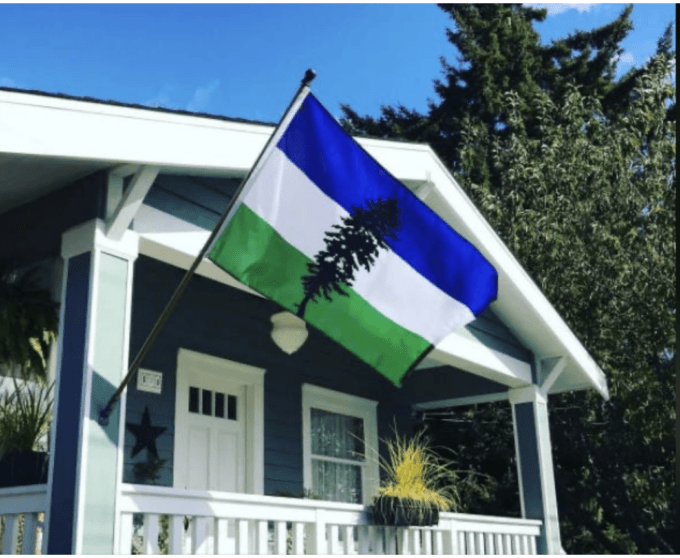
Cascadia has a flag and a strong bioregional identity. Should it become an independent country?
The New York Times has discovered Cascadia. Specifically, it has found news of an emerging Cascadia independence movement fit to print. In the June 13th edition, it published an article, “Independent Cascadia? Greater Idaho? Disunited States Look Toward Divorce.”
Times Northwest correspondent Anna Griffin reported on contrasting movements from the left to declare Cascadian independence from the U.S., and from the right for eastern Oregon to secede and join Idaho. The piece is behind a paywall, but you can read the full article linked here.)
Griffin quoted Andrew Engleson, who has been advocating independence in his Cascadia Journal, “We’re in an abusive relationship with the federal government. Divorce is a valid response.”
Engleson and fellow Cascadian organizer Drew Alcosar recently announced creation of Cascadia Democratic Action (CDA). It is examining the possibility of 2028 Oregon and Washington ballot initiatives to begin moving toward independence
On June 1 they published an article in Cascadia Journal, “It’s time for Cascadia independence from the US.” “One year ago, we wrote about starting conversations on Cascadia autonomy in response to the US descent into fascism. Things have only gotten worse since then. The U.S. constitution is a contract between the people and the federal government. Over the past year and a half, the Trump administration has abrogated that contract many times over. Those offenses are strikingly similar to the American colonists’ complaints against Britain in the 1776 Declaration of Independence.”
Much as that original declaration, the writers spend much of the article documenting those abuses. Among them:
+ Prosecuting peaceful protestors against ICE in Spokane,
+ Illegally withholding federal money budgeted for the region to support clean energy and scientific research, among other items, even as Oregon and Washington send $36 billion more to the federal government than is returned to them,
+ Gutting the Forest Service while planning on logging a billion board feet from regional forests,
+ Illegally imposing tariffs that have cost the region $4 billion
+ Having the U.S. Postal Service undermine vote-by-mail systems, which were pioneered in Oregon and Washington.
CDA advocates actions to increase regional autonomy, including the creation of state banks and measures for states to withhold federal tax funds if budgeted funds are not restored. Engelson and Alcosar write, “We want good schools, free college tuition, universal health care, affordable housing, and a robust transportation system. Fiscal autonomy would allow Cascadia to achieve those goals.”
Wisely, CDA has limited itself to Oregon and Washington. British Columbia is considered part of Cascadia, but CDA does not want to associate itself in any way with the Trump assault on Canadian national identity. Though if a secession movement picking up steam in Alberta succeeds, all bets are off. Parts of Northern California are also mapped as Cascadia. But Engleson and CDA are do not support the idea of a Pacifica encompassing all three states out of concern for being absorbed in a state with more than three times the population and its own complex politics.
Cascadia is a political trendsetter, so what happens here has ramifications far beyond the bioregion. The fact that an independence movement is being boldly forwarded could be a harbinger for the U.S. as a whole. To this point, Texas has had the most active movement for secession from the U.S. It has come from the right. California has an independence movement from the left. Both root in brief histories as independent nations. Cascadia adds to the mix with a movement linking states around a bioregional identity. Its emergence signals a belief that the political system of the U.S. is beyond repair.
The CDA site makes the case. “We are in an authoritarian crisis. The Trump administration has repeatedly demonstrated its contempt for the US constitution by ignoring court rulings, weaponizing the Justice Department against its critics, and kidnapping immigrants without due process, sending them to a brutal foreign prison in a country ruled by a dictator . . . we now realize that the US constitution is a deeply flawed document that has failed to provide the safeguards necessary to protect us from a new tyrant. . . Donald Trump . . . We believe the system of government in the United States is so broken that it cannot bring about the major reforms necessary to restore democracy, civil rights, and the rule of law to the United States any time soon.”
That really is the crux of the issue. I’ve posed similar questions myself. Last October, I wrote, “The U.S. is broken. Time to think about what comes next.” In it I identified the centralizing tendencies of the Constitution as the fatal flaw that has led us to this day. It is clear that the U.S. political system has reached an impasse with no clear resolution in sight. A corrupt Supreme Court tipped far to the right. A Congress bought by powerful interests that has failed to uphold its Constitutional responsibilities. An imperial presidency that has broken Constitutional bounds and is indeed pushing for authoritarian rule. These systemic failures are driving discussion of radical alternatives.
I have long believed a political order than brings power more to the level of states and cities, bioregions and communities, is the antidote to overcentralization in Washington, D.C. Though the 1960s and 70s saw a great era of reform at the federal level, states and cities have been the most fertile field for innovative public policies in recent decades, among them moving to 100% clean energy, increasing the minimum wage, and addressing the housing crisis. So a move to greater autonomy deserves attention. But before advocating for outright independence, three key questions must be answered.
Is independence practical?
Is independence the best way to promote the common good?
Does moving for independence undermine broader progressive movements?
Is Independence Practical?
When President James Polk in 1846 negotiated the division of the Oregon Territory with Britain, he was insistent on the U.S. owning the Puget Sound. Most U.S. settlers were in the Willamette Valley south of the Columbia River, and Britain wanted that to be the boundary. But Polk and the U.S. wanted the harbors of the Puget Sound as jumping off points for the Pacific.
Polk is today obscure, but he was one of the most consequential of U.S. presidents, roughly doubling the size of the country with the Oregon treaty and Mexican-American War. Polk had an agenda, to take control of three great natural harbors on the Pacific Coast, those of the Sound, San Francisco Bay and Coronado near San Diego. He had a vision of U.S. expansion into Asia that Norman Graebner documented is his work, Empire on the Pacific. Taking California was his primary goal in the war with Mexico. He was willing to give up Oregon Territory lands north of the 49thparallel to make sure Britain did not intervene in the war. Gaining the Puget Sound achieved his fundamental objective regarding Oregon.
Polk knew what he was doing. Today, the Puget Sound is indeed a key maritime and aviation link to Asia. It is also a center of U.S. military power projection across the Pacific. U.S. Army operations around the basin are run from Joint Base Lewis McCord near Tacoma. The U.S. Navy complex at Bremerton is one of its most important Pacific bases. The greatest single concentration of U.S. military power is the Trident nuclear submarine base at Bangor, site of the largest concentration of active U.S. nuclear weapons. To put it simply, there is no way the U.S. government is going to give this up. It is too vital a center of the global empire.
Independence advocates cite Cascadia’s rich economic base to support the proposition the bioregion could go it alone. But consider that much of this prosperity rests on some of the most global of corporations, several of which are major U.S. military contractors. Boeing is one of the top five vendors to the Pentagon. Amazon runs the U.S. intelligence agencies cloud. It is joined with Microsoft, a significant military contractor in its own right, to put the Pentagon on the cloud. None of these corporate giants would willingly become part of a different country. Meanwhile, other Cascadia-based corporations such as Starbucks and Costco rely on a singular national market economy. They would not be happy with the prospect of balkanization.
Beyond all these sources of opposition comes the legal question if secession is at all possible. In the case of Texas v. White, the Supreme Court ruled the Union is permanent. But a path might be possible through a treaty supported by two-thirds of the Senate. However, the likelihood of this taking place against the intense opposition any separation would stir is just about zero.
Then there is that other secession movement covered in the NYT piece, eastern Oregon joining Idaho. Eastern Washington has long had a movement to break away and form the State of Liberty. While Cascadia is a biogeographical whole, linked by rivers and watersheds, culturally it is two separate regions divided by the Cascade crest, a more urban liberal west and more rural conservative east. If Oregon and Washington moved to secede, it is a solid bet their eastern portions would move to secede from them.
So, to answer the first question, in the current political environment or anything like it, Cascadian independence is not practical. At least not on its own. In my view, the only way such a change would take place is in the broader context of a U.S. breakup or rearrangement. Where a common agreement is achieved to go our own ways, or to fundamentally change the constitutional order.
Is Independence the Best Way to Promote the Common goodG
This is a more complex question, and the answer is more nuanced. The purpose of governing structures is to promote the common good. We join together to accomplish what we cannot as individuals or singular organizations. Even anarchist philosophies, at least the more sophisticated ones, envision some form of public order. Murray Bookchin, for example, posed the idea of community assemblies to guide the affairs of municipalities linked in confederations.
The Declaration of Independence’s most remembered words state how political orders protect the common good. “We hold these truths to be self-evident, that all men are created equal, that they are endowed by their Creator with certain unalienable Rights, that among these are Life, Liberty and the pursuit of Happiness. That to secure these rights, Governments are instituted among Men, deriving their just powers from the consent of the governed.”
The preamble to the U.S. Constitution places the common good as its fundamental reason. “We the People of the United States, in Order to form a more perfect Union, establish Justice, insure domestic Tranquility, provide for the common defence, promote the general Welfare, and secure the Blessings of Liberty to ourselves and our Posterity, do ordain and establish this Constitution for the United States of America.”
The critical questions are at what levels of government the common good is most effectively pursued, and what to do when a level of government actively undermines the common good. As the Declaration says in the words immediately following the above quote, “That whenever any Form of Government becomes destructive of these ends, it is the Right of the People to alter or to abolish it, and to institute new Government, laying its foundation on such principles and organizing its powers in such form, as to them shall seem most likely to effect their Safety and Happiness.”
CDA is making the case the U.S. government has reached that point. Indeed, the Trump Administration has degraded the capacity of public institutions to secure the common good in critical areas. The outbreak of screwworm among cattle in Texas and Ebola in the Congo trace directly to Trump’s illegal budget cuts. Scientific research of all kinds is being ravaged, notably in health and climate. It is cutting health and food support budgets even as it grotesquely inflates military expenditures and conducts illegal wars.
So if Cascadia could keep that $36 billion more it sends to the federal government than it gets back, would it do a better job of ensuring the common good? Almost certainly. Considering how many of the dollars actually flowing back to Cascadia go to those military bases, and how Cascadia would not support a world-spanning empire, the case strengthens that an independent Cascadia would be better for the common good in the bioregion.
But we face issues beyond the bioregion that require a broader response. Climate, pandemics, AI, to name several. How do we take care of the common good at broader levels? Who does the global health and climate monitoring? How do we join together to do all this? That is why I tend to lean more to a new political order spanning the continent, something like a confederation of bioregional commonwealths that pursues the common good at levels individual bioregions cannot achieve on their own. And which links at international levels to address global issues.
The current order is certainly proving less than a reliable guarantor of the common good, and in so many ways is actively undercutting it. We definitely need something different that allows greater autonomy but also preserves connections at continental and planetary levels.
Does Pursuing Independence Undermine Broader Progressive Movements?
This is the question that should most trouble independence advocates. A backlash to Trump and the depredations of his administration is mounting. New juice is pumping into progressive politics across the U.S. At local and state levels, progressive candidates are winning. With oligarchs sucking off most new wealth while most people increasingly struggle, the message of economic populism is gaining new traction. It is being voiced by Democratic Senate candidates James Talarico in Texas and Graham Platner in Maine among others. A Democratic sweep of the House and Senate is possible. In the longer term, a generational shift favors more progressive policies with younger voters coming to the fore.
Thus, we must ask whether this is the right time to forward independence. Surely in a nationwide progressive sweep, Oregon and Washington will play key roles. Is stepping out of the picture and going it on our own the right step? Or does it undermine a solidarity needed to turn around destructive trends in the U.S. as a whole?
The question gets down to whether the broken system can be repaired within the possibilities of current politics? The basic outlines would be:
+ Expand the Supreme Court, set term limits and remove corrupt judges,
+ Overturn court rulings that open the door to unlimited political campaign funding while setting up a full public financing system,
+ Limit the power of the president to rule by executive order and undertake wars without Congressional authorization,
+ Ban legislative gerrymandering at all levels and create non-partisan districting commissions,
+ Institute proportional voting systems to replace first-past-the-post elections,
+ Restore voting rights protections for Blacks, and make voting easier for everyone.
That last point is particularly relevant to this discussion. It is undeniable that the federal government has ensured civil rights for Blacks and others in regions where majorities would deny them. The almost immediate removal of majority Black Congressional Districts after the Supreme Court eviscerated the last Voting Rights Act protection proves the point. Sometimes a broader alignment is needed to ensure human rights.
Cascadia Democratic Action seems to have its own blind spot in a similar area. It calls for “Congress to pass legislation transferring ownership and management of the Pacific Northwest’s federal lands to state and tribal control.” In this it unfortunately resonates with right-wing movements throughout the west that want public lands placed under state control to allow maximum exploitation. As with civil rights, the federal government has provided environmental protections that state and local majorities would gut if they could. Even Cascadian states have proven less than worthy stewards of their own state lands.
Proposals for serious political reform are on the table and gaining increasing traction. They seem a heavy uphill lift now, but the political turbulence likely over coming years could make them a real possibility. A massive economic downturn could propel deep change, with financial bubbles bursting, AI job losses and supply chain ruptures. Reforms that in the 1920s seemed impossible came into being with the 1930s Great Depression.
So while I am totally with having a serious conversation about the current political order, I wonder if moving to independence is giving up too soon. And whether there are possibilities for fundamental change that will be undermined if we do not join together at broader scales.
Conclusion: Focus on autonomy
To recap, Cascadian independence is politically impossible in the current political climate, but may be with a common agreement to break up the U.S. or create an order of more autonomous states and regions.
Cascadia on its own almost certainly would do a better job of achieving and preserving the common good in its own bioregion. But for doing this at broader scales, linkages at continental and planetary scales would be necessary.
Whether pursuing independence now is the right course, or whether it undermines the solidarity needed for a broader progressive thrust that achieves real change across the U.S., is a question independence advocates need to seriously ponder.
My own conclusion is that Cascadia Democratic Action, and the bioregion as a whole, should focus on autonomy rather than outright political independence. Create public banks and use them to build community-based economic institutions while financing ecological transformation. Create worker coops and circular economies. Supercharge the transition to renewable energy. Build food security by encouraging a greater level of bioregional self-reliance. Create community broadband. Move to state-based single payer health insurance. Many actions are possible and needed.
Independence raises lots of red flags and uncertainties. It will be strongly opposed by forces that cannot be overcome in the current political climate. Advocating for independence may stir reactions that in fact hinders the fight for more realistic forms of regional autonomy.
It may get bad enough that we will be driven to independence, and that would only happen if other parts of the U.S. were also moving to depart. If Trump authoritarianism escalates, if somehow coming elections are subject to interference that cancels clearly democratic results, we could see a national breakup. The abuses cited by CDA are real, and could worsen to the point they become unbearable. So I am not counting out this idea. My best take is that, for the moment, focus on autonomy. Create the institutions, the politics, the movements that build bioregional autonomy. That is the more solid path to deal with any outcome that rises.
This first appeared on The Raven.
[ad_2]
Source link
