
[ad_1]

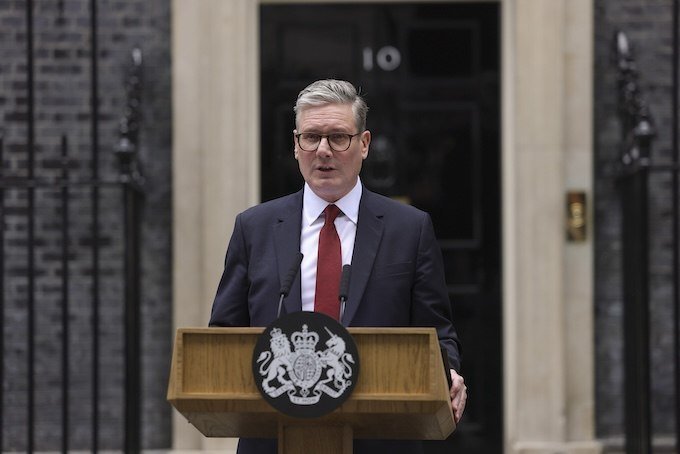
Keir Starmer at Number 10 Downing Street upon his appointment. Picture by Kirsty O’Connor/ No 10 Downing Street. OGL 3
But what we’re really seeing is a grotesque blend of the worst of Thatcherism with the worst of Blairism: bad aspects of “neoliberalism” coexisting with bad aspects of bureaucratic statism. The result combines top-down statist nitpicking with Thatcherite ownership models; corporate, Whitehall and town hall management structures amalgamating into a public-private-partnership blob….
After Labour’s disastrous performance in local elections in England and parliamentary elections in Wales and Scotland in May, it became highly likely that Keir Starmer’s days as prime minister were numbered. This proposition was confirmed by the result of the Makerfield byelection a few days ago in which the Greater Manchester mayor Andy Burnham (though he is Liverpudlian), widely tipped to launch a bid to overthrow Starmer as prime minister if he won the byelection and entered parliament, did so with a huge majority, tallying over 50% of the vote.
Before the byelection Starmer lurched, seemingly almost weekly, from one political stumble to another. Numerous “relaunches”, “rebrandings”, and “resets” followed these stumbles, along with renewed pledges with regard to “mission” and “delivery”. All to no avail. Management-speak could not cloak the paucity of significant policy proposals and their implementation. Beyond vacuous soundbites, there was simply no considered argument advanced on behalf of the “mission” and what “delivery” was really about.
The background to Starmer’s failure has been revealed by several biographies and accounts of his precipitous rise to power. Starmer became an MP in 2015, having been Director of Public Prosecutions from 2008 to 2013 (for which he received his knighthood). He was elected leader of the Labour party in 2020, following Jeremy Corbyn’s resignation after Labour’s defeat at the 2019 general election. Starmer campaigned for the party leadership under what soon turned out to be a false prospectus.
His leadership campaign hinged on Labour’s broadly social-democratic general election manifesto, which he promptly jettisoned once he won the leadership contest. He then purged the party of its leftists, with the aim of restoring Labour’s Blairite wing to ascendency within the party. Leaks and disclosures since the 2024 election indicate quite clearly that the Blairites plotted within Labour HQ to defenestrate Corbyn, while receiving considerable assistance from the UK’s overwhelmingly rightwing media when it came to smearing Corbyn and his supporters.
The Labour HQ plot had as its eminence grise Peter “Mandy” Mandelson, also known as “The Prince of Darkness”, until recently UK ambassador to the US (and before that a senior adviser to Tony Blair and member of Blair’s cabinet), before he was given the boot when the release of the Epstein Files showed his continued close association with Jeffrey Epstein even after the paedophilic financier had been jailed.
Mandy found a way to insert his protégé Morgan McSweeney into the prime minister’s office, where the latter ended up as Starmer’s chief of staff and ”ideas” man. With Mandy’s downfall, and the revelation that McSweeney and his team hastened Mandy’s ambassadorial appointment by shortcutting Mandy’s security vetting for this position, it didn’t take long before McSweeney was ushered out of 10 Downing Street. Many have concluded that Starmer, an ambitious technocrat with no real political convictions of his own (his wife Victoria says he hates political discussions!), had McSweeney lead him by the nose throughout. Starmer now vies with Macron for being the least popular European leader.
Labour was “elected” in 2024 with 66% of the parliamentary seats from 33% of the votes, and half a million fewer votes than when Jeremy Corbyn lost in a so-called landslide in 2019. To put it in a nutshell: 2 out of 3 voters voted against Labour in 2024, so Labour’s current large majority has an extremely shallow base.
This electoral shallowness was borne out in May’s local elections. The gloating Nigel Farage’s far-right Reform UK won hundreds of seats and control of more councils in England (Reform benefitting from the erosion of the Labour vote as progressive voters switched en masse to the Greens); in Scotland the Scottish National Party claimed a historic fifth victory; and in Wales the pro-independence Plaid Cymru ended a century of Labour dominance. In London, the Greens captured several councils across the capital (as well as the borough mayoralties of Hackney and Lewisham); the centrist Lib Dems made some gains in the south-east of England that had no decisive implications for the next general election, while the traditionally incumbent Conservatives were wiped-out as they managed to hold on to a few remaining “heartlands” that probably won’t survive the next two general elections or so (Tory voters are preponderately in the geriatric demographic, and a tier of younger rightwing voters has started to switch its allegiance to sharper-fanged politicians more adroit at dealing with a chaotic media ecosystem, such as Nigel Farage and the even further right Restore Britain. Those GenZers who incline to the left tilted towards the Green’s Jake Polanski, another media savvy politician). The Makerfield byelection however had Andy Burnham seeing off the far-right parties– Farage’s Reform as well as Restore combined failed to match Burnham’s vote tally.
Farage, ever the opportunistic grifter, even though he poses as a “man of the people”, tried to conceal receiving a £5m/$6.6m “donation” from a tax-evading British crypto billionaire domiciled in Thailand. Farage, a media hog whose forte is the daily press conference even when he has nothing to say, has been avoiding the media for weeks after his “donation” became public.
Even though midterm local elections and byelections are always difficult for the party in power, everything in these elections confirmed a deep and widespread disillusionment with a rudderless Labour (and a vitriolic animus towards Starmer in particular).
The 2026 local elections, and the Makerfield byelection (held in a former coalmining area around Wigan), confirmed the UK’s transformation into a multi-party democracy administered alas by a system set up for duopoly—these days it has become clear that the former duopolists, Labour and the Tories, have been joined by the 2 nationalist parties, the SNP and Plaid Cymru, the far-right Reform UK and farther right Restore Britain, and the centrist Lib Dems and centre-left Greens. This now anomalous voting structure is a sure-fire recipe for tactical voting, which in turn generates somewhat unpredictable voting outcomes. And of course, a multi-party system makes it more likely that there will be minority governments, thus increasing the likelihood of coalition governments.
The 2026 local elections led some pundits to speculate on the possibility of a Reform-Tory coalition should Reform not win an absolute majority in the 2029 general election. The Tories polled a mere 2.2% of the vote in the Makerfield byelection, and along with the unimpressive Reform vote, this scenario can be put to bed for now. The Greens were trounced in Makerfield, as their electoral base was depleted by tactical voters turning to Labour/Burnham to keep out the far-right parties.
The only way to curb such seeming electoral anomalies is to move to a system of proportional representation, but such a move is resisted—predictably– by the traditional duopolists (as mentioned, the complication here is that Reform has replaced the Conservatives as the UK’s second national party).
Among Labour’s many slipups, primacy must be given to its failure to deal with the cost-of-living crisis (food prices have increased by 50% in 5 years, exacerbated recently by the war on Iran). The UK has the most expensive rail tickets in Europe, without the accompanying standards of service. Utilities, privatised by the Tories from Thatcher onwards, are in desperate straits, as senior managers pocket stratospheric remuneration packages while their customers face rip-off prices. Thus, for example, England’s privatised water companies pump billions of gallons of sewage into rivers, lakes and coastal waters, while charging customers above-inflation rates for service.
Speculative profits face lower taxation rates (Capital Gains) than workers pay on their wages (Income Tax + National Insurance). Millions of full-time workers receive such low wages that shortfalls are made up by tens of billions of public spending on in-work benefits. 31% of British children grow up in poverty, with 75% of them living in working households!
Labour promised “change” when it took office in 2024, but fearful of the bond-market tyrants and their fans in the rightwing media, continued with its Tory predecessor’s austerity policies and wage suppression. At the same time, it has allowed rampant profiteering on the part of private landlords.
The UK has undergone a debilitating underinvestment for decades– its investment has been the lowest in the G7 for 24 of the past 30 years, resulting in chronic economic underperformance.
Labour needs to channel substantial investment directly to explicit goals (rather than mumbling vaguely about “delivery”), while using state capacity to transform the UK’s flatlining economy. Labour, however, is terrified of being labelled a “tax and spend” government, this nonsense being backed by the discredited superstition that a “big state” will crowd out supposedly “superior/more productive” investment by the private sector.
Don’t these people know, for example, that nearly all the world’s top-ranked airlines are owned by governments—Singapore Airlines, Emirates, Etihad, Qatar Airways, Turkish Airlines, and several Chinese airlines? I have travelled in all of them (bar Etihad), and vouch that no US or UK airlines, all privately-owned, can match their levels of service and comfort. Andy Burnham’s record of favouring public ownership as mayor of Greater Manchester may have helped him gain votes in the byelection.
Labour’s record in undoing the disastrous Thatcherite privatisations has been lamentable. Only the railways are a sector that has been significantly renationalized, as the majority of train operators are finally and belatedly taken into public ownership.
Starmer’s maladroit timidity as a politician (except when purging his party of leftists) is likely to see Burnham challenge him for the premiership in the coming months. For now we know very little about Burnham’s future political prospectus. However, we know he is an excellent political communicator, but also a slippery and chameleon-like operator who supported Blair’s Iraq war when he was last in parliament.
Starmer pledged to fight on, but resigned on Monday, when Burnham was sworn in as an MP. We await the next few weeks as politicians jostle for positions and favours, supporters are rewarded, advisers are chosen, and “democracy” thin as gruel is put on the table.
[ad_2]
Source link
