
[ad_1]
With carefully chosen words, presidents can inspire and shape American history, from George Washington’s farewell address to Abraham Lincoln’s remarks at Gettysburg to John F. Kennedy’s call to “ask what you can do for your country.”
Their words can also shape American history in darker ways, through falsehoods, sometimes knowingly told.
With the nation’s 250th anniversary upon us, we wondered: What if PolitiFact, founded in 2007, had been around for all of American history? What dubious claims needed to be called out?
As we looked into this question with presidential historians, we found recurring examples of U.S. presidents shading the truth, misleading the public or outright lying in ways that led the nation into war or sought to cover up domestic scandals.
We’ve assembled 11 examples of presidents being less than fully honest with the American people, with fateful consequences.
While the historical documentation is often spotty, it’s hard to prove that most of the following statements were clear lies — a word PolitiFact avoids using, for the most part.
Sometimes a president repeated inaccurate information from his staff. Sometimes the truth wasn’t clear at the time he spoke, or he gave it the most positive spin he could. Sometimes the president didn’t say anything per se, but rather left an inaccurate impression by omission. And sometimes the truth hung on “what the definition of ‘is’ is.”
RELATED: What we learned from our deep dive into presidential deception
With that in mind, here’s a chronological list of presidential falsehoods that had an impact on the nation’s 250-year history, and its psyche.
Note: This is a thought experiment; reasonable people can disagree about what deserves mention. If you think we missed one or got it right, email [email protected].
Jackson and the treaty that produced the Trail of Tears
One of the nation’s darkest moments came when Andrew Jackson signed the Treaty of New Echota in 1835 knowing that the signatories represented a minority of Cherokees rather than the tribe’s official leadership. This led to the Trail of Tears, in which thousands of Native Americans died while being forced to migrate westward off their historical lands. By one estimate, 4,000 Cherokees died, nearly one-fifth of their population
In discussing the treaty with the public, Jackson failed to mention the full context of who had signed it, making the portrayal “deceptive,” said Sean Wilentz, a Princeton University historian.
The official Cherokee chief, John Ross, called the treaty signers “a spurious delegation” who agreed to a “pretended treaty” by “false and fraudulent representations.” Ross’ letter called out Jackson and the lawmakers who allowed it to be enacted.
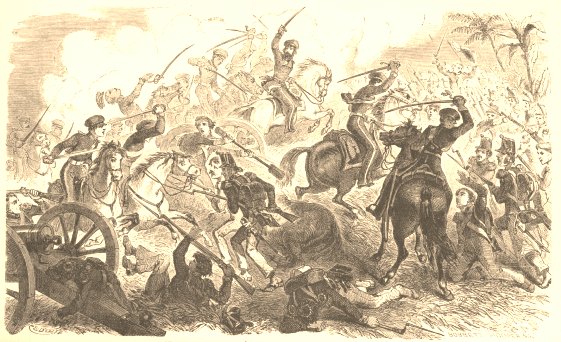
A portrayal of the Battle of Resaca de la Palma, Texas, in May 1846. (Public domain)
Polk’s justification for war with Mexico
In 1846, James K. Polk said that in a series of incidents that killed or injured dozens of American soldiers, Mexico had “shed the blood of our fellow-citizens on our own soil.” This became the pretext for the Mexican-American War, which was fought from April 1846 to February 1848. The U.S. won the war, acquiring 500,000 square miles from the Rio Grande to the Pacific Ocean; more than 10,000 U.S. troops died, the vast majority from illness.
The path to war began months before the fighting, when Polk ordered Gen. Zachary Taylor (who would succeed him as president) to “station his men on the banks of the Rio Grande in an area under dispute between the still-independent state of Texas and Mexico,” Eric Alterman, a Brooklyn College historian and professor of English and journalism, wrote in “Lying in State,” one of two books he’s written on presidential falsehoods. The casualties in this area became the spark for the war.
Despite knowing that the land was disputed, Polk framed it as blood shed on U.S. soil, justifying a military attack. Polk “would eventually go so far as to admit that the battle had taken place on ‘disputed’ rather than American soil,” Alterman wrote, but that was after the war concluded.
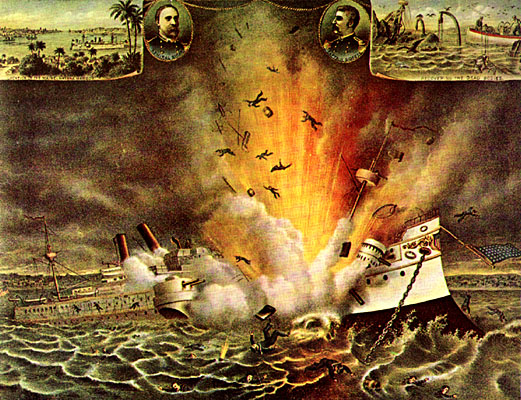
Explosion of the U.S.S. Maine, which triggered the Spanish-American War in 1898. (Public domain)
McKinley, the sinking of the Maine and war with Spain
In 1898, the USS Maine exploded in Cuba, killing 261 crew members. Pushed by a war-hungry media, William McKinley leveraged the incident into the Spanish-American War, even though historians generally believe the explosion was an accident, not an act of sabotage.
“The destruction of the Maine, by whatever exterior cause, is a patent and impressive proof of a state of things in Cuba that is intolerable,” McKinley wrote to Congress in seeking a declaration of war. “That condition is thus shown to be such that the Spanish government can not assure safety and security to a vessel of the American Navy in the harbor of Havana on a mission of peace, and rightfully there.”
Even though “it’s hard to locate an obvious lie among his explanations for the need for war in Cuba,” Alterman said, “McKinley caved into the hysteria manufactured by an increasingly irresponsible press.”
Truman and the bombing of Hiroshima
In 1945, Harry Truman announced the United States’ deployment of the world’s first atomic bomb by saying it was “dropped on Hiroshima, a military base.” It was a seminal moment for the world on the brink of the nuclear age, and it wasn’t the whole story of who would be affected.
Precise comparisons of military and civilian deaths are not available, but there’s broad agreement that most of the 66,000 deaths and 69,000 injuries were civilians, not troops.
Paul Finkelman, an Albany Law School emeritus professor of legal history, said it’s not clear how much Truman knew about the target, which was chosen by Army Chief of Staff George Marshall and Secretary of War Henry Stimson. Hiroshima was the command center for southern Japan, which made it “a significant military target,” Finkelman said.
Even if Truman did know, Finkelman said, “No country at war tells the rest of the world all the reasons for a particular target.”
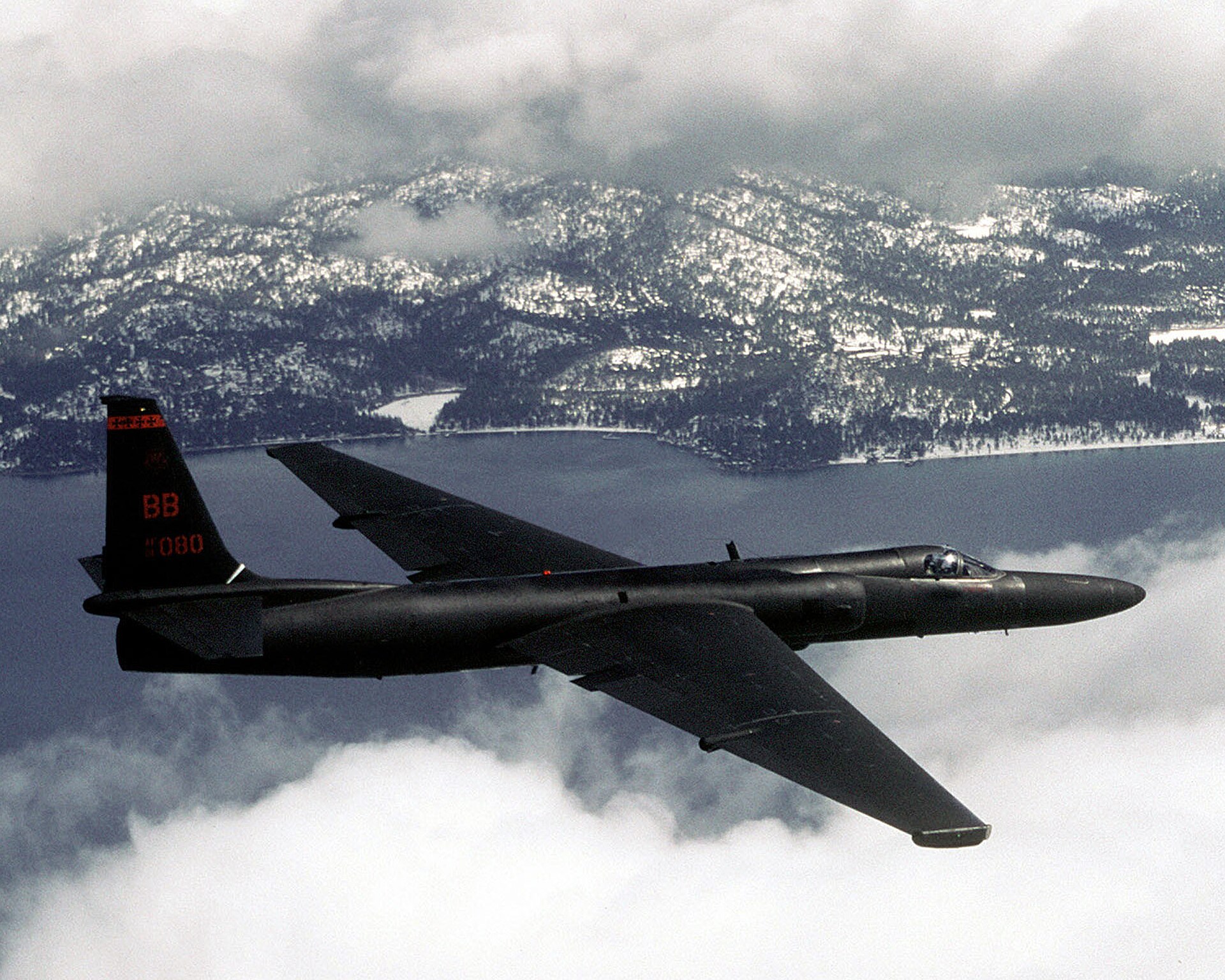
A U-2 reconnaissance aircraft in flight; this was the type of plane shot down over the Soviet Union in 1960. (U.S. Air Force)
Eisenhower and the downed spy plane
In 1960, Dwight D. Eisenhower said a U.S. spy plane shot down over Russia had been a weather research plane. Eisenhower had assumed the pilot had died and the plane had been destroyed, which he thought would make his remark harmless.
Within days, the Soviet Union produced the American pilot, initiating an international incident and exposing Eisenhower’s knowing falsehood.
Eisenhower regretted the incident, telling his secretary, “I would like to resign.”
How Johnson got the U.S. deeper into Vietnam
In 1964, Lyndon B. Johnson used a series of events in the Gulf of Tonkin to get Congress to approve a more extensive military conflict in Vietnam.
U.S. destroyers had reported an attack by North Vietnamese vessels, but evidence eventually emerged that there had not been an enemy attack.
Retired Naval Cmdr. Pat Paterson, a National Defense University professor, has written that documentary evidence about the Gulf of Tonkin incident makes it clear that “high government officials distorted facts and deceived the American public about events that led to full U.S. involvement in the Vietnam War.”
Johnson continued to be less than frank with the American public about the war as it went on.
“Private briefings painted a grim picture, and when he escalated the war, he deliberately downplayed what he was doing,” said John J. Pitney, a Claremont McKenna College politics professor.
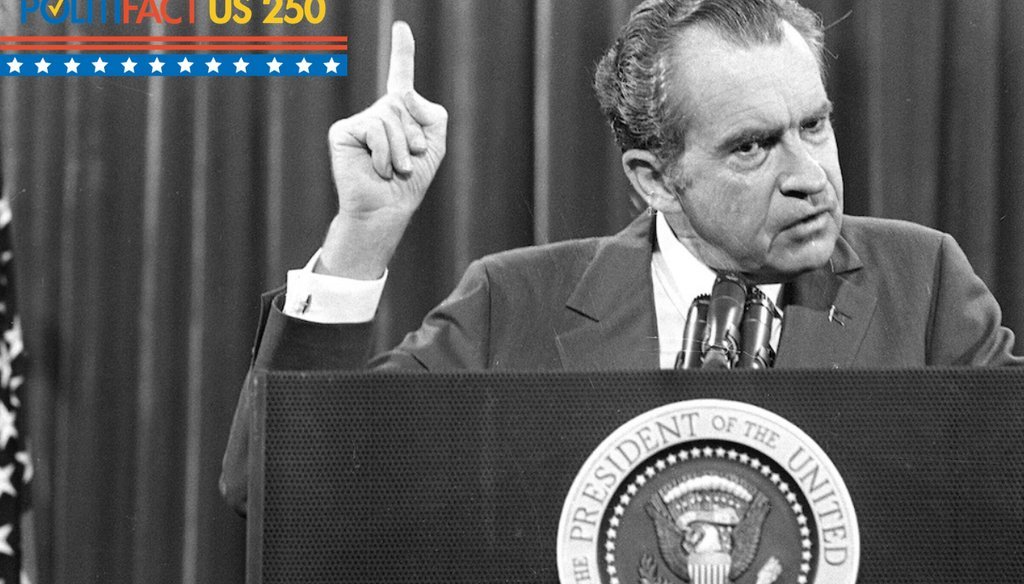
Nixon’s defenses about his role in Watergate
About 10 weeks after the Watergate break-in, Richard Nixon told reporters, “No one in the White House staff, no one in this administration, presently employed, was involved in this very bizarre incident.”
More than a year later, as the scandal was swelling, Nixon uttered the phrase that will indelibly be linked to him: “I am not a crook.”
Subsequent events, including his resignation in the face of impeachment, demonstrated that White House staff were clearly involved in the break-in and that Nixon might have been tried criminally had he not been pardoned.
Reagan and the Iran-Contra Affair
In 1986, Ronald Reagan addressed the nation amid questions about the Iran-Contra Affair, in which the U.S. sold arms to Iran and used the proceeds to support a rebel group in Nicaragua, contrary to U.S. law.
“We did not — repeat — did not trade weapons or anything else for hostages,” Reagan said.
The following year, he changed his story. Reagan said in an Oval Office address, “A few months ago I told the American people I did not trade arms for hostages. My heart and my best intentions still tell me that’s true, but the facts and the evidence tell me it is not.”
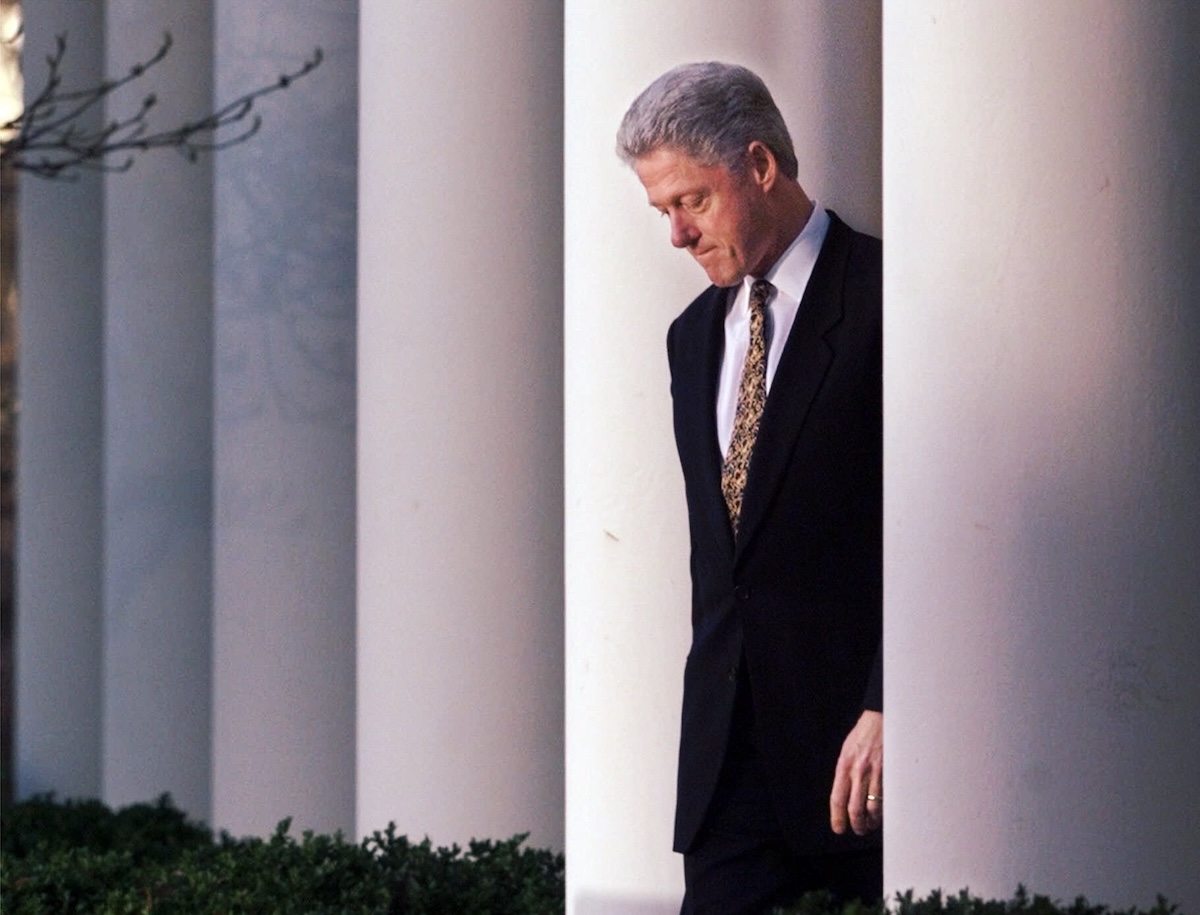
President Bill Clinton walks to the podium to deliver a short statement on impeachment on Dec. 11, 1998. (AP)
Clinton’s denial that he had sex with Monica Lewinsky
As Bill Clinton was fending off allegations that he had a relationship with a former White House intern, Monica Lewinsky, he addressed reporters in January 1998. Clinton said, “I did not have sexual relations with that woman, Miss Lewinsky.”
The truth of that statement hung on hairsplitting whether oral sex counts as “sexual relations” and “what the meaning of ‘is’ is” (as he told a grand jury).
Clinton later acknowledged he’d been intimate with Lewinsky. The American public was in a forgiving mood — voters punished congressional Republicans for trying to impeach him in the 1998 midterm elections. Political scientists say the episode contributed to public cynicism in the longer term, and Clinton’s post-presidential reputation has suffered from the scandal.
Bush’s misleading statements about Iraq
For about a year after the 9/11 attacks, George W. Bush built the case for waging war against Iraq on its ability to deploy weapons of mass destruction.
In a 2002 speech in Cincinnati, for instance, Bush said, “The evidence indicates that Iraq is reconstituting its nuclear weapons program. … Satellite photographs reveal that Iraq is rebuilding facilities at sites that have been part of his nuclear program in the past.”
Bush added that Iraqi leader Saddam Hussein “could have a nuclear weapon in less than a year” and that “facing clear evidence of peril, we cannot wait for the final proof, the smoking gun that could come in the form of a mushroom cloud.”
When U.S. troops entered Iraq, they didn’t find evidence to support such claims.
George Mason University historian James Pfiffner has analyzed the evidence and concluded that Bush “misled the country in important ways, potentially undermining the trust of the citizenry.” However, Pfiffner also concluded that Bush based his comments on misleading evidence from intelligence officials, who “may have been under unusual pressure to support the administration’s goals.”
Donald Trump’s ‘rigged’ election allegations
Trump has told an unusually large number of falsehoods in office, but the most pervasive — and historians say, problematic — is that he won the 2020 presidential election over Joe Biden. He first claimed this on election night, and has repeated it, or the related claim that the election was “rigged,” on many other occasions. It also led to the Jan. 6 Capitol attack.
RELATED: PolitiFact’s fact-checks of Barack Obama
RELATED: PolitiFact’s fact-checks of Joe Biden
RELATED: PolitiFact’s fact-checks of Donald Trump
[ad_2]
Source link
