
[ad_1]
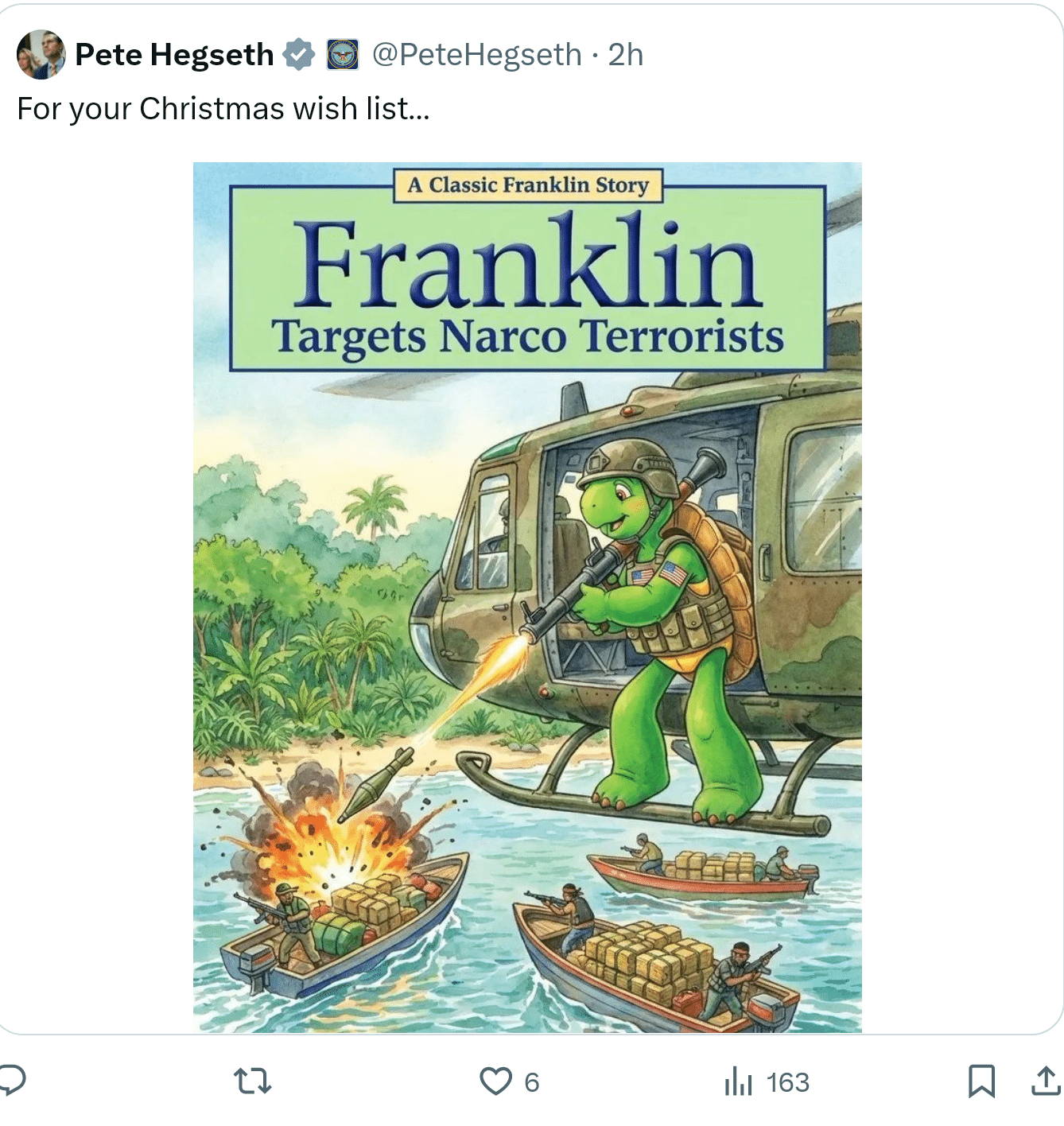
President Trump effectively claims that he is entitled to preemptively kill suspected drug traffickers anywhere on earth, or at least in the Western Hemisphere. The U.S. military has killed hundreds of people in its attacks on suspected smugglers’ boats off the coast of South America.
Secretary of War Pete Hegseth proclaimed that illicit drugs are “tantamount to chemical weapons” and the dead suspects “are the al-Qaeda of our hemisphere, and we are hunting them with the sophistication and precision that we hunted al-Qaeda.” Anyone whom the U.S. military killed is automatically posthumously designated a narco-terrorist.
If the U.S. government is entitled to summarily kill suspected drug traffickers abroad, there is no reason why the same prerogative would not eventually be invoked on the home front. If politicians truly want to protect Americans, why not authorize the U.S. military, state police, and county government dog catchers to summarily attack any boat suspected of transporting drugs on the nation’s lakes, rivers, or overgrown puddles?
Actually, such warped logic has already been taken to absurd ends. The core follies of the Trump-Hegseth war of extermination on drug suspects were established almost a quarter-century ago. American illicit drug users miraculously became collectively guilty for every terrorist attack in the world. In December 2001, three months after the 9/11 attacks, President George W. Bush announced .to antidrug groups in Washington: “It’s so important for Americans to know that the traffic in drugs finances the work of terror, sustaining terrorists, that terrorists use drug profits to fund their cells to commit acts of murder. If you quit drugs, you join the fight against terror in America.”
A few weeks later, the White House Office of National Drug Control Policy spent $3 million for two television ads to appear during the Super Bowl. One ad asked viewers: “Where do terrorists get their money?” The answer: “If you buy drugs, some of it might come from you.” Drug users were portrayed as terrorist financiers—practically the moral equivalent of the hijackers who destroyed the World Trade Center towers. Cameos showed young people confessing what their illicit drug purchases had accomplished:
Teen #1: I helped murder families in Colombia.
Teen #2: I helped the bomber get a fake passport.
Teen #3: I helped kill a judge.
Teen #4: I helped blow up buildings.
The ad purported to show the different costs that go into a drug smugglers’ operation. One item that flashed briefly on the screen was $3,000 for bribes. The ad did not mention who was being bribed—whether it was the U.S. Coast Guard, or the Customs Service, or perhaps foreign government officials. The ad also flashed an item “boxcutters: $2”—encouraging viewers to wrongly presume that the 9/11 hijackers relied on drug financing.
On February 12, 2002, President Bush announced: “If you’re buying illegal drugs in America, it is likely that money is going to end up in the hands of terrorist organizations. . . . When we fight drugs, we fight the war on terror.”
Drug Czar John Walters, appearing at a White House press briefing the same day as Bush’s declaration, was badgered about the president’s assertion. A reporter asked “But in terms of a percentage of overall drug trade, what percentage of the money goes to terrorists, to put it in perspective? . . . I mean, is it a penny on a dollar, is it a penny on $1,000, or is it a dime on a dollar?”
Walters responded: “I think the truth is, since we don’t know exactly the budgets of all the terrorist organizations, and we don’t know the—they don’t have to submit their budget to the White House press corps. But of the— the Americans spend, we estimate, $66 billion on drugs. We know that hundreds of millions of those dollars go to organizations that have been identified as terrorist and drug-related. I can’t tell you what percentage because that would require a level of knowledge we don’t have.”
The White House drug czar’s website, www.theantidrug.com, announced plans to capitalize on 9/11: “From this tragedy we must re-energize efforts to prevent drug use. . . . The September 11 terrorist attack deeply touched the emotions of Americans. Connecting terrorism to drug trafficking also is a subject that has great emotional impact.”
The website declared: “We must recognize that when money goes from the pocket of an American to buy drugs it could end up financing unspeakable crimes around the world.” But the same is true when money goes from the pocket of an American to pay federal taxes, since the U.S. government bankrolls some of the world’s most oppressive regimes.
The DEA opened a new exhibit at its headquarters museum titled “Target America” just before the first anniversary of the attacks. A large hunk of twisted metal wreckage recovered from Ground Zero at the World Trade Center was the exhibit’s centerpiece. Attorney General John Ashcroft declared at the opening of the exhibit: “Law enforcement has long known about the strong linkages between terrorism and drug trafficking. And September 11th made that awareness available to a wider audience of Americans to see that the drug threat and the terrorist threat are largely one and the same.” But the feds never provided any evidence showing that even 1 cent of the $500,000 that Al Qaeda used to pull off the 9/11 attacks came from drug trafficking.
There was no evidence that any U.S. drug purchase ever helped finance an international terrorist attack on the United States. On September 1, 2002, DEA chief Asa Hutchinson announced: “There is increasing intelligence information from the investigation that for the first time alleged drug sales in the United States are going in part to support terrorist organizations in the Middle East.” However, the hot case turned out to be little more than a cabal of people who were buying popular cold and allergy medications in Canada and using them to extract ingredients to produce methamphetamine, known as “crystal meth.” Some of the proceeds of their sales were sent to the Middle East. Assistant Attorney General Michael Chertoff stated in April 2003 that no terrorism charges had been filed against the people involved in the case.
Unfortunately, “terrorism” is an incantation that automatically expunges the minds of many listeners and viewers. The first attack in the Trump-Hegseth assaults near Venezuela occurred on September 2, 2025. Including the second strikes to kill survivors, the attack left 11 people dead. Trump announced that everyone who had been killed was “positively identified Tren de Aragua Narcoterrorists,” and thus was guilty as a member of a “designated Foreign Terrorist Organization.” But why would 11 people be on a small boat smuggling drugs?
According to Nick Turse’s recent report in The Intercept, a rear admiral admitted in a classified Capitol Hill briefing after the attack that some of the casualties may have been human trafficking victims. But don’t expect to hear about that at any of Hegseth’s press briefings.
Most of the media and almost all politicians have zero curiosity regarding who the U.S. government is killing in the name of fighting drugs. Unfortunately, that is the clearest and most toxic parallel with the war on terror and the automatic absolution that the Pentagon and CIA receive for killing anyone posthumously labeled a terrorist suspect.
[ad_2]
Source link
