
[ad_1]
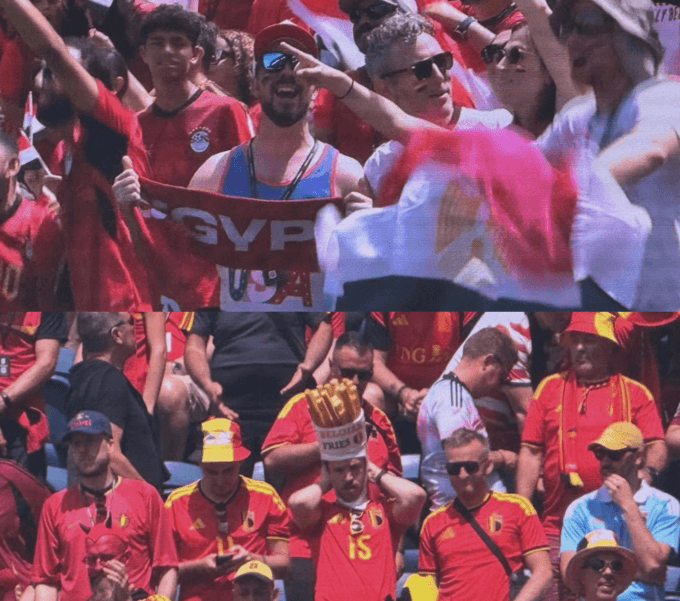
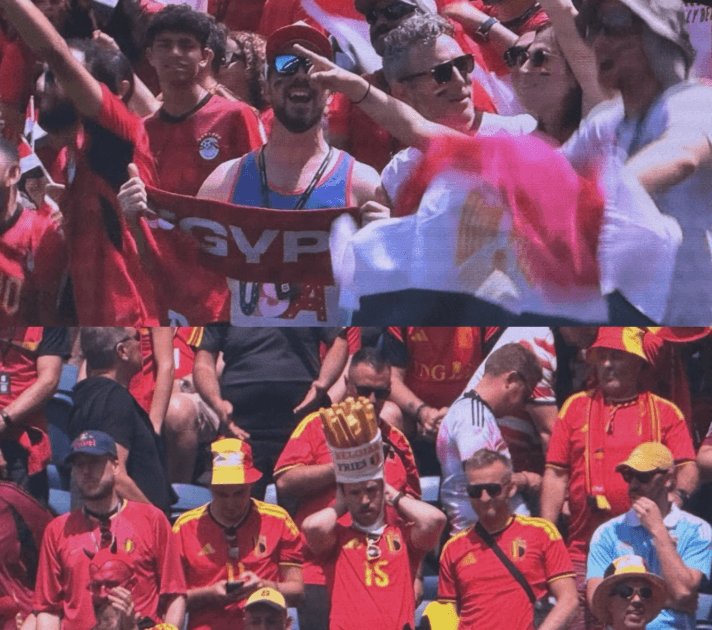
Fans of Egypt and Belgium at the World Cup. (Screengrab.)
What do the World Cup group stage and the Iran War ceasefire deal have in common? Not much at first glance: one is an international sports tournament based on peaceful competition among nations, and the other emerged from a violent cataclysm that has left thousands dead and infrastructure destroyed in a dozen or so nations.
But at second glance, both outcomes have lessons for major powers that are used to domination. The first 2026 World Cup match I watched on TV was Brazil-Morocco, which the powerhouse Brazil should have won, so the 1-1 draw was perceived by both sides as a victory for the top African team.
Draws have now become an early pattern in this tournament group stage, with a lesson attached: A draw for the underdog is a victory over the powerful. I took these photos in Seattle of chagrined Belgium fans—wearing frites (fries) headgear—mourning their 1-1 draw with less-favored Egypt, as the joyous Egypt fans celebrated.
Then tiny Cape Verde drew with mighty Spain, and (shock of shocks) the Democratic Republic of the Congo drew with Ronaldo’s top team Portugal.
This pattern of draws is especially poignant when the heavily favored are the historic colonizers (or other wealthy countries), and the underdogs are the former colonies. Egypt had enormous support in the Seattle crowd, perhaps because the fans understood this asymmetrical power relationship, which makes for good sports drama.
At third glance, the outcome of the Iran War follows a similar pattern. The U.S. and Israel attacked what they perceived as a weakened Iran, with a deeply unpopular regime, a strangled, sanctioned economy, based on vulnerable oil infrastructure, next to wealthier Gulf neighbors, and besieged by enormous U.S. military bases.
In the course of a few weeks, Iran turned most of these deficits into assets, and leveraged the strengths of its enemies into their weaknesses. It leveraged its own geographical position, by closing the Strait of Hormuz shipping chokepoint, and counterattacking against the military bases, and the oil industries of the states that hosted them.
Iran’s propaganda machine leveraged rising gas prices, the growing unpopularity of Trump’s regime, and his party’s vulnerability in the looming midterms. At the same time, by demanding that the Israeli occupation of southern Lebanon be made part of the deal, Tehran managed to drive an unexpected wedge between Trump and Netanyahu. It remains to be seen if this wedge develops into a historic break between the U.S. and its Israeli aircraft carrier, or if Israel (with its Republican and Democratic allies in Congress) sabotages the peace deal to resume the war.
Given the massive destruction and loss of lives in Iran, the Islamabad Memorandum of Understanding is not a victory for either side, even though its terms are more favorable to Iran than Obama’s 2015 nuclear deal. After Trump tore up that deal, Iran pursued uranium enrichment not to build a nuclear bomb, but to build up chips as pressure to lift the sanctions. If the regime can cash in those chips in the months ahead, it can offer economic relief to the Iranian people, and perhaps survive their growing disdain.
So whether it’s underdog teams drawing at the World Cup, or a besieged Middle Eastern power drawing with the most powerful militaries in the region, the system of global apartheid is being challenged at all levels. Just as the British discovered in the 1956 Suez Crisis, all empires eventually fall under their own weight and overextension. When their opponents target this top-heaviness with jujitsu tactics that turn their very strengths into heavy costs, the impunity of empire falls that much sooner.
If the U.S. domination of the Persian Gulf began with the CIA coup that overthrew Iran’s democracy in 1953, perhaps it is ending in Iran in 2026, lessening the pressure on the region and enabling new forms of governance to eventually emerge from the chaos. Tehran could no longer point to foreign enemies to justify its repression, and the Gulf states and Israel could no longer point to Washington to back up their repression. The United States could become a relatively more normal country, tending to its own problems and unresolved histories at home.
Whether drawing at the World Cup, or in a regional war, the trend is toward challenging global inequalities, which means that new teams could rise to the top to savor their place in the sun, and help make the world slightly more peaceful and just.
[ad_2]
Source link
