
[ad_1]
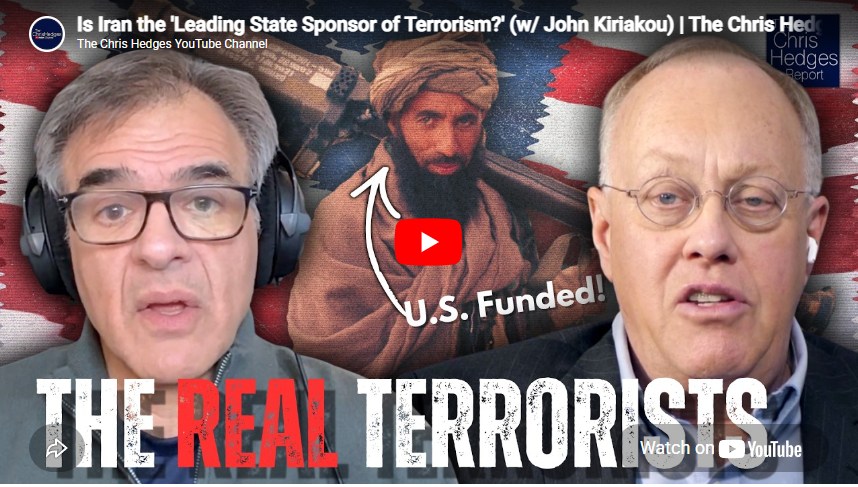
Chris Hedges and John Kiriakou challenge the administration’s narrative and invite listeners to reconsider the assumptions behind the “state sponsor of terrorism” label.
Iran says that its support for resistance groups like Hamas and Hezbollah, framed as threats and terrorists by Israel and the West, is not part of the deal the U.S. and Tehran are expected to sign this Friday, though it had long been a point the U.S. and Israel insisted on. U.S. negotiators may still try to raise it. The following interview illuminates the view put forth in this recent CN piece: Who Is the Aggressor? Turning Obstacles into Threats. It is perhaps the most important misconception in the West, purposely promulgated to justify U.S. and Israeli aggression and occupation in the region.
By ScheerPost Staff
ScheerPost
I n a recent episode of The Chris Hedges Report, C.I.A. whistleblower John Kiriakou joins Chris Hedges to critically examine the Trump administration’s effort to brand Iran as the world’s leading sponsor of terrorism. This label, Kiriakou argues, ignores decades of U.S. involvement in violent proxy operations worldwide and oversimplifies complex regional dynamics.
The administration has been pressuring allied nations to designate Iran’s Revolutionary Guard Corps, along with Hezbollah in Lebanon and Hamas in Palestine, as terrorist organizations. Officials cite Iran’s support for these groups as proof of its threat, often framing it as ideologically driven or nihilistic. Kiriakou challenges this framing, pointing out that these groups arose as resistance movements fighting occupation and foreign influence, rather than as indiscriminate terrorist networks.
Historical Context: America’s Double Standard
The conversation quickly turns to U.S. foreign policy, highlighting its long history of supporting violent actors abroad. From funding the Contras in Nicaragua to aiding anti-Castro operatives responsible for bombing civilian targets, Kiriakou notes that the U.S. has repeatedly backed groups using violence for political ends. Even during the Cold War, the C.I.A. financed “right-wing terrorist organizations” in Europe and armed militias in Latin America, demonstrating that state sponsorship of violence is not unique to Iran.
“This designation has become meaningless,” Kiriakou says, “because it has been used as a cudgel against countries whose policies we dislike.” He emphasizes that political calculations—not objective definitions of terrorism—drive these labels.
Israel’s Role & the M.E.K.
Kiriakou and Hedges also examine Israel’s involvement in shaping U.S. policy toward Iran. Israel, Kiriakou notes, benefits from regional chaos and has engaged in targeted assassinations and covert operations against Iranian officials abroad. This strategy, he argues, contrasts with Iran’s more defensive posture and has long-term destabilizing effects.
The episode also delves into the Mojahedin-e-Khalq (M.E.K.), a cult-like anti-Iranian organization once officially labeled a terrorist group. Kiriakou explains how the M.E.K. leveraged political connections and lobbying in Washington to have its designation lifted, highlighting the influence of U.S. political networks in defining “terrorism” selectively.
Missed Opportunities for Cooperation
Kiriakou laments opportunities lost for U.S.-Iran collaboration in counterterrorism, narcotics interdiction, and regional stability. He recalls historical moments when the U.S. could have partnered with Iran to fight common threats, from the rise of the Taliban to drug trafficking through Afghanistan. Instead, aggressive policies, sanctions, and covert operations have fueled mutual distrust and heightened tensions.
The Blowback Risk
The discussion concludes with warnings about unintended consequences. Kiriakou stresses that U.S. and Israeli aggression could provoke retaliatory action from Iran, potentially targeting American interests abroad. “For the average Iranian, it is better to live with the system they have than risk chaos imposed by a foreign intervention,” he notes, emphasizing that targeted assassinations often harden opponents and strengthen extremist elements rather than weakening them.
Key Takeaways from the Episode
- Iran’s support for proxy groups is a defensive, liberation-driven policy, not nihilistic terrorism.
- U.S. support for violent groups globally undermines its moral authority to label others as “terror sponsors.”
- Israel’s regional strategy relies on chaos, not stability, and has significant influence over U.S. policy.
- Mislabeling groups like the M.E.K. demonstrates how political lobbying can distort official narratives.
- Aggressive policies risk blowback, strengthening hardliners and escalating conflicts rather than resolving them.
This episode of The Chris Hedges Report challenges conventional narratives about Iran, terrorism, and U.S. foreign policy. By situating Iran’s actions within a broader historical and geopolitical context, Hedges and Kiriakou invite listeners to reconsider the assumptions underpinning the “state sponsor of terrorism” label, highlighting the complex, often self-serving nature of global power dynamics.
Chris Hedges is a Pulitzer Prize–winning journalist who was a foreign correspondent for 15 years for The New York Times, where he served as the Middle East bureau chief and Balkan bureau chief for the paper. He previously worked overseas for The Dallas Morning News, The Christian Science Monitor and NPR. He is the host of show The Chris Hedges Report.
This article is from ScheerPost.
The views expressed are solely those of the author and may or may not reflect those of Consortium News.
[ad_2]
Source link
