
[ad_1]
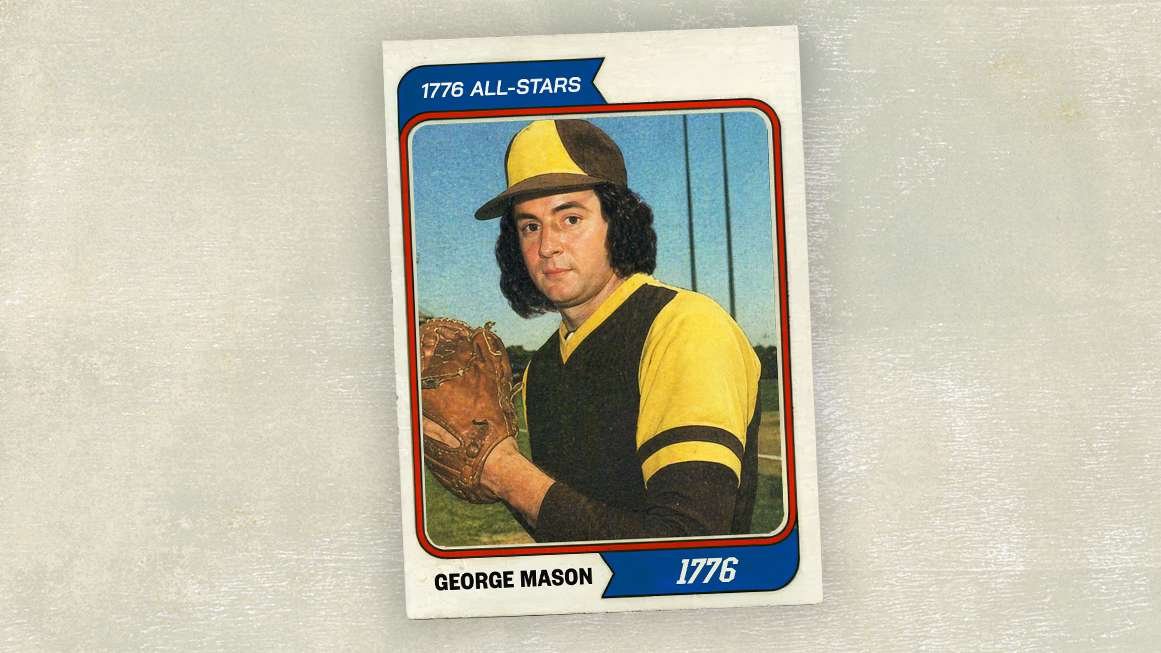
This is part of 1776 All-Stars, a series about Reason‘s top American Founders. Read more here.

George Mason was not the greatest, the most admirable, or the most influential of the Founding Fathers. But he made enormous contributions that are often underrated. And I’m not saying that just because I teach at the university named after him. Mason was the principal drafter of the 1776 Virginia Declaration of Rights, which became a key model for the other state constitutional bills of rights, and eventually for the federal Bill of Rights. Later, he was one of three members of the Constitutional Convention who refused to sign the document. Afterward he opposed ratification. Not all his objections to the Constitution were sound, but several were compelling and prescient.
Mason was a prominent Virginia landowner and political leader. In the 1760s and 1770s, he helped lead opposition to Britain’s increasingly oppressive trade restrictions, attacks on civil liberties, and other unjust policies. After war broke out in 1775, he advocated independence. In 1776, as a legislator in Virginia’s House of Burgesses, Mason became the principal drafter of the Virginia Declaration of Rights and the first Virginia Constitution. The Virginia Declaration guaranteed such crucial rights as freedom of press, freedom of religion, protection for private property, protection against cruel and unusual punishment, and procedural rights for criminal defendants, including a speedy trial and trial by jury.
After the war, Mason believed the United States needed a stronger federal government than that provided for under the Articles of Confederation, but he also wanted tight limits on federal power and strong protections for individual liberties. He was a key member of the Virginia delegation to the Constitutional Convention of 1787. But he ultimately rejected the Constitution.
Some of Mason’s objections were off base. For example, he wrongly predicted that the federal courts would “absorb and destroy the judiciaries of the several States.” That obviously has not happened. He was also wrong to fear that the Constitution would produce a “monarchy” or a “tyrannical aristocracy,” though perhaps the jury is still out on that one. On the other hand, Mason was absolutely right to criticize the absence of a bill of rights and, more generally, to say there were insufficient protections for individual liberty. His opposition on that point helped inspire the movement to enact the federal Bill of Rights.
Mason presciently warned that the seemingly unlimited nature of the president’s pardon power was a mistake, fearing that “the unrestrained power of granting pardons for treason…may be sometimes exercised to screen from punishment those whom [the president] had secretly instigated to commit the crime.” This is almost exactly what President Donald Trump has done in pardoning the perpetrators of the January 6, 2021, attack on the Capitol, except that there was nothing secret about his instigation of that crime.
Mason was also right to condemn the Migration or Importation Clause, which kept Congress from banning the international slave trade until 1808. At the Virginia ratifying convention, he stated that the “augmentation of slaves weakens the states; and such a trade is diabolical in itself, and disgraceful to mankind.” From 1787 through 1808, some 100,000 slaves were imported into South Carolina and Georgia alone. In addition to the horrific violation of the human rights of these particular slaves, the increase in the slave population further entrenched the institution of slavery and made it more difficult to abolish.
Throughout his political career, Mason also denounced the institution of slavery as a whole, not just the international slave trade. In 1773, he called slavery “that slow Poison, which is daily contaminating the Minds & Morals of our People. Every Gentlemen [sic] here is born a petty Tyrant.” He knew that slavery “trample[s] upon the Rights of Human Nature” and emphasized that it had led white Virginians to “lose that Idea of the Dignity of Man, which the Hand of Nature had implanted in us.” Like many other Founding Fathers, Mason knew that slavery was a horrific injustice, contrary to the universalist liberal principles for which they had fought the Revolutionary War.
And yet, like Thomas Jefferson, George Washington, and many other Founders, Mason owned numerous slaves throughout his adult life. He did not free them even in his will. Even as he rightly criticized the Constitution for protecting the slave trade until 1808, he also lamented that it supposedly did not provide adequate protection for slaveholders’ rights to “the property of the slaves we have already,” apparently fearing that the federal government might be able to impose severe taxes on slave property.
This grave failure to live up to his own principles is a serious black mark on Mason’s record. To say so is not to judge him by “anachronistic” modern standards. He himself well knew that slavery was horribly unjust and often said so. Mason wrote that slavery was a “national sin” that could be punished by a “national calamity,” as eventually happened with the Civil War. It was also a personal sin of his.
We cannot forget or forgive this aspect of his record. But Mason and other Founders’ advocacy of liberty also helped bring forward the abolition of slavery. And he did much to advance liberty and justice in other ways. For these reasons, he deserves to be remembered as one of the greatest Founders.
1776 All-Stars, a series about Reason staffers’ favorite American Founders:
[ad_2]
Source link
