
[ad_1]
Kenneth Carlson ScheerPost
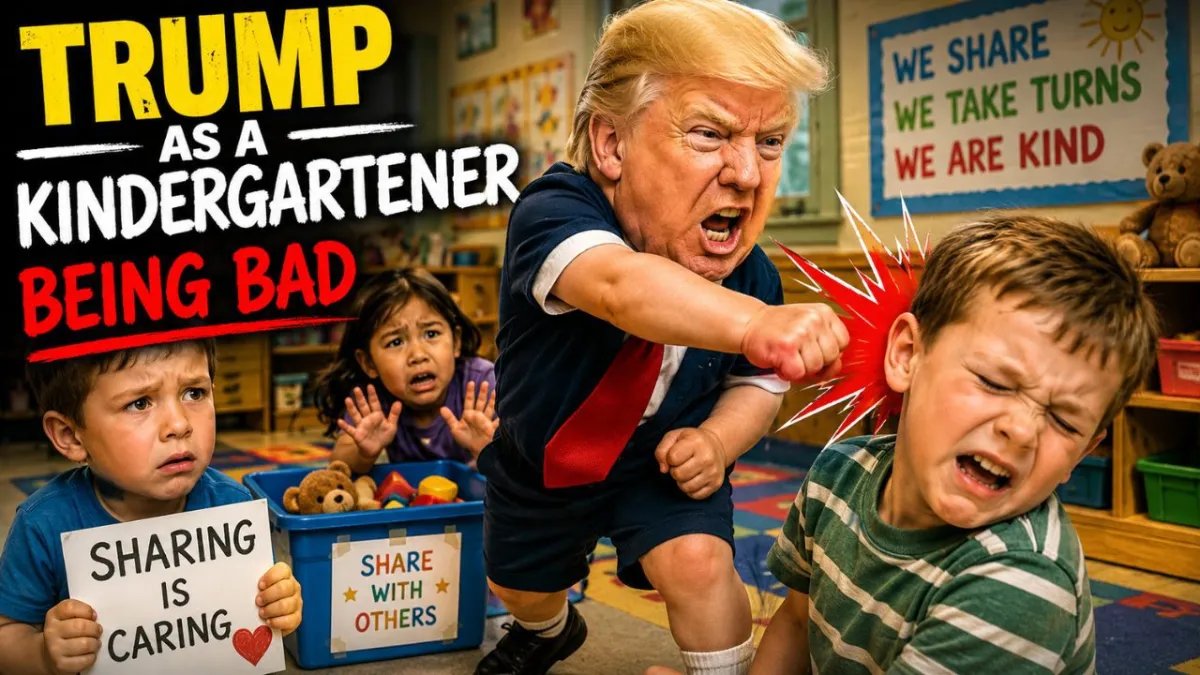
There was a time in America when the moral instruction offered to children in kindergarten sounded almost embarrassingly simple. Share. Be kind. Play fair. Clean up your messes. Say you’re sorry.
Then adulthood arrived, followed by cable news, social media, billionaires with rocket ships, and eventually Donald Trump — a man who somehow transformed every kindergarten rule into a governing strategy for doing the exact opposite, which raises an uncomfortable question for the rest of us: What happens when the President of the United States behaves like the child who would have been sent to the principal’s office for the entire school year?
In All I Really Need to Know I Learned in Kindergarten, author Robert Fulghum arguesd that civilization depends on a handful of foundational virtues learned before age six. The book was published the same year I graduated from Brown University, and I remember reading it and thinking, Why the hell didn’t I think of this? Its genius was its simplicity: profound truths hiding in plain sight, disguised as kindergarten wisdom. Reading the book today feels less like nostalgia and more like a constitutional warning label.
Take the very first lesson: Share everything.
America once understood that prosperity worked best when broadly distributed. Roads, schools, libraries, parks, vaccines, scientific research — these were collective investments. Trumpism, by contrast, often resembles a nationalized version of Monopoly played by a man who pockets the Community Chest cards and then complains that poor people are freeloaders.
Even the language is revealing. Tax cuts for billionaires become “freedom.” Student debt relief becomes “socialism.” Environmental protections become obstacles to quarterly earnings reports. The underlying ethic is not stewardship but acquisition. Whoever dies with the most golf courses wins.
Then there’s the second lesson: Play fair.
This one appears to have troubled Trump for decades. The man approaches rules the way a kindergartner approaches the instruction “Do not touch”— as a dare rather than a direction.
Courts are legitimate only when they agree with him. Elections are fair only when he wins them. Prosecutors are heroes when targeting opponents and villains when targeting him. In kindergarten terms, Trump insists on being both the referee and the child flipping the board game onto the floor because he landed on Park Place bankruptcy.
And yet millions admire this behavior precisely because it looks like strength. But fairness is not weakness. It is the operating system of democracy. Without trust in shared rules, societies begin to resemble demolition derbies with flags attached.
The third lesson may be the most urgent: Don’t hit people.
No, Trump is not literally punching classmates at recess. But political violence begins long before fists fly. It begins with humiliation. Dehumanization. Cruel nicknames. Public lbl. Threats wrapped in jokes. Citizens turned against one another for sport and ratings.
Trump has understood something elemental about modern media: outrage is profitable. Rage keeps eyeballs glued to screens. And so America has become emotionally concussed, trapped in a permanent national food fight where compromise is betrayal and empathy is mocked as weakness.
Even our vocabulary has changed. Political opponents are now “enemies,” journalists are “the enemy of the people,” immigrants are “poisoning the blood,” and disagreement itself becomes treasonous. History suggests that when nations start speaking this way, they rarely drift someplace healthy afterward.
Then comes perhaps the most underrated kindergarten principle of all: Put things back where you found them.
Respect institutions. Leave the classroom intact for the next group of children. Trump treats our democratic institutions the way a child treats a game of Monopoly when he’s losing: rewrite the rules, grab money from the bank, and flip the board when things don’t go his way. Norms that took generations to build were discarded almost casually: respect for election outcomes, independence of the judiciary, trust in alliances, faith in expertise, basic standards of truthfulness.
And here is the maddening part: institutions are boring until they break. Democracy is like plumbing. Nobody applauds it when it works. But once sewage starts backing up into the living room, suddenly everyone becomes very interested in infrastructure.
Which leads naturally to lesson five: Clean up your own mess.
This may be the least Trumpian sentence ever written:. When things go badly, it is always someone else’s fault: the media, immigrants, Democrats, judges, scientists, generals, pollsters, windmills, sharks, electric boats, low-flow toilets. One half might expects Trump to blame Lincoln for the Civil War.
Children instinctively understand accountability better than many adults in Washington. A five-year-old caught drawing on the wall at least has the decency to look nervous. Trump often responds to scandal with the emotional confidence of a man insisting the ketchup threw itself at the wall.
Lesson six: Don’t take things that aren’t yours.
This applies not merely to property but to truth, power, dignity, and the rule of law itself. Democracy depends on restraint — the understanding that power is temporarily borrowed, not permanently owned. Trump has often behaved less like a steward of democratic institutions than a landlord furious that tenants expect rights.
The impulse appears everywhere: attacks on voting systems, pressure campaigns against officials, disregard for ethical boundaries, appropriation of patriotic symbolism while undermining the democratic processes that give those symbols meaning.
Patriotism without democratic ethics is just branding.
And finally, the lesson most absent from modern American politics: Say you’re sorry when you hurt somebody.
Trump’s political superpower may be his almost supernatural inability to apologize. To admit fault, in his worldview, is to surrender dominance. And so the country lurches from controversy to controversy without reflection, repair, or reconciliation. But apology is not weakness. It is social glue. Nations survive because human beings occasionally decide relationships matter more than ego.
And perhaps we should end with one final kindergarten lesson from Fulghum that Trump actually seems deeply committed to honoring: Take a nap every afternoon.
The trouble is that democracy requires the adults to stay awake. To be fair, Trump has been remarkably consistent. Courtrooms, meetings, speeches, international gatherings, if there is a chair and enough time, the President seems willing to test its sleep-inducing properties.
Unfortunately, the rest of us don’t get to nap through the consequences.
Fulghum understood that civilization rests on simple childhood virtues: honesty, fairness, kindness, responsibility. The danger facing America is not merely that we elected a man who never learned those lessons. It’s that millions of grown-ups now cheer when he breaks them.
It’s that millions of grown-ups now cheer when he breaks them.
Fulghum understood that civilization is little more than people choosing, every day, to share, tell the truth, play fair, and clean up their own messes.
The frightening question facing America is not whether children still learn those lessons.
It’s whether adults still believe in them.
[ad_2]
Source link
