

[ad_1]

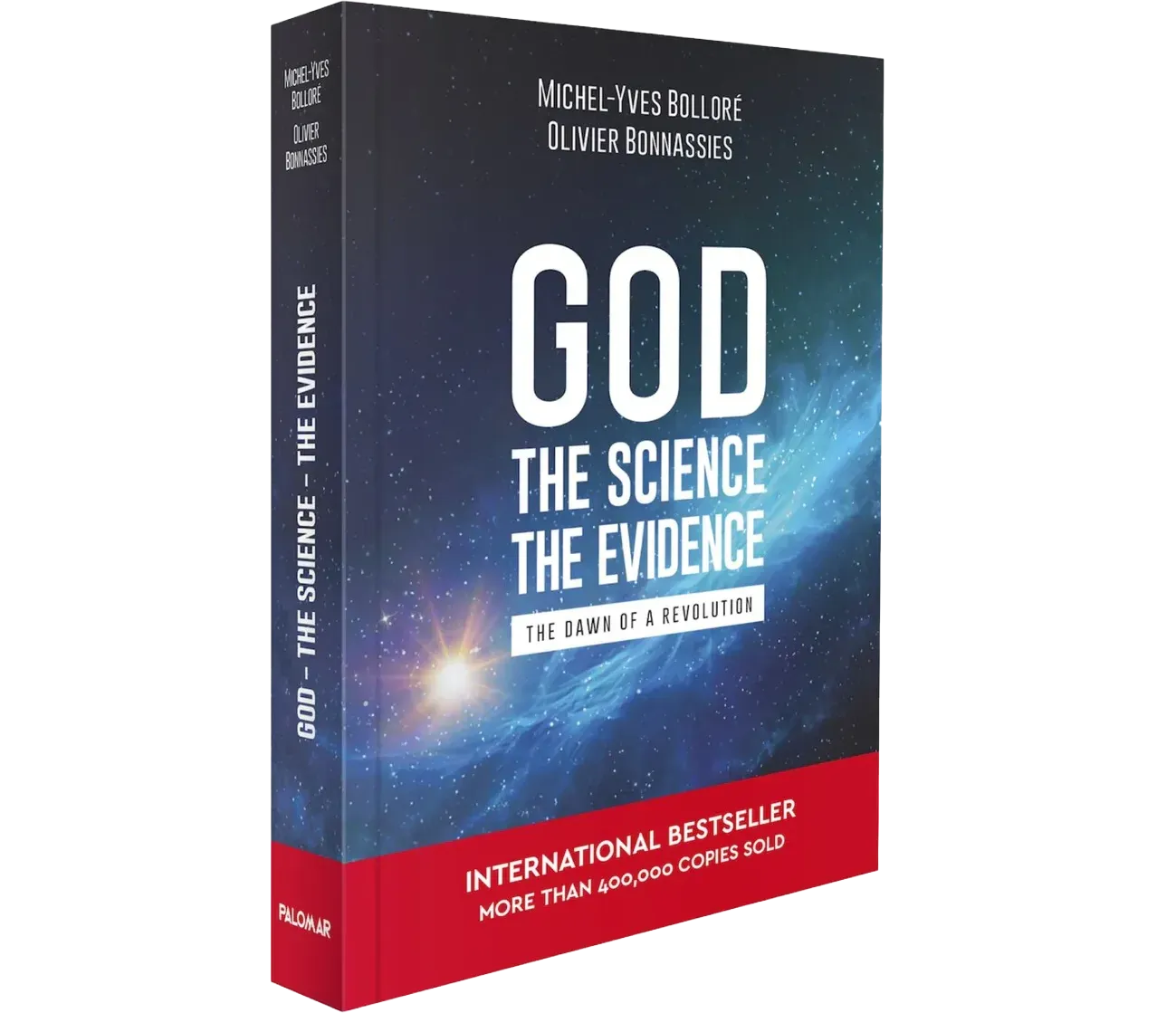
A review of God: The Science, The Evidence. The Dawn of a Revolution by Michel-Yves Bolloré and Olivier Bonnassies.
The purported goal (stated in the Preface) of this book is “to shed light … on the question of the existence or non-existence of a creator God.” This professed evenhandedness is doubly (if not trebly) disingenuous. The actual purpose of the book is to argue not just for the existence of a creator God, but specifically the Christian God—and also not just the Christian God but specifically the God of Catholicism.
Protesting too much, elsewhere in the book the authors assert “the purpose of this book is not to militate for a particular religion,” but this is belied by six chapters with such titles as “The Alleged Errors of the Bible, Which Are Not Errors.” The entire book, in fact, is not good faith argument, but apologetics for a particular religion. It begins with this statement:
Until recently, believing in God seemed incompatible with science. Now, unexpectedly, science appears to have become God’s ally. Materialism, which has always been a belief just like any other, is seriously shaken as a result.
This is sloppy if not entirely disingenuous. The authors use the word materialism as synonymous with naturalism (which is the philosophical foundation for science) but often seem just to mean atheism. And, of course, materialism is not just a neutral word for a philosophical stance; it also has a secondary negative meaning.
The argument rests initially on two pillars, neither of them novel or unfamiliar: the finitude of the universe (as confirmed by the Big Bang and somehow also the anthropic principle) and its supposed fine tuning. Elsewhere in the book the authors even assert that the “slander and harassment” supposedly “suffered” by the supporters of these two ideas serves as proof of their validity! And the authors reach their primary point less than halfway through the book: “That a creator God exists is the only obvious conclusion.” What, then, is the rest of the book about?
Curves of Understanding
The title of the first chapter of the book repeats its subtitle, “The Dawn of a Revolution.” The authors assert that scientific advances beginning in the twentieth century have led to a complete reversal of the thinking that God was incompatible with the sciences, as illustrated in the two-page timeline that ends the chapter:
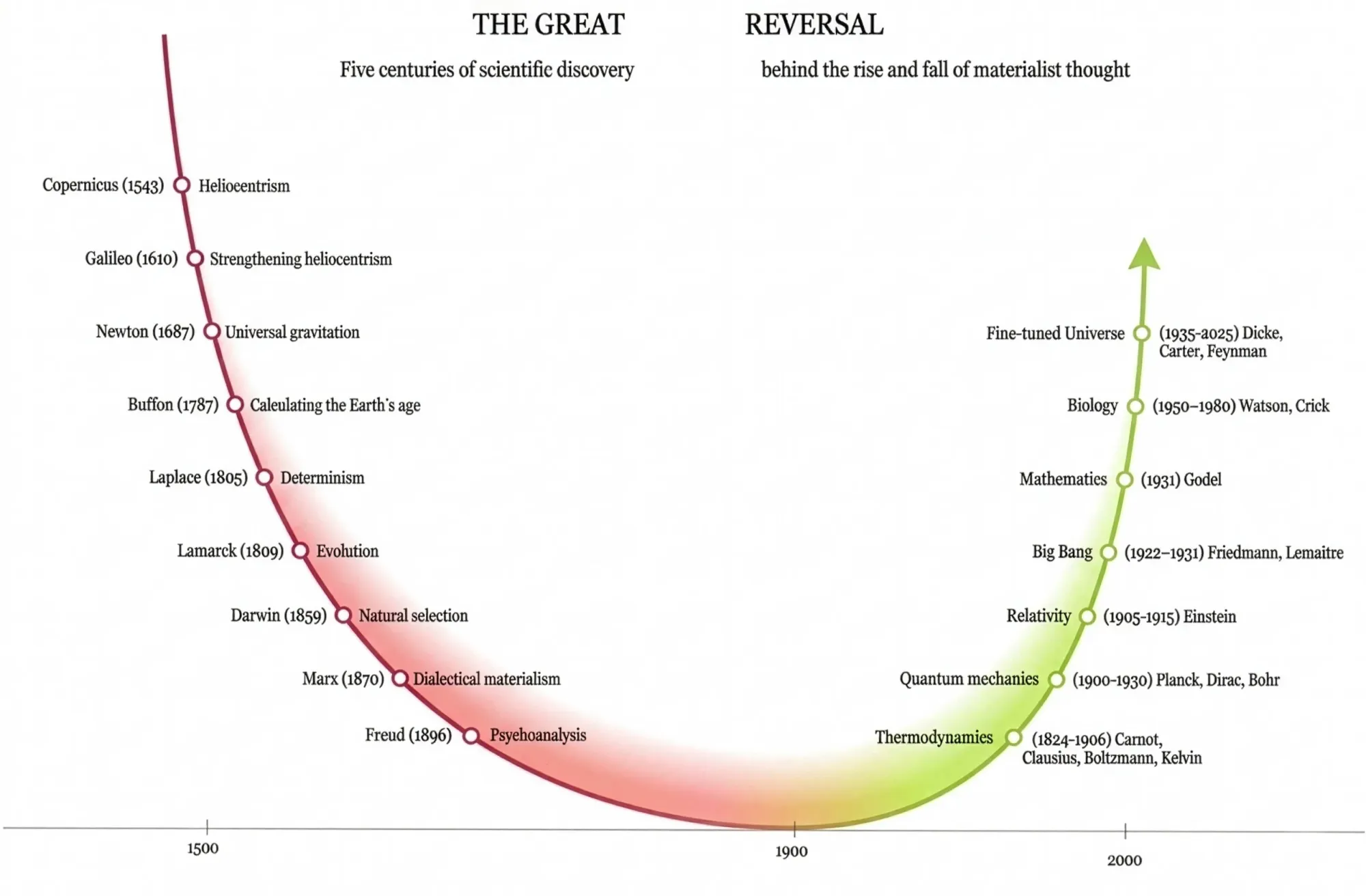
This diagram exhibits several peculiarities:
- The horizontal axis, representing time, is catastrophically distorted. The span from 1500 to 1900 takes a little less than 6"—about one and a half inches per century. The span from 1900 to 2000 measures a little more than 3", so about three quarters of an inch per century—already a serious distortion. But the span from the last figure on the left side (1896) to 1900 (only 4 years!) is a little over three inches, which would require more than six feet per century!
- The vertical axis is unlabeled. The curve is meant to reveal the “rise and fall of materialist thought” (although upside down), so the vertical axis must be … immaterialism?
- The inclusion of Lamarck is dubious. Although he may have been the first naturalist of the period to propose a theory of evolution, it was wrong. In the history of the science of evolution, Lamarck is mentioned only in passing. The theory is of course properly attributed to Darwin and Wallace. In the timeline, Darwin is credited not with evolution but only natural selection, and Wallace doesn’t appear at all.
- The implication of the diagram is that everyone on the right side of the timeline (the part where the line is descending) is associated with the rise of “materialist thought” and everyone on the right is associated with its fall. Many of those on either side would dispute such characterizations.
Science
The authors repeatedly demonstrate a profound misunderstanding of science. The supernatural—literally, super (above, over, beyond) + natural—is not within the subject matter of science at all. And God is, as the authors themselves note, the quintessence of the supernatural.
Naturalism is the framework within which science is conducted. Without it, science simply can’t be done.
But the authors’ misunderstanding goes beyond this. Materialism (naturalism) is not, as they insist, “a belief just like any other.” Naturalism is the framework within which science is conducted. Without it, science simply can’t be done.
Reinforcing this misapprehension, the authors refer to “the theory of a purely material universe.” The entire phrase is meaningless: it's not a theory, it's the ground on which the entire edifice of science stands.
Another persistent misunderstanding is that of the concept of proof and its applicability to science. As a website literally called The Logic of Science puts it, “Science doesn’t prove anything, and that’s a good thing.”
Although the authors actually acknowledge (with a quote from Karl Popper) that science doesn’t deal in proofs at all, they introduce the novel phrase “relative proof” (as opposed to “absolute proof,” which can only be found in logic, mathematics, and the like). This term is so eccentric in this context that a Google search for that exact phrase yields only websites devoted to the subject of genealogical proofs, such as the website of a professional genealogist literally named Relative Proof.
The obsession with proof persists throughout the book. In a chapter bizarrely entitled “Preliminary Conclusions” (bizarre both because the phrase is almost oxymoronic and because it occurs over two hundred pages in), the authors say that “cosmology allows us to establish two separate proofs.” They are, of course, the Big Bang and fine tuning.
The authors’ summary of what they call the scientific “approach” is childishly simplistic and misleading. For example, they write, “The first step … is to create a theory.” Well, no. The first step is to perform observations. In the context of the scientific method, theory means a scientifically acceptable or plausible general principle or body of principles based on data and offered to explain phenomena. A theory is a decisive step—but not the final step—in the process. The point of a theory is to provide a comprehensive understanding of a range of phenomena, not a single phenomenon. And, in any case, science continues far beyond the initial proposal of a theory.
Perhaps the clearest indication that the authors fundamentally misconstrue science is a bizarre table showing what they call the six domains of supposedly scientific theories, ranging from Group 1 (Absolute Proof, which, including as it does mathematics and logic, doesn’t apply to the natural sciences at all and is, if to be included in the table at all, a Group 0) through Group 6 (“Theories without implications, and that are neither modelable nor subject to experimentation”). This classification is entirely idiosyncratic. The sciences are not grouped by the level of support of “proof” possible, but by their subject matter.
Even more remarkable is the set of examples the authors choose for Group 5 (“Theories that can be tested against reality, but that are neither modelable nor subject to experimentation”), which include:
evolution, paleontology, origin of life on Earth, origin of the Moon, origin of water, existence of a creator God
In the last column (“Force of Proof”) is the cell for this group: “The strength of the proof depends on the quality and number of correspondences between the implications of the theory and observable reality.”
There’s no branch of science examining the “existence of a creator God.” Although the word theology looks like it refers to the science of God, it's not a science at all, but a subject in a Catholic seminary. One of the authors (Bonnassies), in fact, earned a B.A. in Theology from the Catholic Institute of Paris.
The Big Bang
The authors assert that the discovery that the universe had a beginning (the Big Bang) was a devastating blow to materialism. No such blow occurred. Such discussions are on forums like Reddit and Quora; religious websites; and books of apologetics, not in scientific labs. According to the authors, the Big Bang refutes materialism because ex nihilo nihil fit (nothing comes from nothing). This is, of course, the Kalam cosmological argument (as the authors themselves acknowledge):
Premise: Everything that begins to exist has a cause.
Premise: The universe began to exist.
Conclusion: Therefore, the universe has a cause—namely, God.
But it’s not as if, before the discovery of the Big Bang, materialism was the dominant view. Quite the contrary—when the universe was believed to be eternal, the same argument was widely used—having been traced back to at least Aristotle and Plato. The authors even manage to rope in the heat death of the universe as further proof:
Premise: The universe is going to end.
Premise: Everything that is going to end has a beginning.
Premise: Everything that has a beginning has a cause.
Conclusion: Therefore, the universe has a cause—namely, God.
The authors even draft the theory of relativity into the argument:
Premise: “space, time, matter, and energy are interrelated.”
Premise: “no single one of them can exist without the others.”
Conclusion: “if a cause exists at the origin of our universe, it's necessarily atemporal, non-spatial, and immaterial”—namely, God.
All of these arguments can be consolidated thusly:
Premise: The existence of the universe is inexplicable.
Conclusion: Therefore, God.
Again and again, the authors insist that the discovery that the universe had a beginning decisively refutes any possible naturalistic explanation for its existence. But, of course, Jews, Christians, Muslims, and other religious adherents alreadybelieved that the universe had a beginning. But many religions believe in both God and an eternal universe, including Hinduism, Jainism, and Mormonism (remarkably, Mormons consider themselves Christians—they accept Jesus as the savior—even if most Christians do not).
There’s no branch of science examining the “existence of a creator God.”
With or without the Big Bang—with or without a beginning of the universe—the argument is the same. The notion that the Big Bang (and other twentieth century scientific discoveries) rendered naturalism false is absurd—however many pages the authors spend pleading it. Furthermore, even if the argument were valid, it would only prove a First Mover—the noninterventionist God of Deism. But, as we’ll see, the authors argue for a specifically Christian God (actually, an even more specifically Catholic God), along with the Bible, miracles, and the whole lot.
Fine Tuning
According to the authors, “The values of these numbers [the so-called constants of nature] were fixed at the moment the Universe came into being.” This is both disingenuous and unsupported. The passive voice (“fixed”) implies agency—who better an agent than God? And the notion that they could have been any values other than what they are is entirely speculative. The authors finish that sentence by asserting that they “are invariable in time and space.” But this is an open question.
Later in the book, in the chapter about biology, the authors assert that “biological fine-tuning is added to the cosmological fine-tuning.” Sean Carroll and others have observed that, even discounting the notion of a multiverse of one sort or another, there are several problems with the fine-tuning argument, not the least of which involved the anthropic principle.
The philosopher Nick Bostrom reports, in fact, that there are over 30 versions of the anthropic principle that range from the weak or tautological (“conditions that are observed in the universe must allow the observer to exist”) to the strong (“the universe must have properties that make inevitable the existence of intelligent life”).
Clearly, the authors espouse not only the strong version—but specifically the notion that this proves the existence of a creator God. It is, in other words, just another version of the fine-tuning argument, which Douglas Adams ridiculed with what has come to be known as the puddle analogy:
If you imagine a puddle waking up one morning and thinking, “This is an interesting world I find myself in — an interesting hole I find myself in — fits me rather neatly, doesn't it? In fact it fits me staggeringly well, must have been made to have me in it!"
The Multiverse
Although the concept of multiple universes is ancient, in the modern era it's most closely associated with the Many Worlds Interpretation of Hugh Everett, which he introduced as a way to resolve the (supposed) problem of the quantum collapse.
The authors mention the concept of the multiverse early as an example of “speculative theories to counter the Big Bang.” But no scientist has suggested that the multiverse might “counter” the Big Bang.
The authors devote an entire chapter to the subject (“The Multiverse: Theory or Loophole?”), which they regard as invented purely to avoid the dilemma of what they see as only two possibilities: “a creator God or pure chance.” They claim that the notion of the multiverse is, quoting Neil Manson, “the last resort for the desperate atheist.”
The notion that the Big Bang (and other twentieth century scientific discoveries) rendered naturalism false is absurd.
As the authors show, many theorists have been troubled by the universe's apparent fine tuning—and see a multiverse as a way of explaining it. But the multiverse was developed by Hugh Everett in studying quantum mechanics, not by atheists disputing God or trying to avoid “the real metaphysical questions at stake.”
Biology
The chapter on biology recapitulates observations that life is incomprehensibly complex and that the origin of life seems unfathomably improbable:
Premise: Biology is incredibly complex.
Premise: The origin of life appears to be incredibly improbable.
Conclusion: Therefore, God.
The authors reinforce these two points laboriously. They leave unclear whether they believe that life arose because God arranged things at Creation (the Big Bang) to make it inevitable, or because God intervened at various points to ensure it arose in the face of otherwise astronomically poor odds.
Appeal to Authority
Not content with scattering quotations from notable people throughout the book, the authors appeal to authority in four entire chapters:
13. One Hundred Essential Citations [by which the authors mean quotations] From Leading Scientists
14. What Do Scientists Believe In?
15. What Did Einstein Believe In?
16. What Did Gödel Believe In?
In Chapter 14, the authors worry over the commonly held belief that “modern scientists are not very religious, or at least far less religious than the general population.” Their excuses, caveats, and quibbles notwithstanding, that’s true. In the United States (and throughout the countries of the world except for a few such as Turkey and India), scientists are much less likely to believe in a personal God than the rest of the population.
Earlier in the book, before devoting an entire chapter to him, the authors mention that Einstein famously said “God does not play dice.” The actual quotation (“I am at all events convinced that He does not play dice.”) is found in a letter Einstein wrote to Max Born specifically disputing the then-new theory of quantum mechanics. This context matters.
Evidence from Outside the Sciences
The next section of the book includes additional material on several unscientific topics:
- The Jews (a.k.a., in the book, “The Hebrews”). In a chapter arguing that the Bible contains “truths” that were “humanly inaccessible” at the time it was written, and a separate chapter recounting the history of the Jews from ancient times through the Six-Day War of 1967, the authors imply (but never explicitly state) that the Jews were and are God’s chosen people. They argue that the Jews’ supposedly uncanny ancient knowledge and later improbable history both imply an interventionist God.
- The inerrancy of the Bible. In both the chapter about the Jews and that one arguing that the apparent (“alleged”) errors were not actual errors, the authors argue that the Bible is inerrant. Their main argument is that the book was written specifically for the ancient Hebrews, and for that reason composed in largely metaphorical language. But the main assertion is that The Bible is not literal: it “pursues purely supernatural ends, and therefore corrects only those errors that prevent us from understanding who God is.”
- “Jesus is the Messiah and God incarnate.” To exclude so many of the rest—even those that might completely agree with the idea of a creator God—is curious. Elsewhere in the book, in a long footnote, the authors characterize the ideas of Buddhism, Hinduism, and Brahmanism about the origin of the Universe as “rarely rationally articulated,” and whose adherents “struggle to present them coherently.” Islam (about 25% of the world population), which also espouses a creator God, goes entirely unmentioned.
- The miracles in Fátima, Portugal, in 1917. By including these purported miracles (as well as the Shroud of Turin) in a book supposedly about the scientific evidence for God, the authors identify themselves as apologists specifically for Catholicism, since other Christian churches don’t recognize them.
- Argument from Emotions. Although, early in the book, the authors assert that “emotions come into play when we evaluate a claim and its conclusions” (implying that they may distort such evaluation), in Chapter 22, they tell us to perform “an exercise in listening to the interior voice.” After recapitulating an explanation of the origin of conscience in evolutionary psychology, they ask, “Is it compatible with what you feel?”
- “Philosophical Proofs”: A recapitulation of arguments, both ancient and modern, supposedly proving the existence of God. Almost all of these arguments (some of which, of course, recapitulate those already presented) assert only a creator God—not the specific Catholic God of the authors.
We are, by this point, far from supposedly scientific evidence.
Straw Man Argument
Throughout the book, the authors repeatedly recite ideas that a “coherent” materialist supposedly must believe. Some of these are indeed widely believed by atheists, such as:
- “Miracles cannot exist.”
- “Prophecies and revelations cannot exist.”
- “The spirit world—including devils, angels, evil spirits, possessions, exorcisms—does not exist.”
- “Deterministic laws apply universally.”
- “All processes in the Universe … operate solely through chance and necessity.”
In the penultimate chapter (“Materialist Arguments against the Existence of God”), the authors assert arguments that, for the most part, materialists (atheists) don’t make—either disbelieving or simply lacking a belief. But the authors all but argue that the burden of proof is on the materialist: “Believing in nothing is a belief in itself and an active choice.” Really? And is belief really a choice?
God Books in Context
Perhaps not surprisingly, given the general interest in the subject, this book is one of an established genre. A search for “God and science” on Amazon, for example, returns over 10,000 results (curiously, reversing the search for “science and God” generates over 50,000 results), including:
- The Science of God: The Convergence of Scientific and Biblical Wisdom
- Finding God in Science
- Cosmic Chemistry: Do God and Science Mix?
- God, Science, and Religious Diversity: A Defense of Theism
- Science Confirms the Existence of God
- Science and God: Do You Have to Choose?
- From Science to God: A Physicist’s Journey into the Mystery of Consciousness
- Science and God: How Science and Logic Support the Bible
- God Speaks Science: What Neurons, Giant Squid, and Supernovae Reveal About Our Creator
- Believing Is Seeing: A Physicist Explains How Science Shattered His Atheism and Revealed the Necessity of Faith
- The Language of God: A Scientist Presents Evidence for Belief
- Science Confirms the Existence of God
- Finding God In Science: The Extraordinary Evidence for the Soul and Christianity, A Rocket Scientist’s Gripping Odyssey
- God and god of Science
- God Discovery: How Science and Logic Reveal the Existence of God
- The Call of Wonder: How the God of Reason Created Science in His Image
The list goes on and on. And, of course, there are also many books of religious apologetics (such as William Lane Craig’s The Kalām Cosmological Argument) without the words God and science in the title.
Apparently, a lot of Christians (to whom nearly all of these books appear to be specifically addressed) are worried about the apparent conflict and are looking for a comforting reconciliation. But from the sheer length of that list, it can be inferred that the worry isn’t easily relieved.
Meanwhile, materialist scientists remain entirely unpersuaded.
[ad_2]
Source link
