
[ad_1]
Imran Khalid for Foreign Policy in Focus
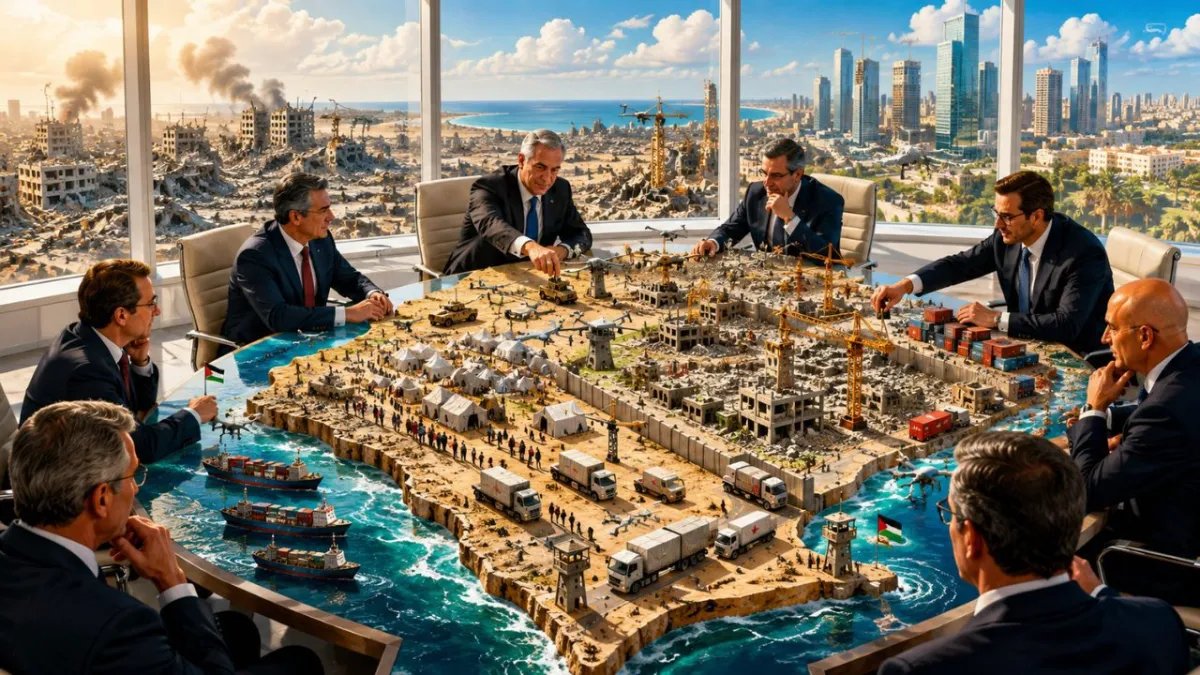
The international community’s approach to conflict resolution has undergone a profound and dangerous structural shift, moving away from the pursuit of political settlements toward the permanent administration of crisis. This transition is vividly apparent in Rafah, where the newly established National Committee for the Administration of Gaza (NCAG) has begun overseeing a reconstruction process stripped of any path toward genuine sovereignty or political renewal. What is being built instead is a sprawling, technocratic bureaucracy designed to manage human suffering indefinitely, transforming a site of active geopolitical dispossession into a permanent administrative holding pattern.
The rollout of Phase Two of the Trump administration’s Comprehensive Gaza Plan—secured with a UN Security Council endorsement—exposes the nakedly corporate logic underpinning modern foreign policy. By placing a “Board of Peace” stacked with billionaire financiers and political hawks like Marco Rubio, Tony Blair, Jared Kushner, Ajay Banga, and Marc Rowan in charge of post-conflict governance, Western hegemony has effectively financialized geopolitical containment. The plan treats Gaza not as a nation deserving of self-determination but as a high-risk economic asset to be secured, stabilized, and folded into regional trade corridors while its population remains permanently disenfranchised.
This containment model carries severe consequences both for the occupied population and the broader global order. For Palestinians, it institutionalizes a bleak daily reality of endless aid lines and checkpoints under an international apparatus that has traded the promise of liberation for technocratic stabilization. Globally, this reveals a deeper systemic reality: the traditional assumption that regional conflicts are temporary shocks awaiting a diplomatic fix has completely collapsed.
For global political and economic elites, perpetual instability is no longer a failure to be corrected but a baseline structural condition around which modern global capitalism is choosing to organize itself.
A Shift in Logic
In the twentieth century, major conflicts were viewed as massive disruptions to globalization. In the twenty-first, globalization is rapidly adapting itself around endless disruption. Entire corporate, financial, and bureaucratic systems now operationalize instability as a baseline condition rather than a temporary shock.
Private-sector logistics firms are securing long-term contracts to manage continuous delivery corridors into high-risk zones. Maritime conglomerates are permanently adjusting pricing models and routing assets around Africa as a structural business reality. Digital and physical infrastructure protection has transitioned from an annual insurance check-box to a core operational expense that drives tech-sector hiring and venture capital investment.
Markets are internalizing this shift. Oil prices no longer spike the way they once did after escalations because commodity investors increasingly price in chronic, localized instability rather than assuming systemic collapse. Capital markets are no longer asking whether a crisis will end but whether it can remain geographically contained. That distinction changes everything for how corporate treasuries allocate capital.
Gaza and Ukraine
Gaza illustrates this vividly. The NCAG’s reconstruction mandate and the Board of Peace’s integration of Gaza into the India–Middle East–Europe Economic Corridor (IMEC) show that crisis management itself has become a growth industry. Reconstruction is not about closure; it is about embedding instability into global supply chains.
This economic adaptation mirrors a deeper systemic fatigue within international governance. The post-Cold War era operated on the logic that major conflicts eventually reached closure, whether Bosnia after Dayton or Northern Ireland after the Good Friday Agreement. Today, that logic is spent.
Instead of diplomacy aimed at structural architecture, modern institutions are becoming highly efficient at administering instability rather than ending it. The UN’s Resolution 2803 did not declare peace; it endorsed a framework for managing crisis indefinitely. The NCAG’s mandate is to restore services under conditions of volatility, not to deliver closure.
Ukraine offers a parallel. Western institutions have become adept at stabilizing financial flows, managing refugee integration, and sustaining military aid—but without a credible path to settlement. Sudan’s humanitarian corridors are similarly managed as permanent relief operations. Gaza’s plan institutionalizes this model: reconstruction without resolution, administration without settlement.
Normalization
The third transformation is occurring inside the human infrastructure of the modern workplace, driven by algorithmic fatigue and the workspace paradox. The digital age has fundamentally altered how societies, consumers, and employees process global trauma.
Previous generations experienced major conflicts sequentially. Today’s professional workforce experiences them simultaneously, continuously, and instantly. In any given hour, a professional’s algorithmic stream displays corporate Slack messages alongside real-time updates from Gaza, Ukraine, Taiwan, and climate disasters.
This continuous exposure has created a dangerous psychological paradox. The global workforce is more emotionally connected to macro-level crises than at any point in history, yet constant exposure is triggering widespread psychological numbness and professional exhaustion. Public and corporate outrage surges rapidly, then stabilizes into fatigue. For leaders, managing a workforce under the weight of this continuous cognitive load is a quiet crisis in itself.
The ultimate danger of the era of permanent crisis is that it becomes intellectually and socially normalized. Once corporate strategies and public expectations internalize the assumption that global disruption never truly ends, ambition contracts. Leaders stop pursuing long-term expansions because planning horizons narrow from years to weeks. Innovation takes a backseat to survival and containment.

Photo by Yannis Boschung on Unsplash
History offers a stern warning: the late Roman Empire did not collapse because every frontier failed simultaneously. It declined because permanent emergencies became routine, and tactical crisis management slowly replaced strategic renewal.
The modern international order risks entering a similar phase. Gaza, Ukraine, and shipping vulnerabilities matter immensely for their immediate human and material costs, but they matter even more because they reveal the new template of global operations. Trump’s Gaza plan, with its NCAG, Board of Peace, and IMEC linkage, is not just a reconstruction blueprint. It is a case study in how global institutions now design for permanence of crisis rather than its resolution.
The challenge for the next generation of business leaders is not simply navigating the next disruption but learning how to build sustainable, human-centric enterprises when disruption is the baseline condition. The permanent crisis economy is here: industries are monetizing instability, institutions are administering it, and workforces are absorbing it.
Gaza’s reconstruction framework, endorsed by the UN and operationalized by Trump’s Board of Peace, crystallizes this reality. It shows that the world’s most powerful actors are no longer promising closure. They are promising management.
For commerce, governance, and society, the task is clear: to resist the temptation to normalize crisis as the only horizon. Otherwise, the machinery of global order will become a treadmill of containment, and the ambition for renewal will fade. The permanent crisis economy may be the present reality, but it must not become a permanent destiny.
Imran Khalid is a geostrategic analyst and columnist on international affairs. He is a senior fellow at Foreign Policy In Focus.
Foreign Policy in Focus is a “Think Tank Without Walls” connecting the research and action of more than 600 scholars, advocates, and activists seeking to make the United States a more responsible global partner. It is a project of the Institute for Policy Studies. FPIF publishes timely commentaries on U.S. foreign policy, sharp analyses of global issues, and on-the-ground dispatches from around the world. We also are interested in pieces that explore the intersection of foreign policy and culture, and on dispatches from social movements involved in foreign policy.
Editor’s Note: At a moment when the once vaunted model of responsible journalism is overwhelmingly the play thing of self-serving billionaires and their corporate scribes, alternatives of integrity are desperately needed, and ScheerPost is one of them. Please support our independent journalism by contributing to our online donation platform, Network for Good, or send a check to our new PO Box. We can’t thank you enough, and promise to keep bringing you this kind of vital news.
You can also make a donation to our PayPal or subscribe to our Patreon.
Please share this story and help us grow our network!
[ad_2]
Source link
