
[ad_1]
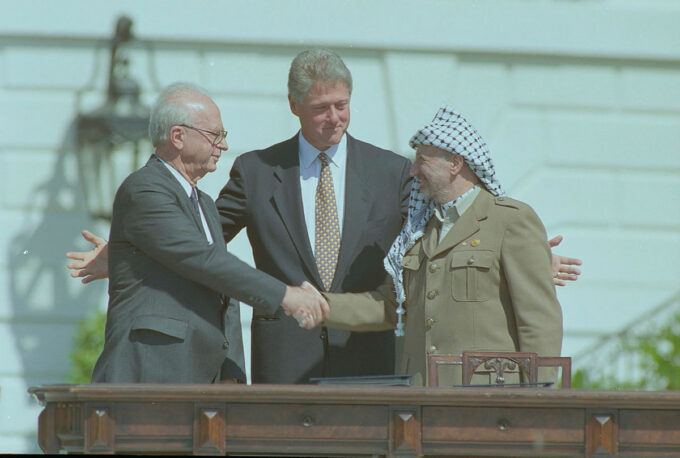
Bill Clinton mediates the handshake between Yitzak Rabin and Yassir Arafat outside the White House on September 13, 1993. Photo: White House Historical Association.
“A truce [between Lebanon and Israel] that has been in effect since April 17 has never been respected,” AFP reported. So what exactly is a cease-fire worth if the fighting continues? From Lebanon to Ukraine, cease-fires are announced with great fanfare and violated with remarkable speed. Yet politicians and commentators still speak as if a truce were the same thing as peace.
Donald Trump is one of the worst violators of this confusion. Trump’s claims to have ‘ended’ eight wars follow a familiar pattern. A cease-fire becomes peace, a negotiation becomes a deal, and a temporary pause in fighting becomes the end of a war. Trump’s declarations belie the underlying reality that the conflicts he refers to remain unsettled—much like a schoolyard fight is declared “over” the moment the children are pulled apart.
Did Trump really “end” eight wars? Are the underlying conflicts actually over? Lebanon remains unstable. Iran and Israel continue to exchange threats and attacks. Russia and Ukraine are still at war. The Houthis still fire missiles. Gaza remains unresolved. Kashmir remains disputed. The Democratic Republic of Congo remains violent. These claims often amount to relabelling partial stabilization, normalization, or temporary pause as a final resolution. If these wars were truly “ended” by Trump, nobody seems to have informed the combatants, civilians killed in the fighting, or the millions suffering and displaced.
Cease-fires are among the most celebrated and least understood achievements in modern diplomacy. They generate headlines, press conferences, handshakes, and declarations of success. (See the famous September 13, 1993, photo of Bill Clinton, Yitzhak Rabin and Yasser Arafat White House handshake from the Oslo peace process.) Many cease-fires are violated almost immediately. Some collapse within days. Others survive on paper long after they have ceased to exist in reality.
What is the value of the cease-fire? The New York Times headlined recently: “Israeli Strike Kills 3 Lebanese Soldiers, Days After Truce Was Signed.” While there may be benefits to agreements intended to halt fighting, the cease-fire glass appears not merely half-empty, but nearly drained. Too often, the promises are celebrated while the fighting continues.
Three recent examples of the cease-fire illusion:
1) A new U.S.-brokered cease-fire framework was announced June 3, 2026, under which Israel and Lebanon agreed to enforce a cessation of hostilities and expand Lebanese Army control in southern Lebanon. Within days, renewed exchanges of fire spread across multiple border sectors. Repeated evacuations followed in southern Lebanon. Tens of thousands were displaced. Reports of casualties continued from ongoing clashes. The cease-fire exists in declaration, not in control of events on the ground.
2) The United States and Iran maintain a cease-fire framework. Both sides accuse each other of violations. Military pressure continues across multiple fronts. On June 8, Iran and Israel exchanged missile and drone strikes again, breaking through a fragile truce and triggering renewed escalation. Israeli strikes hit targets inside Iran. Iranian missiles reached Israeli territory. Additional attacks extended across the wider regional network of aligned forces. The cease-fire holds in language, not in conduct.
3) The Russia–Ukraine war. Since Russia’s full-scale invasion in 2022, repeated cease-fire attempts, humanitarian pauses, and localized truces have failed to hold. Fighting continues across eastern and southern Ukraine. Missile and drone strikes continue on Ukrainian cities. Temporary pauses collapse quickly, often within days. Prisoner exchanges and localized cessations of fire occur, but do not translate into sustained reductions in combat or movement toward settlement. The cease-fires exist in interruption, not in resolution.
There is nothing new about cease-fires. Armies have been pausing wars for thousands of years. Sometimes to negotiate. Sometimes to regroup. Sometimes simply because both sides were exhausted. In the ancient world, Greek city-states occasionally suspended hostilities during religious festivals, while medieval rulers often arranged truces that paused wars for months or even years without resolving the underlying conflict. Sometimes the warriors stopped fighting to return home to harvest the crops.
What cease-fires have rarely done is resolve the conflict they interrupt.
There are exceptions. In modern times some cease-fires have become major turning points to end conflicts rather than merely time-outs. The 1953 Korean War cease-fire froze the battlefield and stopped large-scale combat. Although the conflict was never formally ended by a peace treaty, the cease-fire has largely held for over seventy years.
Other cease-fires have opened the door to lasting political settlements. In Northern Ireland, repeated cease-fires by paramilitary groups in the 1990s helped create the conditions for negotiations that culminated in the Good Friday Agreement. In the Middle East, the cease-fire agreements that ended the 1973 Arab–Israeli War paved the way for diplomacy between Egypt and Israel, eventually leading to the 1979 peace treaty. Cease-fires can create the breathing room needed for diplomacy to succeed where armed conflict could not.
Despite the limited cease-fire successes, they were never intended to be peace treaties. They are instruments for stopping violence, not for resolving the political disputes that caused the violence in the first place. Their success should therefore be measured by whether they create the conditions under which diplomacy becomes possible. The problem in many of today’s conflicts is not that cease-fires exist; it is that they are increasingly treated as substitutes for political settlement rather than as a first step toward one.
In that sense, a cease-fire is a comma, not a period. “I have no illusions about the difficulty of peace,” George Mitchell said while working on the Northern Ireland peace process. “It is hard, painstaking work that requires patience and persistence.” Yet politicians like Trump, and real estate brokers like Witkoff and Kushner keep presenting it as the end of the sentence, all show and closure with little chance of sustainability. It is like the passing of the eye of a hurricane before the high winds pick up again. Confusing cease-fires and peace may make for a good political talking point and publicity about “ending” wars, but it makes for poor history.
The tendency of politicians like Trump, journalists, and the public to confuse a cessation of hostilities with a resolution of conflict obscures deeper diplomatic efforts to find lasting resolutions. Obama’s team spent about two years, from 2013 to 2015, negotiating the Iran nuclear deal, led by Secretary of State John Kerry, Under Secretary Wendy Sherman, and Energy Secretary Ernest Moniz, with close involvement from National Security Council officials including Jake Sullivan and Ben Rhodes. Real estate salesmen should not be confused with diplomats. A Trumpian announcement on CNN Breaking News should not be confused with “hard, painstaking work.”
A cease-fire can pause a war. It cannot resolve the conflict that produced it. What is often claimed as having “ended” a war is merely political branding. Only sustained diplomacy can turn a pause into a settlement.
[ad_2]
Source link
