[ad_1]
iPhones may have slightly exacerbated an already underway drop in unintended pregnancies among teens. That’s the big finding in a new working paper published by the National Bureau of Economic Research (NBER).
In a more sane environment, this paper would be greeted with somewhere between slightly increased respect for the poor smartphone and a collective shrug. Or perhaps with some skepticism—how exactly did the authors reach this conclusion anyway? Does it hold up?
You are reading Sex & Tech, from Elizabeth Nolan Brown. Get more of Elizabeth’s sex, tech, bodily autonomy, law, and online culture coverage.
Alas, we live in a period of total paranoia and doom about smartphones. So the NBER paper is being heralded as a sign that smartphones are to blame for birth rates falling generally and a big, tragic harbinger of population doom.
Today, I want to look (once again) at why this fatalistic view is unwarranted and how the hype about phones and fertility doesn’t hold up.
Let’s start with the study itself. Authors Caitlin K. Myers and Ezekiel Hooper attempt to look at the iPhone’s effect on childbearing by assessing U.S. fertility rates in places where AT&T provided mobile broadband coverage between 2003 and 2011 and places where it didn’t. The iPhone was available only on AT&T networks during the period between June 2007 and February 2011.
From this, they conclude that iPhones did, indeed, lead to birth rates dropping. But even taking their calculations and explanations at face value, we’re mainly looking at a phenomenon involving teen girls and, to a lesser extent, women in their early 20s. The results suggest “the fertility drop is concentrated among young populations and largely operates through declines in unintended births,” the authors write, adding that one of the methods of suppression may have involved greater access to information about birth control.
Per Myers’ and Hooper’s calculations, “access to the iPhone reduced births by 4.5–8.0% at ages 15–19 and 3.2–6.6% at ages 20–24.” But among 25- to 29-year-olds, the reduction was just between 1 percent and 1.3 percent; among 30- to 34-year-olds, it was as little as 2.7 percent; and among 35- to 39-year-olds, it was just 1.4 percent.
Is alarm really quite the right response here? Because even if we accept the underlying premises and conclusions of the study—and that’s a big if, as we’ll get to in a minute—what we’re looking at here seems to be more girls and women avoiding unintended pregnancy at young ages or choosing to wait until they’re more emotionally, financially, or professionally ready to have kids. If the iPhone really did depress fertility in this way, I’m not convinced that’s a bad thing.
I’m also not convinced that there’s really an iPhone-to-fertility-drop pipeline at play here. Remember, this whole experiment is based on studying “counties with near-universal AT&T coverage to counties with little or none over 2003–2011,” as the authors put it.
The authors didn’t measure how many people in their study areas actually had iPhones or whether birth rates actually dropped more among iPhone users. They just measured overall birth rates in areas with more or less AT&T coverage.
There are likely many differences between places where A&T coverage was extremely high and those where it was extremely low. More remote or rural areas would have had less coverage, while densely populated urban and suburban areas would have had more coverage. The former tend to be places where people are poorer, more religious, more isolated (including from access to birth control), have different norms, and so on. And keep in mind these were also the years of the Great Recession, which could have hit people in big cities and in small towns quite differently.
In short, there are all sorts of reasons independent of phones why births might have continued more apace in places with low AT&T coverage.
The authors attempt to control for this by “reweight[ing] control counties to match treated counties on observable demographics.” But even if you control for certain aspects—income and education, say—it’s hard to control for differences in cultural attitudes, community norms, economic and psychological effects of the recession, political leanings, access to contraception, and everything else that sets these areas apart.
It becomes really unclear: Are we looking at iPhone effects, or just urban vs. rural fertility trends during the Great Recession?
Even the study authors admit that it may be the latter. “Given that [high coverage] counties are systematically more urban than control counties, any other forces causing urban fertility to decline relatively more than rural fertility over this period could generate the same pattern.”
Some problems with this study:
1.) There was already a pretrend in evidence. So they’re claiming smartphones caused a pattern already in evidence.
2.) As others pointed out, there’s confounding rural/urban issues in this analysis (it’s geographic, not behavioral).
3.) Models…— Chris Ferguson 🇺🇸🎇🎆 (@CJFerguson1111) June 9, 2026
The broad contours of this study just don’t lend themselves to a simple and causal phones-to-fertility-drop explanation. And this becomes even more clear when you drill down a little on birth trends and phone ownership demographics.
For instance: There was “no effect” for black women of any age. Should we take from this that black women are somehow impervious to the effects of smartphones? Or does it perhaps suggest that maybe something else was at play? (Black women in urban areas are also more likely than white peers to be low income, so this could again hint at a socioeconomic component to all of this.)
Then there’s the fact that birth rates began dropping before the iPhone’s introduction, positioning their post-iPhone drop as a continuation of a trend. Or the fact that teen and young adult birth rates still dropped significantly in areas with low AT&T coverage. For instance, “births to women in their twenties fell by 10.0% in counties without coverage but by 14.6% in counties with extensive coverage.” And “teen births declined by 13.8% in counties without AT&T coverage, compared to…26.0% in counties with near-universal coverage.”
We should also think about the demographics of iPhone or smartphone ownership. Just because AT&T coverage was high in a given area does not mean that ownership was high among teens or people in their early 20s, the groups for which birth rates dropped the most.
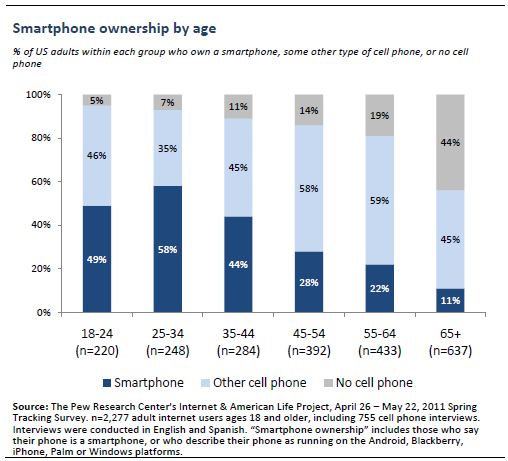
According to Pew Research Center data, just 23 percent of 12- to 17-year-olds had smartphones in 2011. About 49 percent of 18- to 24-year-olds did. “Smartphone ownership [was] highest among Americans in their mid-twenties through mid-thirties, as fully 58% of 25-34 year olds own a smartphone,” Pew reported.
So, smartphone ownership was highly concentrated among the groups with the lowest birth rate declines.
It seems we’re destined to discuss phones and fertility every month now. Last month, this discussion was spawned by a Financial Times article positing that “the most recent [birth rate] plunge appears connected with our use of technology.” But as I pointed out then, a recent paper on phones and fertility (different than the one discussed in this post) found a depressing effect for teens, not for women generally. Also, birth rates have been falling for centuries.
Proponents of the smartphone theory of fertility decline have an answer to that second objection: Sure, fertility rates have been falling for a long time—but this time it’s different.
“One set of factors best describes why birthrates declined toward 2 around the world in the last few decades—modernization, contraception, women’s education and social freedom, etc.,” suggests Derek Thompson. “But another set of factors seems to better describe why birthrates have fallen toward 1 and below one in many places and among many groups. And smartphones belong in the second category.”
I don’t think that’s entirely implausible. But it’s also just conjecture; we don’t have data to back this up.
We should also contend with the fact that in many places birth rates started falling below two in the 1970s. In the U.S., for instance, the total fertility rate went from 2.5 in 1970 to 1.9 in 1973, not rising above 2 again until 1990.
And late–20th century declines were often much steeper than those we’ve seen in recent decades. Korea’s total fertility rate dropped by three whole children per woman between 1971 (when it was 4.5) and 1987 (when it was 1.5), according to World Bank data. Since 2007, it’s gone from 1.3 to 0.7 (in 2024). In the United Kingdom, the fertility rate went from 2.9 in 1964 to 1.7 in 1977—down 1.2 kids per woman. In the most recent data, it was 1.4—a decline, yes, but nowhere near as steep as in the ’60s to the ’70s.
What’s more, recent declines don’t always line up neatly with smartphone introduction or adoption. In Italy, for instance, the total fertility rate went from 2.4 in 1971 to 1.2 in 1995 before rising slightly, reaching 1.4, and only falling below that threshold in 2017. In Japan, the fertility rate went from 2.2 in 1971 to 1.3 in 2005. After that, it rose again, hitting 1.4 in 2008 and remaining there until 2020, when it began to fall again (to 1.1 in 2024).
Around the world, birth rate data present a very murky picture, and not one easily mapped onto the smartphone-first theory of fertility decline.
I’m not ruling out the possibility that phones have in some ways contributed to people having fewer babies. But if phones have played some role, it’s worth thinking about why—and whether this why is a cause for alarm. Because there is a positive explanation, and a negative explanation.
In the negative scenario, we have fewer babies because phones have displaced social interactions. People are just sitting at home on social media instead of going out and watching porn instead of trying to pick up sex partners in real life. This means they have fewer opportunities to meet people and start a relationship that might lead to marriage and children, or to have an ill-planned hookup that inadvertently leads to children. And when they do meet people, they’re less trusting and less receptive to them because of online toxicity and gender wars. Decreased fertility rates are downstream of people being lonely, disagreeable hermits.
It’s worth noting that even in the negative scenario, not all of it is negative. Fewer teens hooking up out of boredom is not bad. Fewer college students having unintended pregnancies is not bad. Fewer drunken hookups that lead to oops-babies is not a bad thing.
In any event, there’s another theory: Phones have led to what Jordan McGillis called “high-speed norm diffusion.”
In this more positive scenario, phones have provided young people—including young people in conservative communities and countries, isolated locales, etc.—a glimpse of lives that don’t follow a traditional path and still turn out just fine. They have provided women with access to feminist movements and ideals, reinforcing the idea that one need not settle for poor treatment from a partner or marriage to an unloved person just for the sake of following the script before it’s too late. They have provided access to countless tales of women who have waited until their 30s or later to have children and still had children—perhaps fewer than they would have if they’d started earlier, but still, enough. They have empowered people around the world to feel like they have more of a choice about when and whether to marry and have kids. And they have provided teens and young adults in previously sheltered communities access to information about contraception and abortion.
Which narrative you prefer is basically just a choose-your-own-adventure-book at this point, because the data we have can’t really tell us. But taken all together, I think four things about the phones and fertility debate are clear:
1) Any theory that tries to pin phones as the primary cause of the birth rate falling below replacement level (2.1) is wrong. It simply doesn’t square with the trajectories of the declines.
2) To the extent that phones have played a role in very recent declines, it’s not at all clear that the mechanism of action is negative, a cause for alarm, or something we would necessarily want to tamp back. People who say it obviously comes down to porn, or polarization, or isolation, are not magically right just because their version of events is more alarming. And any attempt to bolster support for age-verification measures, greater government suppression of online content, or other internet control regulation is opportunistic at best.
3) The data we have to “prove” phones have caused fertility declines do no such thing. Areas did not get high-speed connectivity at random, and people did not start adopting smartphones at random. Differences between these areas and these people are highly confounding. And there’s nothing to say that smartphone users in these areas were the same ones having fewer babies.
4) To the extent that the data suggest phones have played a role in very recent declines, it’s mostly been among the youngest cohorts, with the largest effect on teenagers—again, not necessarily something we should want to undo.
Shrexting is not a crime. “An Ohio courtroom may soon have to determine whether a blogger should face jail time for texting an image of Shrek’s penis to a public official,” notes Reason‘s Meagan O’Rourke. He was charged with telecommunications harassment. Harassment is not protected by the First Amendment. Neither is obscenity.
But this does not rise to the level of harassment or obscenity, argues the Foundation for Individual Rights and Expression (FIRE). “A handful of afternoon texts—including a single image—from one easily blockable number, looks like protected speech, not criminal harassment. Especially absent any apparent request to stop.” And while “the Shrek image may have been crude or vulgar…there is no serious argument Byrnes sent it to arouse anyone’s sexual interest, let alone that it satisfies the Miller test.”
Should preschoolers be using iPads in the classroom? Many schools seem smitten but parents are pushing back, notes Nicholas Smyth at Persuasion.
The average parent of a young American child is now a Millennial. They remember growing up with technology, with computer class, with laptops in high school. They have cellphones, use the internet, and may even work in tech or communications. They have concerns about technology but are happy to incorporate it into their family life when it makes sense.
However, they are often deeply shocked when they find out that their 4 year-old is about to be given a Chromebook or an iPad upon entry to kindergarten. They think: isn’t that a little young?
They discover that this is now common practice. According to 2022 data, 73% of K-2 classrooms have a 1-to-1 device policy. They ask: Who made this decision?
They discover that COVID-era tech policies, which may have been necessary during the pandemic, have not just been continued, but mysteriously ramped up. They start to ask more questions. They quickly learn that their school boards, technology directors, and superintendents have enthusiastically overseen all of this with virtually no opposition.
The pushback from parents is spawning some reform, notes Smyth. In Vermont, a “right to opt out” of digital instruction and assignments is being considered in the Legislature, and Iowa approved a screen-time maximum for kindergarten through fifth graders.
Usually this section is reserved for things where I mean: “Read this thread because it’s insightful or otherwise great.” Today’s is… not that. I’m Team Taylor.
Recently, Magdalene J. Taylor declared in the New York ‘Times’: “There has still never been a better time in human history to happily and successfully pursue heterosexuality.” Despite all the grim headlines, straight Americans “have greater freedom than ever before to become whom… pic.twitter.com/hfBm3Mqk6q
— New York Magazine (@NYMag) June 9, 2026
Contrast that with Taylor’s take:
We have all the choice in the world, including the choice to never marry, date or have sex again. We have the choice to date younger, date older, date around or date one person forever. These should be our personal choices, informed by our own experiences, not the product of political pressure or online rhetoric.
Forget the gender wars: Let’s go forth with the excitement and fun we deserve. Now is the time to be hetero-optimists.
• “The next Internet crisis may start with age verification,” suggests Inc. “Apps and even governments are surprisingly vulnerable to hackers, and they only become more appealing targets as they collect more identity verification data.” And “as more websites that collect sensitive information are hacked and data is exposed, it can ultimately create a new internet trust crisis.”
• “We know from experience that sex workers are the beta testers for taking away people’s digital rights.” Ana Ornelas of the European Sex Workers’ Rights Alliance nails it in this Mashable piece on how sex workers are fighting against bad tech policy.
[ad_2]
Source link