
[ad_1]
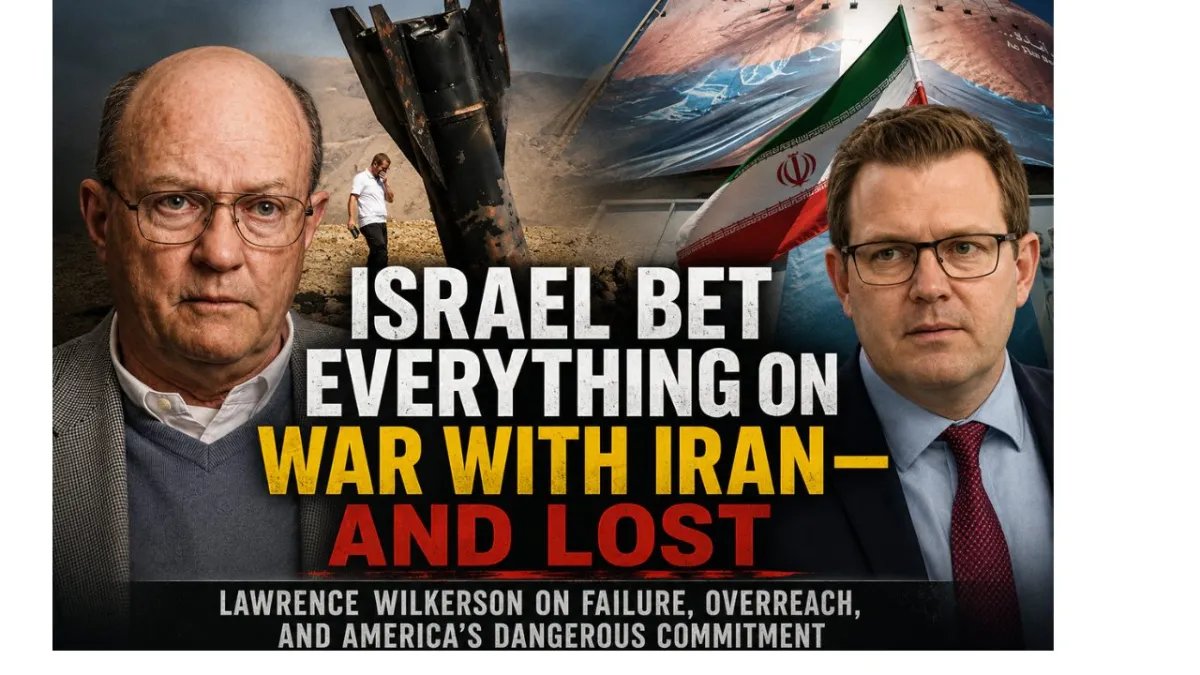
As Washington Moves to Bind Itself Even More Closely to Israel’s Security Apparatus, Former State Department Chief of Staff Lawrence Wilkerson Warns That the Real Crisis Is No Longer Iran—It’s the Political, Moral, and Strategic Cost of Endless War.
For decades, Israeli leaders argued that confrontation with Iran was essential to the country’s security and survival. But according to retired Colonel Lawrence Wilkerson, former chief of staff to Secretary of State Colin Powell, that strategy has reached a dangerous dead end. In a sweeping interview with political analyst Glenn Diesen, Wilkerson argues that Israel’s long campaign to isolate and weaken Iran has instead strengthened Tehran’s regional influence, exposed the limits of military power, and accelerated a global shift away from U.S. dominance. Meanwhile, as Gaza’s humanitarian catastrophe deepens and public support for Israel continues to erode worldwide, Washington is moving in the opposite direction—embedding Israel more deeply than ever into America’s military, intelligence, and defense-industrial infrastructure. The result, Wilkerson warns, is a path toward greater instability, diminished democratic oversight, and a foreign policy increasingly disconnected from the will of the American people.
Speaking with political analyst Glenn Diesen, Wilkerson contends that despite years of military escalation, sanctions, and regional conflict, Israel has failed to achieve its central objective: weakening Iran’s influence across the Middle East. Instead, he argues, the war has strengthened regional opposition, intensified global criticism of Israel’s actions in Gaza, and exposed growing cracks in America’s support for endless military intervention.
At the center of Wilkerson’s analysis is a point often ignored in Western discussions: the conflict ultimately revolves around Palestine.
“The Palestinians are still dying every day,” Wilkerson noted, arguing that military campaigns against Iran, Lebanon, and Gaza have failed to address the root political crisis driving instability throughout the region.
Highlights
• “All Iran has to do is not lose.” Wilkerson argues that Israel and the United States require a decisive victory while Iran simply needs to survive and endure.
• Palestine remains the core issue. According to Wilkerson, efforts to shift attention toward Iran, Hezbollah, or other regional actors obscure the unresolved question of Palestinian statehood.
• Growing public opposition. Wilkerson points to rising global criticism of Israel’s actions and increasing skepticism among Americans about continued military involvement abroad.
• A deeper U.S.-Israel integration. He warns that proposed legislation would further embed Israel within the U.S. military and defense establishment while reducing public oversight and accountability.
• A changing world order. Wilkerson argues that conflicts in the Middle East and Ukraine are unfolding alongside a broader shift in global power away from Western dominance and toward emerging Eurasian economic and political networks.
For Wilkerson, the danger is not simply another regional war. It is the possibility that Washington continues doubling down on military solutions while ignoring the political realities that have fueled conflict for generations. The result, he warns, could leave both Israel and the United States increasingly isolated in a rapidly changing world.
Editor’s Note: At a moment when the once vaunted model of responsible journalism is overwhelmingly the play thing of self-serving billionaires and their corporate scribes, alternatives of integrity are desperately needed, and ScheerPost is one of them. Please support our independent journalism by contributing to our online donation platform, Network for Good, or send a check to our new PO Box. We can’t thank you enough, and promise to keep bringing you this kind of vital news.
You can also make a donation to our PayPal or subscribe to our Patreon.
Please share this story and help us grow our network!
[ad_2]
Source link
