
[ad_1]
Juan Cole for Informed Comment
South Korea, the world’s 13th largest economy, spends more of its gross domestic product to import fossil fuels than almost any other country on earth, with the bill amounting to $25 billion a year, according to Energy Live News.
Worse, the cost of fossil gas could increase by 41% this year, since has seen a price spike over the Iran War and the closure of the Strait of Hormuz. Moreover, it seems unlikely that the Persian Gulf will ever again be a reliable source of fossil fuels, since there will be further Israel-US-Iran wars. So South Korea’s carbon-heavy approach to energy is not only expensive but foolhardy.
And, South Korea is especially tied to the Persian Gulf, from which it gets 70% of its petroleum imports.
South Korea only has about 37 gigawatts of renewable energy, and only 11.4% of its electricity is generated by wind, water, solar and battery. Even these small renewables installations are projected to save the country $4.7 billion this year, which is what it would have cost to import fossil gas to cover that 11.4% of electricity generation.
The country’s 26 nuclear plants generate 31.1% of its electricity. But dirty and dangerous coal accounts for more, at 32.6%, with imported fossil gas at 24.9%. This high carbon profile with nearly 60% of electricity coming from dirty high-emissions sources, is shameful just as a matter of responsibility to the planet. But even just as a practical matter, it is very expensive, and South Korea is paying through the nose.
The government has just announced, however, that it will try to triple renewables over the next four years, to nearly 100 gigawatts. It could replace half of the imported fossil fuels by doing so, slashing its import bill by $12 billion. Although wind and solar farms and batteries incur up-front installation costs, after that the fuel is free, so the savings accrue year after year.
The plan involves a government-backed push to build 10 massive solar complexes in the eastern Gangwon Province, in the central Chungheong Province, and in the Seoul metropolitan area with a hope of generating 12 gigawatts.
In addition, the government wants to slap solar panels everywhere it can, on rooftops, on factories, on roads and in parking lots, with an aim of generating another 44 gigawatts from these PV panels. It wants to bring down the cost of solar-generated electricity below that of electricity produced by liquefied natural gas. (That should be easy, since solar is 5 to 8 US cents per kilowatt hour and LNG is 12 cents per kilowatt hour).
The country is also trying to expand community solar .
But the real prize would be if South Korea could develop solar PV panels that are more efficient and cheaper than those of China, which dominates 80% of the global solar panel market. Hyundai and Hanwha Q Cells are in a race to do just that.
The state-run Korea Southern Power Co. or KOSPO alone plans for 11 gigawatts of new wind and solar by 2040.
Seoul very much has its eye on expanding battery storage as well, which is key to benefiting fully from solar and wind farms, since the sun doesn’t shine at night and the wind doesn’t always blow.

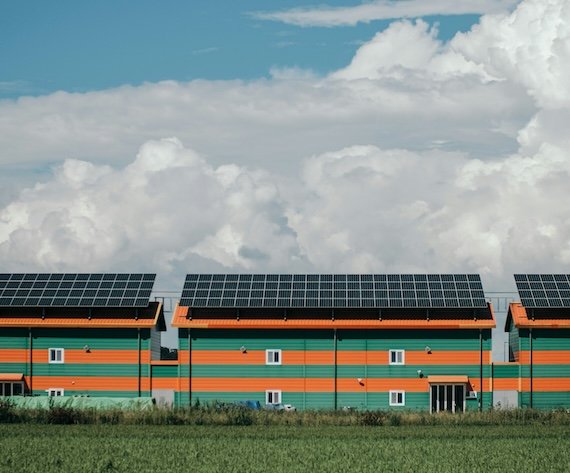
Photo of Sinseong-ri, Hansan-myeon, Seocheon-gun, Chungcheongnam-do, South Korea by insung yoon on Unsplash
Hyundai observed in its Q1 report that the “EV chasm,” i.e. a prolonged period of stagnant growth, in South Korea is over. From January to April, Tesla sales skyrocketed by 445.2% year over year, and South Korea’s Kia sold even more EVs than Tesla did. Hyundai’s sales volume lagged the other two. The Chinese BYD is now also available in South Korea and is doing well. As the South Korean grid gets 50% cleaner over the next four years, that will drive down transportation emissions.
This sudden drive toward renewables by one of the laggards among the industrialized democracies is an important signal that the Hormuz crisis may have just kicked off a massive and permanent demand destruction in the fossil gas and petroleum spaces. The South Koreans who begin driving electric and discovering how much cheaper it is, and those who pay 5 cents a kilowatt hour for solar electricity instead of 12 for LNG electricity, are never going back. Those customers are forever lost to fossil fuels. That is the big difference between past energy crises and today’s. People used to just cut down on their driving and use less air conditioning when prices were high, but then usage roared back afterwards. This time, it won’t roar back.
Juan Cole is the founder and chief editor of Informed Comment. He is Richard P. Mitchell Distinguished University Professor in the History Department at the University of Michigan He is author of, among many other books, Muhammad: Prophet of Peace amid the Clash of Empires and The Rubaiyat of Omar Khayyam. Follow him on Twitter at @jricole or the Informed Comment Facebook Page
Editor’s Note: At a moment when the once vaunted model of responsible journalism is overwhelmingly the play thing of self-serving billionaires and their corporate scribes, alternatives of integrity are desperately needed, and ScheerPost is one of them. Please support our independent journalism by contributing to our online donation platform, Network for Good, or send a check to our new PO Box. We can’t thank you enough, and promise to keep bringing you this kind of vital news.
You can also make a donation to our PayPal or subscribe to our Patreon.
Please share this story and help us grow our network!
[ad_2]
Source link
