
[ad_1]
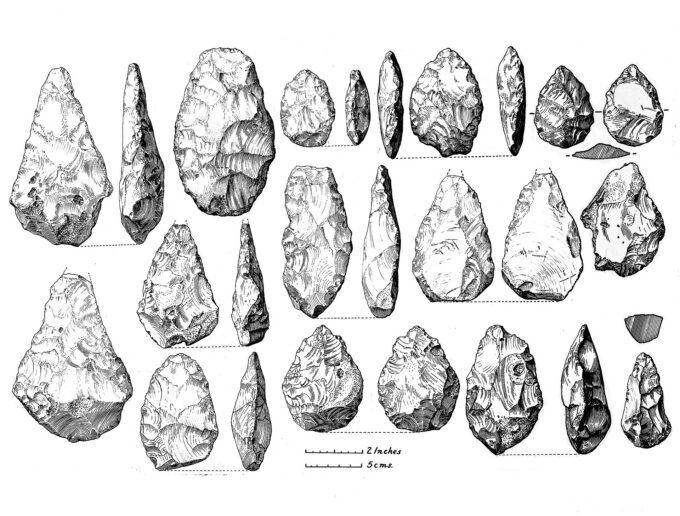
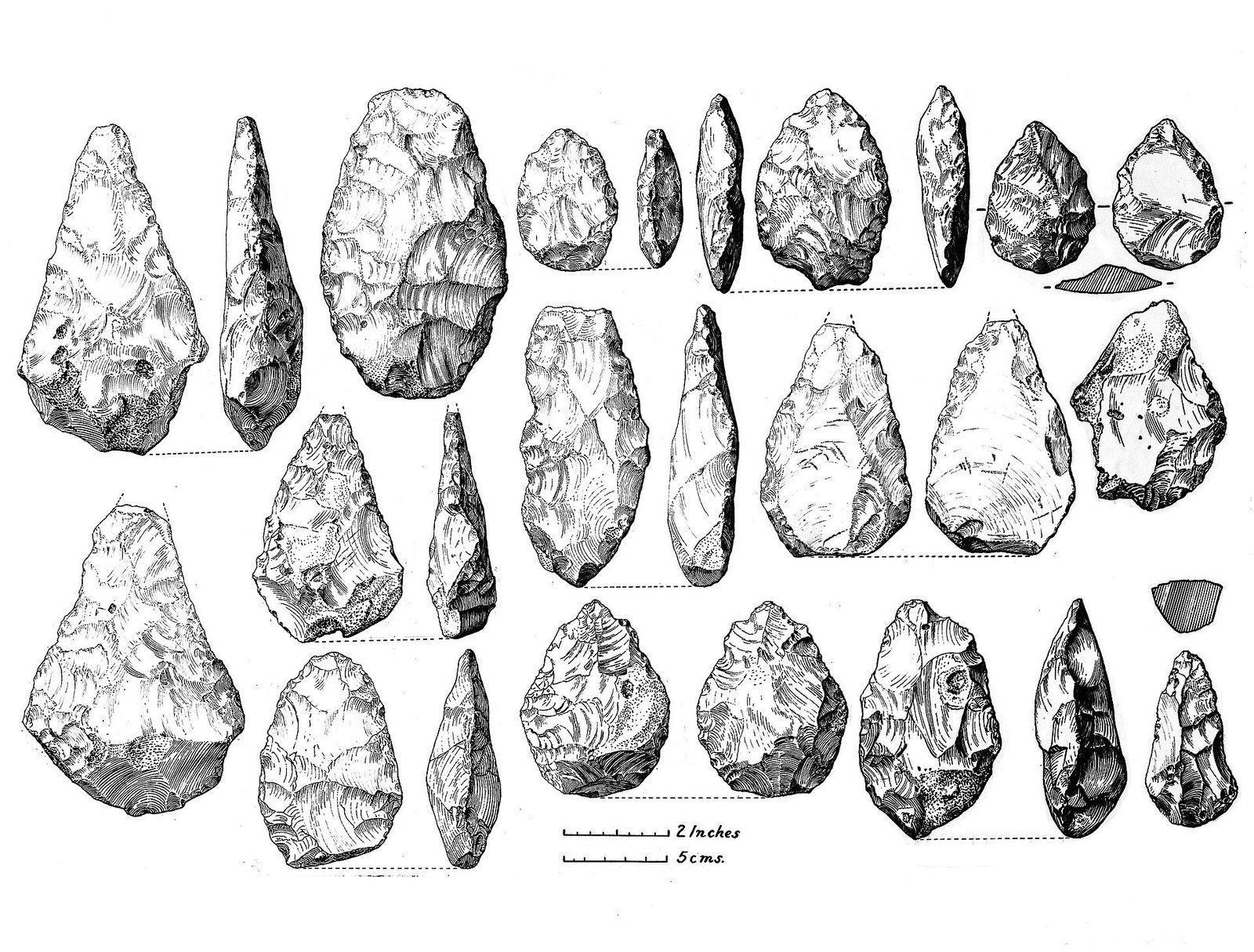
Acheulian bifacial tools (hand-axes) from Burnham Beeches, Bucks. Image Source: This file comes from the Wellcome Collection, a website operated by Wellcome Trust, a global charitable foundation based in the United Kingdom – CC BY 4.0
Many people are overwhelmed by the fast-paced evolution of mass communication in a world increasingly shaped by the internet and artificial intelligence (AI). Yet ideas have not always circulated across the globe at lightning speed.
Looking into deep time allows us to view our current mode of existence from a broader perspective and to discern patterns of change that may offer insights into our species’ possible trajectories in the future. We can begin by trying to identify the conditions under which humans developed complex symbolic communication, which is considered unique in the animal kingdom. Today, we have succeeded in transposing incredibly complex digital languages, beyond the grasp of the human mind, into computerized systems capable of processing, storing, and sharing all kinds of information with the push of a button or a click of a mouse.
Human language is at the root of this system. While hardly perceptible in the archeological record, hominin physiognomy assessed from the fossil record allows us to observe that the capacity to vocalize across a significant range dates back to a very early time period. Physical features linked to resonance complexity and articular precision, like the low positioning of the larynx, an enlarged pharyngeal cavity, and a flexible tongue housed in an ample palate, were already part of the human anatomy by the time Homo erectus emerged in Africa nearly 2 million years ago.
Somatic harmonization, necessary for speech production, is ensured by the tiny and crucial hyoid bone, a floating anchor for the muscles controlling the tongue, throat, and voice box as they work together to regulate sounds emitted during speech. Paleoanthropologists studying the position, geometry, and internal structure of Neanderthal hyoids discovered in archeological sites found them to be nearly identical to those of anatomically modern humans, suggesting that they were already capable of emitting a similarly sophisticated range of sounds. Evidence from Spain also reveals that modern hyoid morphology was present by at least 530,000 years ago, indicating that it could be a derived characteristic shared by modern humans and pre-Neandertals, which they inherited from their last common ancestor.
The ability to emit a wide range of vocalizations characteristic of modern human language did not appear abruptly, but rather, was favored over millennia by interrelated adaptive elections taking place under the evolutionary orchestration of both natural selection and techno selection. As early as around 7 million years ago, some early primates displayed several craniofacial modifications believed to have evolved, at least in part, to accommodate bipedal locomotion. These included features such as reduced prognathism, more gracile jawbones with smaller teeth, and a restructured skull base, all of which subsequently facilitated the anatomical tweaks necessary to increase the human capacity to pronounce a wide range of sounds.
By the time hominins began systematically making stone tools some 2.6 million years ago, a series of changes in the archeological record reflected the significance of this adaptive strategy. Around 1.75 million years ago in Africa, these (Oldowan) assemblages were progressively replaced by Acheulian industries comprising tools with wider technological and morphological variability, including skillfully manufactured and (esthetically pleasing) premeditated forms, like spheres and symmetrical pointed tools called handaxes, which required high degrees of dexterity to make.
Observing synapses activated during experimental tool replication has shown that the cognitive processes involved in passing on the skills necessary to make such tools are linked to those activated by language. Furthermore, evidence from ancient DNA analysis suggests that regulatory genetic variants favoring language-producing abilities underwent long-term evolutionary selection in hominin populations, with some of these features predating the divergence of modern humans and Neanderthals.
Fully embracing the advantages offered by their newfound technological proficiency, Acheulian hominins benefited from access to the choicest morsels of meat and viscera to feed their developing brains. They experienced unprecedented demographic expansion and assembled into more complex group settings sheltering numerous individuals. Eventually wielding fire, Acheulian populations spread into new lands within and beyond Africa, utilizing their rapidly developing technologies to confront diverse environmental and social challenges.
Some archeologists have described this process as a biocultural feedback loop, in which unprecedented cerebral growth (supported by higher protein intake) was linked to toolmaking. This process was catalyzed by increasing social complexity, reinforced by the development of culture, and favored the selection of symbolic communication. Language—the preponderant expression of symbolic transmission—initially developed as a survival-related response to effectively transmit technological competence, and ultimately became a means to express multifaceted cultural norms developed to promote social proficiency.
There is no doubt that culture evolves; that it was/is transmitted socially through learning processes that have been intricately developed over time and now extend well past adolescence and, in some cases, beyond the optimal reproductive age for women. Culture is inherently cumulative: it is an aggregate of past human experiences, errors, discoveries, adaptations, and rectifications to deduce scientific and philosophical insights about the universe—and our place in it. Symbolic communication, expressed as language and writing, and later also as art and music, reinforces cumulative culture by allowing us to express, preserve, and share knowledge beyond time constraints.
The story of technological evolution following the emergence of the Acheulian reveals two major forces that still operate today: acceleration and complexification. By the end of the Acheulian and into the Middle Paleolithic period and beyond, technological and (linked) social achievements accumulated exponentially, widening the baseline upon which hugely transformative accomplishments emerged. At the same time, populations multiplied, creating interrelational networks that favored reproductive, material, and cultural exchanges.
I have proposed defining this phenomenon as a fractalization process, insofar as each branch replicates the underlying evolutionary patterns, overcoming the constraints of its ancestral source while retaining the full spectrum of human cognitive expression. In this model (that is comparable to biological natural selection), small variations or adjustments can lead to exponentially magnified outcomes through recursive and effectively infinite cycles of reproduction.
By the time our own species came on the scene more than 200,000 years ago, culture had flourished into symbolic material expressions, inexorably linked to the technological and social realities of past human lives. Fire, for example, provided ample fodder for experimenting with the power of transforming existing materials, enabling new capacities during the Neolithic and Metal Ages, with successive discoveries, such as pottery and, eventually, glass and metallurgy, transmuting and enabling new societal paradigms.
Following the shift from hunter-gatherer to production-based lifeways, technological complexity split individual role-playing into distinct occupations, sharpening perceptions about (imagined) interpersonal “value” within social settings. As populations swelled and collective living arrangements expanded, these systems became structured around complex symbolic interactions, material cultures, territorial identities, and hierarchies constructed to sustain group cohesion. Importantly, social organization came to rely upon artificially constructed (symbolic) notions that led regionally assembled groups to contrast their ideas of communal belonging (identity) with those existing in neighboring territories. As competition for land and resources increased, these contrasting symbolic realities became a justification for (sometimes violent) interpopulation conflicts.
Communication networks grew increasingly complex alongside expanding production and territorial markets, accelerating the spread of cultural and material exchanges. Protohistoric societies developed early writing systems based on symbolic signs used as mnemonic strategies to represent ideas and objects. Emerging independently in regions such as Mesopotamia, Egypt, Central America, and China, these systems gradually evolved from pictorial symbols into stylized phonetic and logographic writing largely detached from their original visual meanings.
Throughout human experience, learning has been central to survival, with scientific and behavioral complexification acting as a driving force to develop sophisticated new ways to educate, demonstrate, and train each successive generation to become effective agents of our seemingly unstoppable technological proficiency. Presently, ideas move instantaneously across space and time through global communication networks. Digital platforms make information accessible worldwide, shrinking distances and connecting populations, while promoting mass media and consumer culture. Often shaped by corporate interests that influence production, consumption, and resource distribution in a world driven by digital images and symbolic messaging, global connectivity has become the force shaping human thought and social organization.
Uniformity is increasingly becoming a defining characteristic of human life shaped by digital communication. Despite the technological sophistication of the systems that mediate and transmit human thought, we are adopting simpler forms of communication, homogenizing language, and gradually adapting our patterns of thinking to fit the digital platforms used to express them. The next stage of human evolution involving the merging of human intelligence with AI may already be here. As we become increasingly dependent on computerized tools to function within contemporary social environments, the ability to communicate effectively through digital means is emerging as a fundamental requirement.
At the end of the 1980s, screenwriter Maurice Hurley and the creators of Star Trek showed remarkable foresight in creating the Borg: fictional cybernetic organisms linked through a single collective consciousness in which thoughts and actions are shared and controlled by a powerful centralized computer system. In this dystopian vision of the future, the Borg’s main purpose is to assimilate other species in pursuit of greater knowledge, efficiency, and power. Once assimilated, subjects lose their individuality and become linked to the Collective (or hive mind).
As humanity moves toward a predicted state of post-humanism (human-
This article was produced by Human Bridges.
[ad_2]
Source link
