
[ad_1]
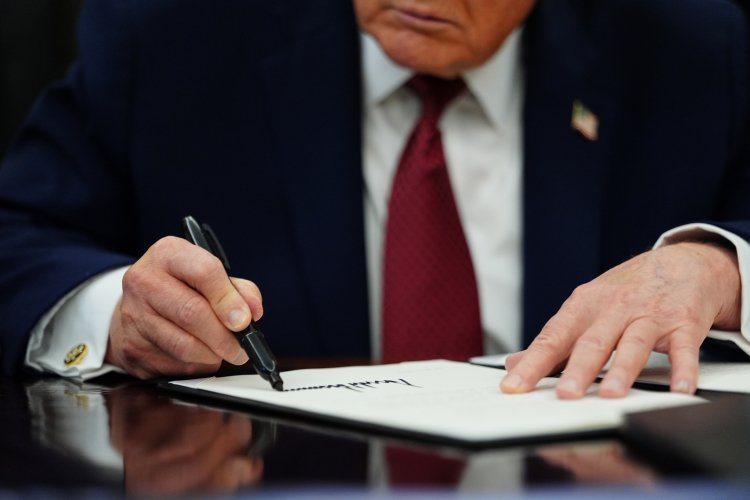
In the wake of President Donald Trump’s sudden signing of an executive order on artificial intelligence, analysts and developers alike are scratching their heads trying to figure out what precisely it means. And while both the accelerationists and the safety hawks claim a victory, the nation’s intelligence communities seem to be benefitting the most from Trump’s executive order.
“If there’s any such thing as a Mythos Moment, the intelligence agency has taken the upper hand and they’re driving this process, it seems, more than anything else,” American Enterprise Institute senior fellow Will Rinehart told RealClearPolitics.
In May, Anthropic made the rare statement that it had a new model out but would not release it to the public because it was too dangerous. The large language model, called Mythos, has extensive codebase auditing abilities which allow it to pinpoint vulnerabilities better and faster than any other program. But in the wrong hands, that could exploit banking, infrastructure, and government programs. The alert from Anthropic served as a wake-up call for the White House.
The executive order directs federal agencies to create a classified process to vet frontier artificial intelligence models such as Anthropic, OpenAI, and Google 30 days before public release. The National Security Council, Treasury Department, and Defense Department will test the models for cybersecurity threats. But the executive order makes clear that the pre-release system is entirely voluntary. Developers who want White House favor will have an incentive to give early access but are not required to.
This closely follows an earlier version of the same order that Trump refused to sign two weeks ago. At the time, he told reporters that he was concerned it would affect the United States’ competition with China. But the only change between the original and the version signed this week was a shortening of the review period from 90 days to 30.
David Sacks, venture capitalist and former AI czar for the White House, balked at the 90-day number. According to Politico, he called Trump on the day he was supposed to sign the first bill and urged the president to eliminate any middle process between development and release. But AI hawks in the White House had their own concerns.
The Politico report divided the president’s advisors into three factions: Sacks represents the accelerationist team, supported by Silicon Valley. Defense Secretary Pete Hegseth pushed for stringent regulations to protect national security and keep China at bay. White House chief of staff Susie Wiles and Treasury Secretary Scott Bessent fell into a middle ground that pushed for regulations balanced with ways to keep developers competitive.
The version signed this week mollifies the Sacks contingent but lands solidly in the third camp.
“This is [a] fairly major win for the safety contingent within the admin, and a significant loss for the Sacks/accelerationist wing, and is surprising to me,” Foundation for American Innovation senior fellow Dean Ball posted on X. He formerly worked in the Trump administration and authored part of the AI Action Plan published last year.
In the end, Sacks got part of what he wanted. He posted to X on Tuesday that he understands the 30-day benchmark to mean calendar, not business, days. Sacks described the difference between this and the original 90 days as a game changer.
“It allows our AI labs to comply with the voluntary framework without delaying new model releases. They can synchronize their efforts under the EO with other pre-release activities,” Sacks posted. “In the AI race, every day counts.”
Installing any measure to pump the brakes represents a shifting position for the Trump White House. Vice President JD Vance urged only speedy development at a Paris speech last year. Now, the regulators, and particularly intelligence agencies, seem to be steering the ship.
“We’ve seen a sea change in the administration’s policy on AI over the past year,” Americans for Responsible Innovation vice president of communications Chris MacKenzie told RCP. “The bulk of the administration’s energy went into how to preempt state laws on AI and there was no activity on how to mitigate risks. Now, compare that to today: The administration is taking a serious look at how to address AI risks especially in the domain of cybersecurity.”
“I think the Mythos issue … is a separate national security moment where we have to make sure that our networks are hardened up, because that model has capabilities that are particular to finding cyber vulnerabilities and patching them,” Defense Department CTO Emil Michael told CNBC’s “Squawk Box” in May.
The Defense Department labeled Anthropic a supply chain risk and banned the agency from implementing any of its programs, due to what Defense Secretary Pete Hegseth called ideological lunacy. Anthropic sued the administration to push back against the blacklisting. But Mythos appeared to highlight the federal government’s admission that it needed to pay more attention to regulatory guardrails.
“This is formalizing a process led by the federal government to provide a clear path for companies to preempt a bad scenario,” MacKenzie said. “These developers don’t want their models to be used to undermine the financial system. So having the expertise of the federal government also working to discover vulnerabilities before release is beneficial.”
The administration’s public messaging in the days after the order was released attempted to calm fears about the government controlling AI model releases, clarifying pre-release was voluntary and only focused on the largest AI labs.
“We are NOT conducting oversight of all new models, as that level of government overreach would have chilling effects on free speech and innovation,” the Office of Science and Technology Policy posted to X, in response to a New York Times report about the order. “The EO creates a process for frontier labs to voluntarily share cutting-edge cyber models in order to secure critical infrastructure and strengthen the government’s own cyber defenses.”
While the administration promotes the voluntary nature of the order, it also stipulates that the agencies in charge of determining vetting procedures and which developers qualify as frontier will be classified. For some, that contradicts the White House’s transparency message.
“I continue to think this [executive order] is a mistake,” Dean Ball with FAI wrote. “The fact that the administration is classifying the details of how this ‘voluntary’ system will work is egregious … All for a benefit that is barely articulable; what, exactly, is the intelligence community going to do in 30 days to make the models safer?”
Rinehart said he was encouraged by the newfound emphasis on safety regulations, but the order is still not clear enough. The NSA and the Cybersecurity Infrastructure Security Agency will lead the government-wide effort to establish a classified process to test these models, but they’re not directed to share that criteria with developers.
“This seems a bit hand-wavy,” Rinehart said. “The entire process doesn’t bring any light to that, and the industry doesn’t have a great standard by which to determine what are truly frontier models. Experts don’t agree on how to determine frontier model capability, so it’s not even well-understood within the industry.”
Ultimately, Rinehart said the White House would benefit from establishing a point person, similar to David Sacks’ former role, to direct a clear AI strategy. It is not unusual for the president to seek a variety of opinions on any given topic, and the broad involvement also highlights the far reach of policy concerns. But Rinehart says the White House could use some more organized direction.
“[The White House has] people working on AI, but they’re split between many positions,” Rinehart said. “I don’t think that even what they want out of an AI bill is as developed as the Biden administration was towards the end of his term.”
Many cooks have joined the White House’s AI kitchen over the past year. On paper, Sacks was the AI czar, but he was never a full-time White House employee. Office of Science and Technology Policy director Michael Kratsios is involved, but Sriram Krishnan serves as the senior policy advisor on artificial intelligence.
On his third day back in office, Trump re-chartered the President’s Council of Advisors on Science and Technology, first established by President George W. Bush. But he did not nominate any members to the council until March of this year. Kratsios and Sacks will serve as co-chairs, and several tech executives will comprise the board. The list includes Meta CEO Mark Zuckerberg, Dell Technologies CEO Michael Dell, and Oracle co-founder Larry Ellison. Trump also added former Attorney General Pam Bondi to the board last week.
Carolina Lumetta is White House correspondent for RealClearPolitics. Follow her on X @CarolinaLumetta.
[ad_2]
Source link
