
[ad_1]
By Hend Salama Abo Helow
This article was originally published by Truthout
A Palestinian doctor in Gaza says the territory is facing its worst medication shortage since Israel began the genocide.
My mother has been a hypertension patient for the past 25 years. Ever since her initial diagnosis, she has adhered strictly to her prescribed medication. Yet since the genocide broke out, her medicine gradually ran out until it vanished from the markets altogether, with no clinic, pharmacy, warehouse, or stockpile left untouched by the shortage.
Eventually, my mother was forced to redraw her therapeutic map around two alternative drugs with relatively similar efficacy to the one she had lost. The doses were measured carefully according to her condition. But the fear of losing the medication again grew on her, so she began rationing her doses, taking half a pill instead of a full one, to make them last longer.
Although the ceasefire that followed was supposed to allow the unhindered influx of humanitarian aid and life-saving medical supplies at scale, it proved to be nothing but another trap. My mother went to collect her monthly prescription, only for the pharmacist to tell her that this would likely be the last refill, as the medication had already been depleted.
This is not an isolated plight endured only by my mother, but the status quo for 350,000 chronic patients in Gaza whose health, like hers, hangs in the balance, conditioned on the fluctuating status of the borders.
Faced with a shattered health care system, patients’ survival is dependent on Israel’s tightening restrictions on border crossings. The World Health Organization has warned that Israeli forces are no longer only claiming people’s lives through bombs, but are also endangering Palestinians by denying them urgently needed health care services and medication.
Israel is willfully violating international law, which obligates the occupying power to maintain health care services, not undermine them nor use them as a bargaining chip.
Dr. Ahmad Al-Farra, head of the pediatric department at Nasser Hospital, described the ongoing crisis as “the worst period ever of depletion of medical supplies,” stressing that it even far outweighed the medicine shortage Gaza had witnessed earlier during the genocide. “It is the worst ever,” he emphasized.
He condemned the use of the word “ceasefire,” stating, “We are nearly 900 days into a war despite the one-sided truce.” He pointed to more than 2,400 breaches of the so-called ceasefire, during which 765 Palestinians were killed and roughly 2,100 wounded. Al-Farra further noted that around 1,700 medical staff have fallen during the two years of genocide, while many others remain captured in Israeli prisons.
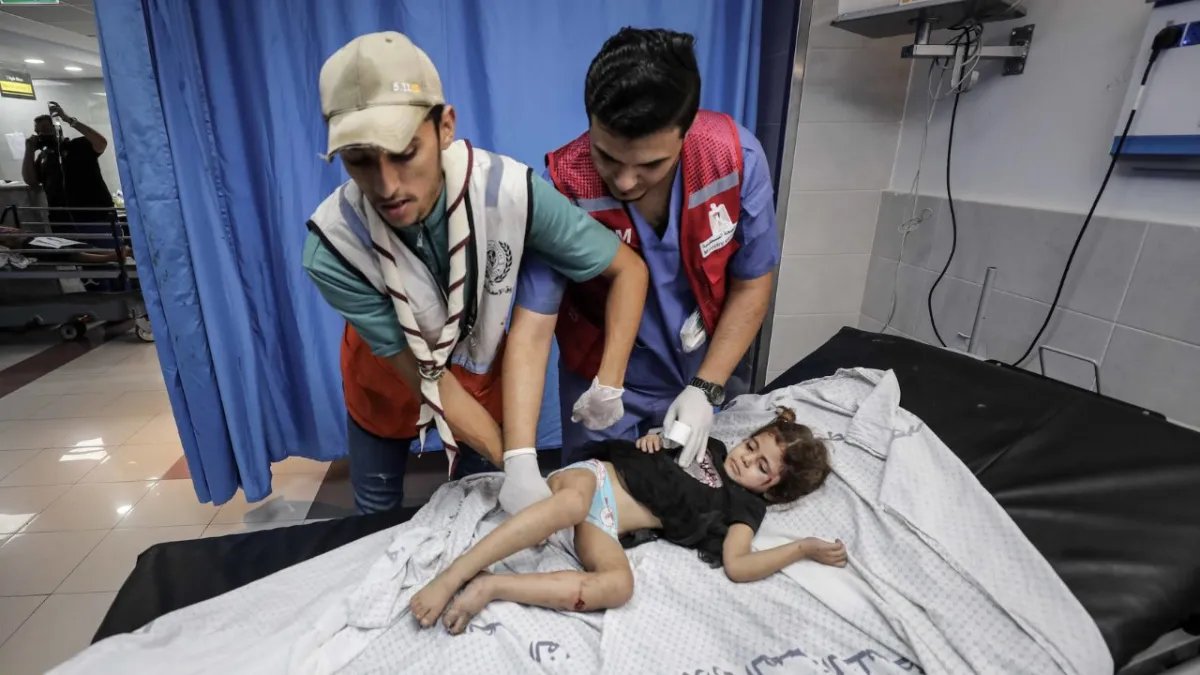
Bringing the picture together, he told Truthout that 25 out of Gaza’s 36 hospitals are now out of service, while 103 out of 137 primary health care centers have been damaged, and medical supplies have totally run out.
Al-Farra, in a broken voice, remarked that hospitals have become “nothing more than hollow cement blocks, stripped from the very core they were built for: medical services.”
Sharing the latest not-yet-public statistics of the exact shortages compiled by Gaza’s Health Ministry exclusively with Truthout, he said:
Fifty percent of basic medications for noncommunicable diseases like hypertension, diabetes, asthma, and respiratory diseases are now missing. Around 70 percent of medical equipment is nonexistent, while 84 percent of laboratory resources are unavailable. At the same time, hospital capacity has surged by 225 percent. Around 25 out of 35 oxygen stations have been damaged, while 61 electricity generators out of 110 have been leveled down.
The health care system is “in its final throes,” Al-Farra sighed.
The unending crisis has extended beyond governmental hospitals to the humanitarian organization Médecins Sans Frontières (MSF). In early April, MSF released alarming reports stating that it had not been able to bring any medical supplies into Gaza since January 1, 2026. Israel has obstructed its vital role in providing necessary health care services for chronic and trauma-related patients, and those requiring surgical operations and post-operative care, all amid a growingly conducive environment for diseases to exacerbate.
Yet Dr. Abdullah Al-Naami, who has worked in the pharmacological field for the last 26 years, doubled down on the alarming report released by MSF about the unfolding medication crisis.
Al-Naami told Truthout that “the current stockpile of medicines is nowhere near enough for the spiraling needs.” He added that “hypertension, cardiovascular, and cancer patients are impacted the most.”
“New emergency cases have been rising due to the low-quality living conditions and contamination inside the displacement camps, including scabies and infectious diseases.” Yet “painkillers, antibiotic pills, ointments, and sterilized gauzes are running critically low. Patients receive their treatment for one month, while the following months remain suspended until further notice and medications become available again.”
Based on the medication scarcity, Al-Naami explained, “this is why we cannot provide the full amount of the prescribed medication. Instead, patients receive either half or quarter the quantities. The Ministry of Health has even resorted to extending the expiration dates of medications and renewing their use after testing their efficacy. All of this is merely to enhance the patients’ survivability amidst suffocating restrictions meant to crush Palestinians’ health.”
Al-Naami also underscored the significant shortages of nebulizers, whose absence has ultimately threatened hundreds of thousands of lives.
Young children are also facing devastating health consequences due to what Al-Farra described as “one of the Israeli strategies”: allowing one specific type of infant formula into Gaza until it became the primary milk depended on by nearly every child, only to later ban its entry after infants’ tiny bodies had already grown accustomed to it.
“Such abrupt switches in milk type result in malabsorption diseases, allergies, and potentially fatal complications,” he explained.
Al-Farra recounted the story of his patient, Huda Abo Al-Naja, a 12-year-old girl who was in the third phase of malnutrition, immunocompromised, and suffering from severe anemia.
He said she had been admitted to the hospital four times due to edema, “the accumulation of fluids in her body.”
Al-Farra lamented that the patient was “a unique and genius child,” fully aware of her own condition. He recalled how she would even compete with the intern doctors, answering questions related to her illness on their behalf.
Her journey fluctuated constantly between remission and relapse, improvement and deterioration, until she eventually developed sepsis that progressed into hypotension and septic shock, leading to admission to the ICU. During her stay, she urgently needed numerous diagnostic procedures and therapeutic interventions, including “bacterial cultures, a central line, arterial blood gas analysis, and electrolyte testing” — all of which were unavailable back then.
“Due to the lack of the necessary diagnostic and therapeutic tools needed to save her life, Huda died,” Al-Farra said.
Al-Farra placed the blame directly on “the collapse of Gaza’s health care system and the complete closure of border crossings imposed all by Israeli forces.”
For those who survived two years of genocidal war, the atrocities did not stop there. They are now at the peril of “a more engineered silent weapon: scarcity of medication,” as Al-Farra put it plainly.
He called on the international community and mediators to pressure Israel into opening the border crossings for the unconditional and unhindered flow of medical supplies. He added the need to reclaim Palestinians’ right to a dignified life and proper treatment, which is “a fundamental legitimate right under international law.”
This article was originally published by Truthout and is licensed under Creative Commons (CC BY-NC-ND 4.0). Please maintain all links and credits in accordance with our republishing guidelines.
Editor’s Note: At a moment when the once vaunted model of responsible journalism is overwhelmingly the play thing of self-serving billionaires and their corporate scribes, alternatives of integrity are desperately needed, and ScheerPost is one of them. Please support our independent journalism by contributing to our online donation platform, Network for Good, or send a check to our new PO Box. We can’t thank you enough, and promise to keep bringing you this kind of vital news.
You can also make a donation to our PayPal or subscribe to our Patreon.
Please share this story and help us grow our network!
[ad_2]
Source link
