
[ad_1]
Michigan state Sen. Mallory McMorrow criticized an economic development program during a May debate, saying the state has shelled out billions for corporate subsidies but has little to show for it.
“Michigan has spent more than $2.5 billion on incentives to companies since 2019, and so far, that fund, the (Strategic Outreach and Attraction Reserve) fund, has created zero jobs,” McMorrow said during the May 28 Democratic primary debate. McMorrow supported the fund in 2021 but has since backed away from it, citing a lack of resulting jobs.
McMorrow, chair of the Michigan Senate’s Economic and Community Development Committee, is running for U.S. Senate in Michigan. Her opponents in the Democratic primary include former public health official Abdul El-Sayed and U.S. Rep. Haley Stevens.
Since Gov. Gretchen Whitmer, a Democrat, took office in 2019, she has focused on recruiting businesses to the state through subsidy and incentive programs. Her administration’s flagship program is the Strategic Outreach and Attraction Reserve Fund, or SOAR.
To back McMorrow’s statement, her campaign pointed to local reporting that said the state had pledged $2.5 billion of SOAR money to companies and other organizations. “SOAR cost billions and largely failed to deliver for Michiganders,” McMorrow campaign spokesperson Jackson Boaz said.
Publicly available state data shows that about $2.2 billion has been approved for projects, and $1.3 billion has been spent. The state announced the first awards from the fund in 2022, not 2019. Companies self-reported creating at least 1,800 jobs; the state said it plans to verify that once milestones are reached.
How much has Michigan spent on SOAR?
State lawmakers created the SOAR fund through a series of 2021 bills and initially allocated $1 billion. Later state budgets provided more funding.
Bridge Michigan, a local news outlet, reported that $2.5 billion in spending had been approved from the program. PolitiFact was not able to independently verify that figure.
But not all of that has been spent. In 2025, state lawmakers stripped the program of future funding because of dissatisfaction with outcomes, but the previously budgeted amounts remained in place.
The SOAR funding is split into two pots: the Critical Industry Program, which pays companies to encourage hiring in Michigan, and the Strategic Site Readiness Program, which gives grants to economic development groups to prepare industrial sites. The site readiness grants aren’t paid directly to companies nor are they tied to a promised number of new jobs, but groups often have a company in mind when developing a site.
As of October 2025, Michigan officials had spent $1.3 billion between the two programs, according to a report from the Michigan Economic Development Corporation, a public-private partnership agency that administers the SOAR fund. The fund spent $720 million on company subsidies tied to promised jobs, and another $590 million on site preparation. The Michigan Economic Development Corporation declined to comment for this report.
The latest official tally of approved funding, which includes grants that have been awarded but not spent yet, sits at close to $2.2 billion, according to the development agency’s report.
Eric Lupher, president of Citizens Research Council of Michigan, a nonpartisan public policy center, said it’s reasonable to consider money committed to specific projects as money “spent” by the state. The work has been contracted, and the money will be spent when it’s complete, he said.
“One way or another that money’s going to go out the door,” he said. “Some of it’s sitting in an account waiting for the check to be cut when the time is right.”
But, Lupher said he’d have “some hesitancy” to judge the program’s effectiveness at creating jobs based on projects that are in progress.
“You sort of have to wait for that facility to be up and running for a few years to let the dust settle and then look at it in its totality,” he said.
To receive the full awarded funding, companies have to meet certain benchmarks and hiring standards. Some deals have already fallen apart, including a deal with electric vehicle maker Gotion to build a battery factory in Big Rapids. In that case, the state attorney general is trying to claw back $23.7 million that a development group passed onto Gotion from the site selection fund.
How many new jobs did SOAR create?
The Michigan Economic Development Corporation’s report said companies receiving SOAR incentives reported creating 1,846 jobs by October 2025. The companies promised a combined 14,559 jobs over several years.
Most of the jobs so far came from one company, Solar Technology LLC, which is building a 1 million-square-foot factory in Saginaw County. The company reported 1,244 jobs linked to a $68 million state investment. Other projects that reported new jobs included battery factories being built by Ford Motor Co. and LG Energy.
The jobs are self-reported. Because none of the job verification deadlines under the grants have happened yet, the state-verified count of jobs is zero, the report said. The first of those milestones, with Solar Technology, is not until December 2027.
Our ruling
McMorrow said, “Michigan has spent more than $2.5 billion on incentives to companies since 2019, and so far, that fund, the SOAR fund, has created zero jobs.”
The SOAR fund has committed more than $2 billion toward attracting companies to create jobs in Michigan; since 2022, about $1.3 billion has been spent on companies and economic development groups.
Companies reported creating more than 1,800 jobs. The state has not verified the jobs number yet.
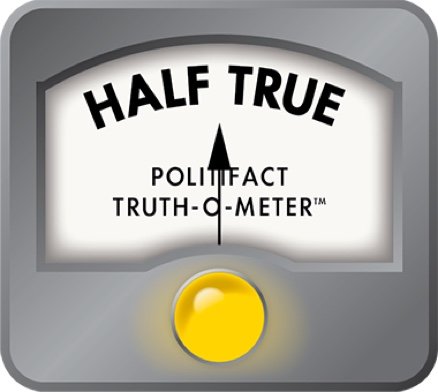
We rate McMorrow’s claim Half True.
[ad_2]
Source link
