
[ad_1]
In the U.S., the average college professor who donates to political candidates is “only slightly less left on the political spectrum than Bernie Sanders.”
That’s the top-line finding from a new study of American academics’ political donations, commissioned by the Foundation for Individual Rights and Expression (FIRE). The study scored academics’ political ideologies based on the voting records of the candidates to which they donated. It found that academics are increasingly donating to far-left politicians like Sanders and Alexandria Ocasio-Cortez.
The study also found that the vast majority of politically active faculty cluster in that far-left neighborhood. “The figures suggest that ideological diversity is essentially absent from universities today,” writes the study’s author, University of Rochester professor David Primo.
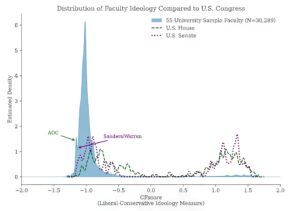
That most university professors prefer left-wing politicians is no new insight—but the near-disappearance of any right-wing counterweight is. The study found that among the donor sample, the interquartile range of opinions—a measure of how much the most moderate 50 percent’s views vary—”has essentially shrunk to nothing over time,” indicating that a historically large proportion of professors are in orthodox agreement today.
Using another measure of political diversity, the study determined that the most elite universities were among those with the least variation in opinions. Other recent analyses would seem to agree: A 2025 survey of Harvard faculty found that 9 percent would describe themselves as “conservative,” up from 1 percent in 2022. And an analysis of Yale faculty members’ political alignment made headlines some months ago when it uncovered that 27 of the 47 undergraduate departments (including American studies and English) didn’t have a single registered Republican on faculty. It also found that Yale’s history, economics, philosophy, political science, and law faculties included just one Republican each.
As political conservatives have disappeared from campus, progressive faculty have become more comfortable inserting their politics into their teaching. An exploratory report on “curriculum degradation” at the University of Chicago, for instance, found that since 2012, courses whose titles or descriptions contained a “progressive signal,” such as “racism,” “equity,” or “implicit bias,” rose from 12.7 percent of the catalog to 28.3 percent. Meanwhile, the share of those with a “Western canon signal,” which includes the Enlightenment and “classical literature,” fell slightly from 13.2 percent to 11.9 percent.
Despite all this, some are skeptical of FIRE’s findings—or at least of their scope. In a column for Inside Higher Ed, author John K. Wilson writes that the study’s subjects make up “an unrepresentative sample of faculty at an unrepresentative sample of colleges.” For him, that renders “this particular study…worthless.”
The criticism is sensible, though it perhaps goes too far: The report on Yale faculty members’ political alignments—which identified around 80 percent of them, and whose conclusions agreed that Republicans are strikingly hard to find on campus—suggests that the faculty sample might be a rather characteristic one after all. But it’s quite reasonable to think that the study’s conclusions cannot be extended beyond places like Yale and Harvard without more evidence.
Even then, the more limited conclusion—that the most elite colleges in America are sites of overwhelming faculty bias—could be cause for concern. As a recent Yale faculty report points out, ideological bias and conformity are degrading the public’s trust in higher education, which has set off funding battles with the Trump administration over research grants and educational practices.
This trend could also have a broader social impact. Research suggests that graduates of Ivy League (and comparable) universities are massively overrepresented in American politics and media. If it were these graduates’ professors alone who had fallen in line with the likes of Bernie Sanders and Alexandria Ocasio-Cortez, that could still contribute to a major shift in the American public discourse. Indeed, such a shift has already begun, with the rise of young, well-educated, democratic socialist figures like New York City Mayor Zohran Mamdani and Nithya Raman, a frontrunner in the Los Angeles mayoral election.
To reverse the trend, universities would need to bring dissenting voices back to their campuses. The best way to do that, according to FIRE, is by the adoption of strict institutional neutrality policies and robust speech protections. It might lead to some uncomfortable conversations, but bringing free discourse back to campus would go a long way toward restoring these institutions’ social beneficence and building trust again with the public.
[ad_2]
Source link
