
[ad_1]
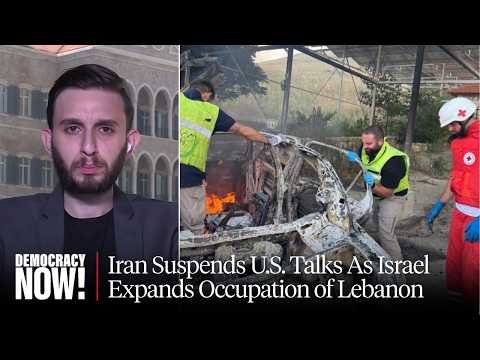
Israeli drones have killed at least eight people in Lebanon despite an announcement Monday by U.S. President Donald Trump that both Israel and Hezbollah had agreed to stop fighting. Trump’s intervention came as Israel threatened new strikes on the southern suburbs of Beirut, leading Iran to suspend indirect negotiations with the U.S. to protest Israel’s expanding military offensive in Lebanon. Since March 2, Israel has killed more than 3,400 people in Lebanon while seizing large swaths of the country and displacing about one-fifth of the population.
Lebanon is “a weak state, it doesn’t have a lot of leverage, and a lot of people are concerned,” says Associated Press reporter Kareem Chehayeb in Beirut. “They sort of feel beholden to the regional and global powers on their fate.”
Transcript
This is a rush transcript. Copy may not be in its final form.
AMY GOODMAN: We begin today’s show in Lebanon, where Israeli drones have killed at least eight people despite President Trump’s claim that Israel and Hezbollah have agreed that, quote, “all shooting will stop.” Trump made the claim as Iran said it’s suspending indirect negotiations with the U.S. to protest Israel’s expanding military offensive in Lebanon. Iran’s Foreign Minister Abbas Araghchi wrote online, “The ceasefire between Iran and the US is unequivocally a ceasefire on all fronts, including in Lebanon. Its violation on one front is a violation of the ceasefire on all fronts. The US and Israel are responsible for the consequences of any violation,” he said.
Since March 2nd, Israel has killed more than 3,400 people in Lebanon while seizing large swaths of southern Lebanon, including the medieval Beaufort Castle.
On Monday, President Trump spoke with Israeli Prime Minister Benjamin Netanyahu by phone after Israel threatened new attacks on Beirut. Axios is reporting, during the expletive-laden call, Trump told Netanyahu, quote, “You’re f’ing crazy. You’d be in prison if it weren’t for me. I’m saving your ass. Everybody hates you now. Everybody hates Israel because of this,” Axios reported Trump saying to Netanyahu.
After the call, Trump wrote online, quote, “I had a very productive call with Prime Minister Bibi Netanyahu, of Israel, and there will be no Troops going to Beirut, and any Troops that are on their way, have already been turned back,” he said.
In Beirut, displaced Lebanese residents decried Israel’s ongoing attacks.
ISSAM KANOUN: [translated] We — this is a feeling that can’t be described, that we have experienced this before, and we rebuilt our land. And God willing, we will rebuild it even better. We have lived through something like this before. I was born in 1975. From the first day I was born, we have been living through wars until now, about staying in the south of Lebanon. As long as there is a strip, an occupied strip, an occupied land, it means Israel is harming us.
AMY GOODMAN: At the United Nations, the Security Council held an emergency meeting to discuss Lebanon. This is Russia’s U.N. Ambassador Vasily Nebenzya.
VASILY NEBENZYA: [translated] The ceasefire reached on April 17th between West Jerusalem and Beirut, brokered by Washington, has unfortunately turned out to be a smokescreen for a creeping aggression against Lebanon. While the entire world was waiting for the next round of negotiations planned for June 2nd in the United States capital, Israel continued to methodically expand its zone of occupation, razing entire settlements to the ground as part of its scorched-earth tactics. It has become evident that Lebanon is seeing an almost identical replay of the scenario of clearing the Gaza Strip, with the establishment of large-scale occupation control and the forced displacement of the local population.
AMY GOODMAN: We go now to Beirut, where we’re joined by Kareem Chehayeb, Associated Press reporter based in Beirut. His most recent co-authored piece is headlined “Trump says Israel and Hezbollah have agreed to dial back fighting.”
Welcome back to Democracy Now!, Kareem. Can you explain what you understand President Trump is saying, who he’s spoken to, and what, in fact, is happening on the ground?
KAREEM CHEHAYEB: Absolutely. What happened yesterday was, in no means, a ceasefire or a step towards a complete ceasefire. However, it was a containment effort to stop what could have, in fact, taken Lebanon back to where it was in the peak of the war, where Israel would be bombing the southern suburbs of Beirut, where there would be mass displacement from these sprawling urban neighborhoods, and it would — and Hezbollah would continue launching rockets and missiles into northern Israel. They weren’t doing much of that in this period, and most of their attacks were targeting Israeli troops in Lebanon, but we did witness an escalation of that.
Now, what happened was, is that, obviously, Hezbollah and the United States do not communicate with each other. The Lebanese Speaker of Parliament Nabih Berri, who is a key Hezbollah ally and communicates with the United States, and has done so with mediators in the past, such as Amos Hochstein and so on, it appears he played a very crucial role in the communication on the line, as well as the Lebanese ambassador to Washington, who, of course, is taking part in the negotiations, including tonight, the ones taking place today and tomorrow. And so, there has been a series of calls. In the meantime, the president of Lebanon has repeatedly been on the line with Secretary of State Marco Rubio and the State Department, as officials have told us, and there’s been a flurry of, you know, diplomatic calls. And this is why we saw a lot of statements from France, from Germany, from Saudi Arabia and other countries basically trying to halt what looked like an imminent escalation that would have basically taken Lebanon back to where it was before this nominal ceasefire went into effect on April 17.
This obviously is something that Beirut wants to use its momentum in order to get something out of these talks. Beirut has — you know, basically, you can see from the statements coming out of the president and the prime minister’s office that Lebanon wants to stick to these talks but are trying to get something out of it. Israel’s military escalation last week has really frustrated the authorities. They’re very concerned that they’re losing support over these talks. And they’re trying to show that, indeed, they have leverage to get something out of this, and they are sticking to wanting a complete ceasefire. So, yet there was — they’re trying to take advantage of yesterday’s momentum, but, of course, this is, in no means, a full ceasefire. The strikes in Lebanon continued this morning across southern Lebanon, and Hezbollah has also claimed some attacks on Israeli troops in southern Lebanon.
JUAN GONZÁLEZ: And, Kareem, why do you think Iran is insisting so strongly on the inclusion of Lebanon in an overall negotiated settlement with the United States?
KAREEM CHEHAYEB: Hezbollah is Iran’s closest ally in the region. Hezbollah relies heavily on Iran, and has done so over the years, since its inception in the early ’80s. And Iran played a huge role in building up Hezbollah. And Hezbollah began as an insurgency group when Israel had invaded Lebanon and occupied southern Lebanon in 2000, and now is a full-fledged political party with strong institutions.
And so, Hezbollah, in the last war, which ended in late 2024, was severely battered in Israeli strikes. A large chunk of its senior leadership, both political and military, were killed in Israeli airstrikes or drone strikes. And, you know, it wasn’t completely disarmed militarily, obviously, but it did lose a large amount of its — a large sum of its military caliber. And, you know, even Hezbollah leadership today sees them as kind of adjusting to these new realities. And so, there’s momentum in Lebanon, since the end of that war, that maybe now is the time to disarm Hezbollah and for the Lebanese military to deploy in southern Lebanon. And, obviously, this put Hezbollah in a bit of a difficult political situation.
Now, obviously, things have changed with this round of war and so on. But Hezbollah is very, very important to Iran in the region, especially at a period of time, for example, where, in Iraq, a lot of Iran-backed militias — you know, the Iraqi government, for example, wants to weaken Iran’s influence there, and there has been sort of a divergence of the different armed, you know, groups in Iraq that sort of banded together, and most of them were sort of pro-Iran. So, Lebanon is very, very important for Iran in that way.
And also, this is an opportunity for Iran to maintain its leverage in Lebanon, right? If the war between Lebanon and Israel ends because of the leverage Iran had in its talks with the U.S. in Pakistan, in Islamabad, then this shows that Iran can sort of be the savior. And this is why Hezbollah opposes direct talks, because they’re saying, “The Lebanese government has no leverage. Let’s use Iran’s,” because when Iran started to strike back, you know, in the Gulf countries and so on, they put the globe on notice. They put the global economy on notice. And I think that’s kind of the game where Iran is trying to make sure that its leverage remains in Lebanon and that the Lebanese authorities that have come to power in early 2025 cannot break away from Iran, as they’ve been slowly trying to do so, and rekindle their ties with the United States and the Gulf countries, as well. So there’s a geopolitical angle, as well, where Iran is trying to maintain its position here.
That’s how things appear at the moment. And obviously, it’s a very complicated situation. Lebanon has always been, you know, stuck between the geopolitical battles. And, you know, we can speculate for a long time, but Hezbollah and Iran have been really trying to maintain their influence and their support base in Lebanon, at a time where the Lebanese authorities have been trying to, you know, push back against Iranian influence in the country.
JUAN GONZÁLEZ: And to what degree can the Lebanese government negotiate also what happens in terms of Hezbollah? Is it your sense that despite their internal conflict, that Hezbollah and the Lebanese government continue to have discussions and communication?
KAREEM CHEHAYEB: Well, the Lebanese government understands that this is a very tricky situation. This is based on officials that we’ve been speaking to since these discussions began, that, you know, Hezbollah not being part of the conversation in Washington and sort of rejecting these talks does complicate things in a way.
Now, in terms of their leverage, they’re banking a lot on a few things. They’re banking on the fact that the ambassador in Washington has very good ties with the U.S., and this was a very strategic pick, as well as the representative who’s leading Lebanon’s negotiating team, former Ambassador Simon Karam, who has negotiated with the Israelis in the last mechanism after the 2024 ceasefire, and the fact that there were apparently some very positive conversations, according to these officials, between Beirut and Washington. But they certainly understand that the consequences or the results of the Iranian-American talks will also play a role, as well. They truly are banking on that.
And with Hezbollah, they’re — you know, they’re in a bit of a tricky situation, because they received a lot of support and celebration from the United States for saying that they want to disarm all nonstate actors and assert full state authority and sovereignty on Lebanese territory, but they have been criticized for not taking a more aggressive approach. The Lebanese government says that, you know, there’s a risk for a civil war; we don’t want to, basically, seem like we’re ostracizing a group of people. And so they’ve been playing it in a very — you know, in a less aggressive approach, where — and they say that these things take time. They want more time on this. And they’ve also been critical of Israel by saying that the ongoing Israeli airstrikes, especially in this recent war, obviously, is a major obstacle in them being able to do that, because Israeli troops are continuing to push deeper into Lebanon.
So, it’s a very complicated situation. That’s why their approach at the moment is focused on getting a complete ceasefire. And then, once they can get that, they can at least negotiate all these other things, like Israeli withdrawal and disarming Hezbollah and this whole laundry list of issues. But for them, this idea of negotiating while the airstrikes continue, while the invasion pushes deeper into the country, further hinders their efforts into achieving what they want, which is complete state authority in the country, which, of course, includes disarming Hezbollah and other nonstate groups. So, it’s a very complicated situation, and there’s a lot of gaps in these talks, but they are committed to these talks. The president yesterday, President Aoun, said that talks are the least harmful option for Lebanon, so it’s the safest option, compared to going back into a full-scale war. But he did admit that Lebanon is left with very little choices at this point.
AMY GOODMAN: Can you, Kareem, talk about the significance of, since March 2nd, Israel killing some 3,400 people in Lebanon? And you wrote a piece on its seizing large swaths of southern Lebanon, including the medieval Beaufort Castle. The meaning of that, and what’s happening in Nabatieh and Tyre, and the hospital that has almost been hit, bombed all around it, and what this means for the Lebanese people? And are they shifting their position, giving this level of bombardment?
KAREEM CHEHAYEB: Certainly. And there really —over the past week alone, there has been so much to unpack with that military escalation, and literally in just seven days. So, the capturing of the Beaufort Castle, you know, it is a 1,000-year-old Crusader castle. It’s strategically located because of its elevation. It does not signal anything, you know, sort of beyond that immediate achievement, in the sense that it is a 1,000-year-old Crusader castle. It doesn’t mean that Israel is going to roll into Beirut tomorrow. But it represents something greater than that, which is fears of a long-term occupation similar of that from 1982 to 2000. You know, the Litani River in southern Lebanon was used as a de facto border, in which, you know, Israeli troops are mostly present south of that river. And them crossing over into some of these towns close to the city of Nabatieh, including the towns where the castle is located, sort of symbolized sort of the balance of power at the moment. You know, it definitely ruined a lot of the morale that maybe some people had. There was very little hope in the first place. And there are concerns that it’s unclear where, you know, Israel could go.
And now Israeli troops are very close to the city of Nabatieh, which is a major city in southern Lebanon. And on the flip side, of course, the coastal city of Tyre is the country’s fourth-largest city. It was struck heavily in the past. But, of course, there’s a lot of concerns of to what extent Israel is going to push deeper in the southwestern part of Lebanon. A lot of people who are perhaps close to Nabatieh, close to Tyre, as well, who are still living there, or maybe they went back home during this nominal ceasefire, are starting to flee again. And these, of course, are major cities in southern Lebanon. And for this kind of push to take place in a period of negotiations, you know, exceptional periods of direct talks between Lebanon and Israel, brings a lot of concern that Lebanon really has no skin in the game. But at the same time, you know, there’s sort of this — I mean, from people I speak to, they understand that Lebanon is kind of in a — you know, it is a weak state, doesn’t have a lot of leverage, and a lot of people are concerned. They sort of feel beholden to the regional and global powers on their fate.
Regarding the hospital strike, yes, there was a strike near the Jabal Amel Hospital near the city of Tyre. We’re still getting information from the authorities on the extent of the damages, but what we’ve seen, of course, is significant. There definitely have been — several people have been killed, at least a dozen medical workers who lived close to the hospital wounded. And, of course, this brings about great concern. There’s already dozens of medical workers and first responders who have been killed in Israeli strikes. Now, Israel says that, you know, some of these paramedics who are affiliated with Hezbollah’s medical organization, the Islamic Health Committee, they are accusing them of being involved in military activity. But the Lebanese authorities are pushing back, saying this is not necessarily true. The World Health Organization has come out with statements about the well-being of these hospitals. And, of course, there’s a lot of concern for people who are in these hospitals or need this kind of attention, special medical attention, of what’s going to happen to them. And, of course, a lot of Lebanese look into what’s happening in the Gaza Strip, and worry that it could happen to them, as well, because, you know, it’s something that they’ve been glued to in the past.
So, it’s definitely brought the morale down. I think a lot of people are definitely questioning Lebanon’s ability to really make a change. It doesn’t mean a lot of them are turning into the idea of supporting Iran or maybe supporting Hezbollah. Lebanese are still very divided on that. But a lot of Lebanese are questioning whether really any of the fate of the country is in their hands at all in the first place or not. You know, the morale is low, despite yesterday’s breakthrough, which, of course, people are relieved about here, but, you know, people understand that this is not the end of the war, and an escalation can happen at any point. The situation is fragile, and no one here thinks otherwise, regardless of whether they support Hezbollah or not.
AMY GOODMAN: Do you think that Israel is bombing Lebanon to this extent because Netanyahu doesn’t dare do the same to Iran, since Trump is putting pressure on him, but knows that if he bombs Lebanon, that will force Iran to stop negotiating?
KAREEM CHEHAYEB: You know, it’s really hard to — you know, to know these things. And, you know, I’m not one to sort of speculate. But what we have seen here, at least, is that, you know, there’s an understanding that the Israeli authorities are trying to reassure northern — people living in northern Israeli towns and villages by the border, who have been very concerned by Hezbollah’s increased frequency of rocket attacks there. It’s been far less frequent than the last war, and you can tell by Hezbollah’s military capabilities. But Hezbollah was able to reach just north of the city of Haifa, Nahariya, as well, and there have been a lot of measures in northern Israel to close down schools and so on. And you can see that there has been sort of an assurance that we’re going to keep — that they want to keep them safe. And that’s the rhetoric we see from Israeli authorities, as well. And it appears that the fact they have pushed deeper into Lebanon, but these attacks are still happening, you know, perhaps has brought some friction. And you can kind of tell from the statements that they need to do more.
Our understanding is that there has been a divergence in Israel and U.S. policy on Lebanon, in the sense that the United States has not been keen on letting Israel bomb the southern suburbs of Beirut and the heart of the capital. We hear the drones, we hear the jets here, but there have no — there hasn’t been any airstrikes here in Beirut. In the southern suburbs, it seems they’ve launched two strikes in the southern suburbs since the ceasefire, and these are drone strikes targeting apartment buildings, where, you know, according to the Israelis, there are some senior Hezbollah officials who were there. And we kind of saw the U.S. sort of pushing back against another series of strikes against the southern suburbs from what happened yesterday. And you can see that Israeli officials, Minister Ben-Gvir, for example, saying, you know, “We need to bomb the southern suburbs. We have to send a message to Hezbollah and to the Lebanese government,” and so on. And there’s sort of the push and pull that we’re seeing between United States and Israel when it comes to Lebanon, but we don’t know to what extent that will — well, whether, you know, Washington will change its perspective and let Israel bomb Beirut, for example.
I think the next couple of days of talks will tell us, you know, a lot more about where things are heading, whether or not we will see some sort of convergence between both sides, or whether things will stay like this, in this, you know, unstable situation. The United States appears keen to have a ceasefire with Iran, and certainly with the Iranian statements coming out, like from Foreign Minister Araghchi, for example, emphasizing on Lebanon’s inclusion in their ceasefire, perhaps bombing the southern suburbs would have completely jeopardized the reported gaps being bridged between Washington and Tehran. So, it’s all interconnected, even if there’s a separate diplomatic track between Lebanon and Israelis via Washington. They are — it is part of the region in the end, and the Lebanese officials, at the highest level, are quite aware of that.
AMY GOODMAN: Kareem Chehayeb, we want to thank you for being with us, AP journalist based in Beirut. We’ll link to your most recent piece, “Trump says Israel and Hezbollah have agreed to dial back fighting.”
Coming up, more than 200 people have now been killed in U.S. military strikes on boats in the Caribbean and eastern Pacific. We’ll speak to Amnesty International. Stay with us.
[break]
AMY GOODMAN: “Massive Will” by Emel Mathlouthi, performing in our Democracy Now! studio.
The original content of this program is licensed under a Creative Commons Attribution-Noncommercial-No Derivative Works 3.0 United States License. Please attribute legal copies of this work to democracynow.org. Some of the work(s) that this program incorporates, however, may be separately licensed. For further information or additional permissions, contact us.
Editor’s Note: At a moment when the once vaunted model of responsible journalism is overwhelmingly the play thing of self-serving billionaires and their corporate scribes, alternatives of integrity are desperately needed, and ScheerPost is one of them. Please support our independent journalism by contributing to our online donation platform, Network for Good, or send a check to our new PO Box. We can’t thank you enough, and promise to keep bringing you this kind of vital news.
You can also make a donation to our PayPal or subscribe to our Patreon.
Please share this story and help us grow our network!
[ad_2]
Source link
