
[ad_1]
By C.J. Polychroniou
This article was originally published by Truthout
Many US states have the ability to implement climate stabilization programs and become carbon-neutral by 2050.
The evidence for rapid human-caused climate change keeps piling up, yet the world continues to flood the atmosphere with greenhouse gases amid a political backlash against the struggle for a future free of fossil fuels. Greenhouse gas emissions continue to grow, which means humans are continuing to make the climate crisis worse. Global average temperatures are expected to stay at record levels for the 2026-2030 period, exceeding preindustrial averages by more than 1.5 degrees Celsius. As global warming speeds up, events like wildfires, droughts, hurricanes, and floods will become more intense, and there will be a substantial increase in premature deaths, with the overwhelming majority occurring in low-and middle-income countries. The climate crisis presents a grave threat to life on Earth, although scientists have now scrapped the worst-case climate scenario on account of the expansion of renewable energy — which means there is still hope.
In the interview that follows, world-renowned economist Robert Pollin talks about the forces resisting green transition and highlights the results of a major study he and some of his co-workers at the Political Economy Research Institute (PERI) produced for advancing a green transition in Michigan. According to Pollin, there are simply no technical or economic considerations preventing Michigan and other U.S. states from achieving carbon neutrality by 2050. Pollin is distinguished professor of economics and co-director of PERI at the University of Massachusetts Amherst.
C. J. Polychroniou: Over the past few years, we have observed the climate crisis taking a back seat to geopolitical conflicts and wars, but also to immediate economic concerns such as inflation. Indeed, climate action is colliding with political and economic realities and, subsequently, climate change is no longer a top issue in the international policy agenda. Moreover, U.S. Energy Secretary Chris Wright has called the International Energy Agency’s (IEA) net zero modeling “ridiculous” and European leaders themselves are also divided over the pace of the green transition. Why would a green transition be fueling backlash, and what might be the consequences of more inaction on climate change?
aBy far, the largest factor driving the global climate crisis is the burning of oil, coal, and natural gas to produce energy. This is because burning fossil fuels to produce energy generates carbon dioxide (CO2) emissions. In turn, the accumulated stock of CO2 in the atmosphere is the primary source of rising average global temperatures.
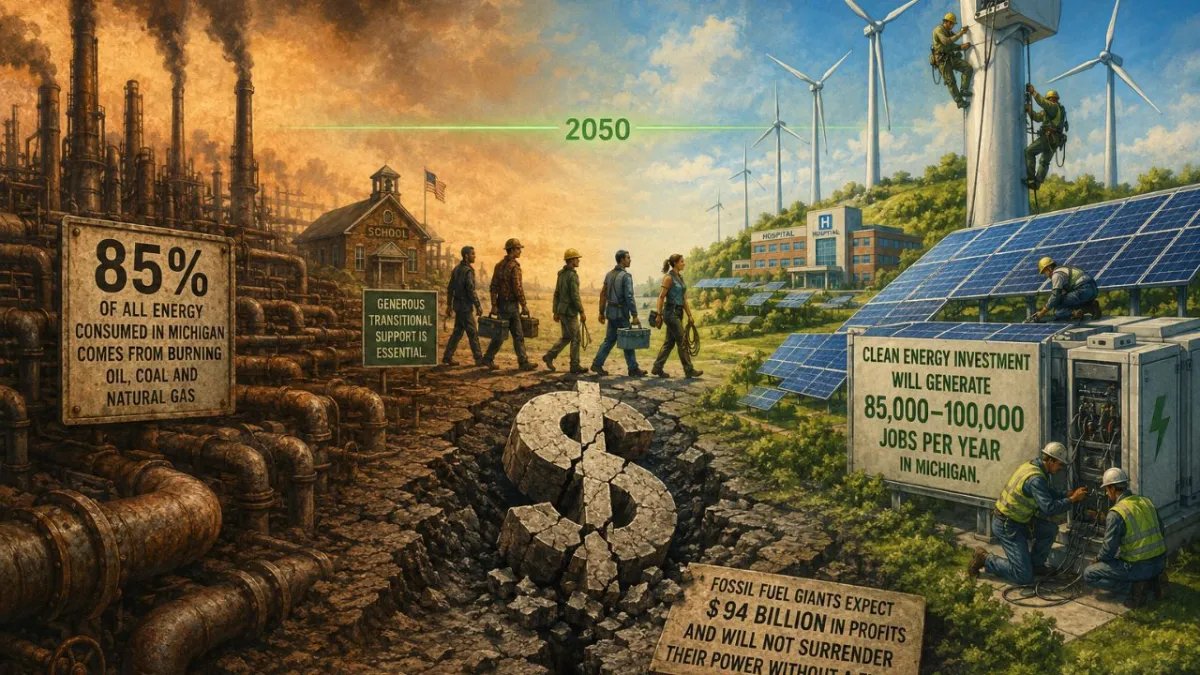
Once we start from these straightforward facts, it becomes obvious as to why there is a global pushback against a green transition project. While burning fossil fuels to produce energy is driving the climate crisis, it is also delivering gigantic profits for fossil fuel corporations. A recent Oxfam study projects 2026 profits for the six largest fossil fuel corporations — Chevron, Shell, BP, ConocoPhillips, Exxon, and TotalEnergies — to reach $94 billion. These companies and their shareholders are not about to surrender $94 billion without a fight. Such cash piles also make it easy to buy off politicians. Donald Trump leads the pack here, such as with his ridiculous pronouncement last September before the UN General Assembly that the climate crisis is “the greatest con job in history.”
But it’s not just greedy corporations and corrupt politicians who resist the green transition. Not surprisingly and with good reason, it also includes a fair share of working people whose livelihoods are tied to the fossil fuel industry as well as governments which depend on fossil fuel tax revenues to finance their social spending. For example, the state of New Mexico finances nearly half of its entire state budget through oil and gas tax revenues. Figuring out alternative funding sources to pay New Mexico’s public school teachers and health care workers is not obvious.
Of course, none of this means that giving up on the green transition is an option. The reality of the climate crisis doesn’t just go away. A widely reported recent study did lower its high-end forecast of the extent of global warming up to the year 2100, from 5.0 degrees to 3.5 degrees Celsius (C) above preindustrial levels — 9.0degrees to 6.3degrees Fahrenheit (F). But let’s put this new estimate in context. To date, the extent of global warming is at 1.4 degrees C (2.5 degrees F) — i.e., nowhere close to an increase of 3.5 degrees C, much less of 5 degrees C. The severe consequences of this 1.4degrees C of global warming are before our eyes. Average daily high temperatures this past April in New Delhi, a metropolitan area of 35 million people, were 109degrees F (43 degrees C). This past May, a major heat wave broke temperature records across northwest Europe, triggering water shortages in the U.K. and causing several deaths in France.
You are the lead author of a new and massive study on how the state of Michigan may become carbon neutral by 2050. What are the challenges facing Michigan in phasing out oil, coal, and natural gas as the state’s main source of energy, and what are the primary renewable energy sources that will secure a green transition?
In a 2022 report from Michigan’s Department of Environment, Great Lakes and Energy (EGLE) called the MI Healthy Climate Plan, the state established, as its central climate target, for Michigan to achieve carbon neutrality — i.e., net zero emissions — by 2050. Reaching zero emissions in Michigan by 2050 is a realistic target as long as the state maintains its commitment to achieve it. As a starting point, it is a major statement in itself that the state government set this emissions reduction target and is actually still taking it seriously. This isn’t easy under Trump 2.0.
At present, about 85 percent of all energy consumed in Michigan’s economy comes from burning oil, coal and natural gas. The challenge is obvious: how to go from 85 percent dependence on fossil fuel energy sources as of now to zero, or near zero, fossil fuel consumption in 24 years.
Our study works out a plan to accomplish this. The central feature of our plan is to build a clean energy infrastructure to supplant the existing fossil fuel–dominant infrastructure. Solar and wind power will be the state’s primary new energy sources, operating at a greatly upgraded level of energy efficiency. Geothermal and low-emissions bioenergy will be supplemental renewable sources. Michigan will also need to create large-scale battery storage capacity to account for the fact that solar and wind are intermittent energy sources — i.e., the sun doesn’t shine and the wind doesn’t blow all day everywhere.
We estimate that the costs of these clean energy investments — including all renewables, efficiency upgrades, and battery storage — at about 2 percent of Michigan’s overall spending (GDP) per year every year between now and 2050. For 2027, this total spending would amount to about $15 billion. That’s obviously real money. But it is still only 2 percent of total spending in Michigan. That means that 98 percent of spending in the state can still go to everything else besides its green transition project.
It is also critical to emphasize that, according to our estimates, these clean energy investments will generate an average of between 85,0000-100,000 jobs per year between 2027-2050 within Michigan, equal to about 2 percent of Michigan’s current workforce. These will include jobs across all occupations in the state, including, for example, roofers, machinists, accountants, office managers and assistants, truck drivers, and wind turbine engineers. This level of job creation will continue as long as the state continues to invest 2 percent of its GDP on clean energy projects.
A major component of the study revolves around a just transition for fossil fuel workers. While from the climate justice perspective a just transition for underrepresented and vulnerable communities is seen as an important issue, some may wonder why a transition for fossil fuel workers is also made to be such a big issue. Is a comprehensive just transition possible and financially viable?
As I noted above, if we are proposing to eliminate the fossil fuel industry as the first imperative for a green transition project, it follows that we are equally proposing to eliminate all the jobs for workers now employed in the fossil fuel industry. Without generous transitional support, these workers, and the communities in which they live, are facing potentially huge losses in their economic security and living standards.
A just transition program for these workers therefore has to be a first-order priority of the overall green transition project, as the late, great labor and environmental leader Tony Mazzocchi first emphasized decades ago. This is a matter of simple economic justice. But without a generous just transition program fully embedded in the green transition project, it is also fair to expect that a large share of the workers and communities staring at major losses in their living standards will become green transition opponents. They then become fertile targets for exactly the type of brazen political opportunism practiced by Trump and company. Trump, for example, recently anointed himself the champion of the miners in “America’s beautiful clean coal industry.”
In Michigan, there are now about 21,000 people employed in the full range of fossil fuel-based industries, amounting to only 0.5 percent of the state’s current workforce. Virtually all of these jobs will be phased out between now and 2050 under the statewide green transition. If we assume that the phase-out proceeds in more or less steady increments between 2026 and 2050, and we also take account of workers voluntarily retiring over the next 25 years, we end up with only about 350 workers getting laid off every year. This compares with our lower-end estimate that about 85,000 jobs will be created in Michigan as long as the state invests 2 percent of GDP per year on clean energy projects.
Still, each of the 350 workers who will be displaced every year needs to receive generous transitional support. This should include pension guarantees, guaranteed re-employment at their previous pay levels, as well as job retraining and relocation support as needed. We estimate that a generous transitional support package for all these workers would cost about $45 million per year. That is less than 0.01 percent of overall 2025 statewide spending in Michigan.
Of course, the impact of the fossil fuel industry phase out will be much greater in states where fossil fuel activity is more prominent. But even for a heavily fossil fuel dependent state such as West Virginia, we estimated in a previous study that the costs of a generous just transition program would still be only about 0.2 percent of overall statewide spending.
For Michigan, an additional major concern is the impact on employment of automobile manufacturing transitioning from building internal combustion engine powered autos to battery electric vehicles (EVs). As of 2025, total auto manufacturing employment in Michigan was about 49,000 jobs, i.e., more than double the employment level for all fossil fuel sector jobs in the state. It is possible that this transition to EV manufacturing could expand employment levels and improve conditions for auto workers within Michigan. But whether this happens will depend on the effectiveness of industrial policies to locate EV manufacturing operations, battery production in particular, within Michigan. More broadly, these trends demonstrate the imperative of a commitment to full employment policies, along with rising wages and expanded benefits, as a centerpiece of a U.S. economy-wide Green New Deal.
How realistic is it, given the present political climate political, that Michigan and other U.S. states will be able to implement climate stabilization programs and become carbon neutral by 2050?
In terms of purely technical and economic considerations, it is entirely realistic for Michigan and other states to achieve carbon neutrality by 2050. But as discussed above, there is no getting around that the opposition is formidable, especially coming from the fossil fuel corporations and their bought politicians. Still, it stands as one significant counterforce to this opposition that the Michigan state government remains committed to its carbon neutrality project.
More generally, a range of other developments are working to strengthen the ongoing global green transition project, even amid Trump 2.0. Thus, an April 2025 report by Trump’s own Energy Department estimates that by 2030, solar and wind power will generate a kilowatt of electricity at between 3.0 and 3.2 cents per kilowatt hour. This is less than half the cost of natural gas plants, at 6.5 cents per kilowatt hour. Similarly, a December 2025 article published in Canary Mediawas titled “The year that Trump tried and failed to stop clean energy.” The article reports that “through November, a whopping 92% of all new electricity capacity built in the U.S. came in the form of solar, batteries, and wind power. Electric vehicles hit a record too.” The clean energy transition is advancing still more rapidly outside the United States. Science magazine pronounced that “The seemingly unstoppable growth of renewable energy is Science’s 2025 breakthrough of the year.” Among other developments, Science reported that “solar panel imports in Africa and South Asia have soared, as people in those regions realized rooftop solar can cheaply power lights, cellphones, and fans.” As one further critical indicator, the International Energy Agency (IEA) reported that for 2025, worldwide investments in renewable energy, energy efficiency, electric grid and battery storage reached over $2 trillion. This figure was nearly twice the $1.1 trillion that was invested in oil, coal, and natural gas over 2025.
One especially sweet irony among these developments is that Trump’s war of choice in Iran is actually accelerating the global green transition. Thus, a Financial Times article from early May titled “Donald Trump’s Green New Deal” reports that the spike in oil prices caused by the Iran war has produced the strongest month of EV sales on record in Europe, a 20 percent jump in search traffic for EVs in the United States, and the highest level of solar panel installations in the United Kingdom since 2012.
The obstacles ahead obviously remain massive. But it is critical to recognize that the forces supporting a global green transition — i.e., the project for saving the planet — are advancing and will continue to advance as long as supporters remain focused around everything that is required for building the movement. This includes large-scale clean energy investments generating equally large-scale job opportunities. It equally includes just transition support for the workers and communities whose livelihoods are currently dependent on the fossil fuel industry.
This article was originally published by Truthout and is licensed under Creative Commons (CC BY-NC-ND 4.0). Please maintain all links and credits in accordance with our republishing guidelines.
Editor’s Note: At a moment when the once vaunted model of responsible journalism is overwhelmingly the play thing of self-serving billionaires and their corporate scribes, alternatives of integrity are desperately needed, and ScheerPost is one of them. Please support our independent journalism by contributing to our online donation platform, Network for Good, or send a check to our new PO Box. We can’t thank you enough, and promise to keep bringing you this kind of vital news.
You can also make a donation to our PayPal or subscribe to our Patreon.
Please share this story and help us grow our network!
[ad_2]
Source link
