

[ad_1]
The natural world is often imagined as a system of competition where predators hunt prey, rivals vie for limited resources, and survival turns on relative advantage. At a deeper level, a quieter competition occurs within all living organisms. As the primary units of selection, genes endure insofar as they successfully replicate.
Over evolutionary time, this process has shaped life from its simplest incarnations to complex organisms. Through genetic expression, morphological, physiological, and behavioral traits emerge, giving rise to survival strategies. Across scales, life unfolds under competitive selection pressures.
Taken to its starkest expression, Richard Dawkins wrote in The Selfish Gene:
“We are survival machines—robot vehicles blindly programmed to preserve the selfish molecules known as genes.”
Against this backdrop, cooperation presents a puzzle. If natural selection rewards traits that maximize individual fitness, why doesn’t behavior collapse into constant defection? In a world shaped by selfish replicators, what explains the persistence of cooperation—and how is it sustained across animal communities and human societies?
In 1979, Robert Axelrod set out to identify the best strategy for repeated interactions between two players by hosting a computer tournament. In a series of iterated games, each strategy played every other strategy as well as itself. Scores were aggregated across all matches using Prisoner’s Dilemma payoffs.
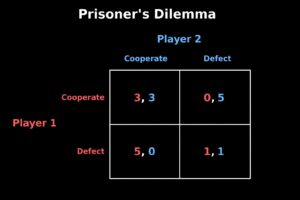
Figure 1. Payoffs are listed as Player 1, Player 2. Colors correspond to each player.
The winner was Tit-for-Tat, a simple strategy that initially acted cooperatively and then mirrored the other player’s previous move. Its behavior was predictable, allowing opposing players to adapt accordingly. If the other player defected, it would retaliate, but then return to cooperation. In essence, Tit-for-Tat models the underlying logic of reciprocal altruism.
In reciprocal altruism, there is a cost to the giver and a benefit to the receiver. Such behavior is maintained because individuals are statistically likely to receive benefits in return over repeated interactions. Once a cooperative relationship is established, defection is treated as a violation, and if systematically repeated, constitutes cheating.
Vampire bats embody reciprocal altruism. Each night, the colony leaves the roost in search of blood, though hunts are not always successful. Bats that fail to feed for two or three consecutive nights face the risk of starvation. Regardless of kinship, bats will regurgitate blood to help roost mates at a personal cost. Over repeated interactions, those who have previously received help are more likely to reciprocate on subsequent nights. This strategy is sustainable because bats can recognize others and preferentially assist reliable partners, while avoiding cheaters. Reciprocal altruism fosters cooperation, but it is only one pathway.
Cooperation need not depend on repeated interaction, memory, or the capacity for reward and punishment. Unlike reciprocal altruism, mutualism is a form of cooperation where both parties benefit immediately through aligned incentives. Biological markets bring mutualism to life, playing out both within and between species.
In and around coral reefs, cleaner wrasses set up stations where fish of different species stop by to have ectoparasites, mucus, and dead skin removed. Client fish pose, exposing delicate areas to allow the wrasse to work. In this mutualistic exchange, the cleaner wrasse feeds, while its client benefits by staying healthy. Nibbling on healthy scales is considered cheating, and although this occasionally occurs, it is rare when other fish are present, as this could undermine future client trust. For client fish, a wrasse would make for an easy meal, but at the cost of losing a reliable cleaner.
While the exchange is immediately beneficial, relationships still develop as wrasses allocate attention based on history, prioritizing loyal clients. Client fish reciprocate by warning wrasses before swimming off, and have been observed protecting their cleaners from predators. In all of these interactions, incentives are aligned between participating parties.
In vampire bats, cleaner wrasses, and their fish clientele alike, each individual acts in accordance with its own self-interest under structured incentives. From an evolutionary game-theoretic perspective, these patterns of interaction can be understood as an Evolutionarily Stable Strategy (ESS), a refinement of a Nash equilibrium. An ESS is a strategy that, when adopted by most of the population, cannot be invaded by alternative strategies. Thus, in these interactions, stability persists even in the presence of defectors.
In a community where reciprocal altruism is prevalent, cooperation depends on repeated interactions. Individuals must be able to identify one another and retain information about past behavior. These conditions enable retaliation against defectors and the dissolution of exploitative relationships, with exit serving as a key constraint on defection. Partner choice, in turn, creates a decentralized enforcement mechanism that operates under what Axelrod termed the “shadow of the future.”
Mutualism shares many of these characteristics, but trust is less central in immediate exchanges where incentives are directly aligned. Still, when partner quality varies, reliability can be rewarded and non-cooperative partners can be avoided. The prospect of future gains and continued access to desirable partners, mediated by reputation, reinforces cooperative behavior.
If a cluster of cooperators exists in a population and individuals can identify one another, cooperation tends to spread. Through replicator dynamics, strategies that yield a higher relative payoff increase in frequency. Cooperators thrive not in isolation, but in a landscape where defectors are systematically outcompeted.
Stable patterns of cooperation emerge in exchanges where payoff structures are aligned and individuals are free to select, maintain, or exit relationships. Such systems coordinate behavior through decentralized incentive structures. In biological systems, this corresponds to reciprocal altruism and mutualism emerging under selection pressures. However, human societies introduce a new problem: sustaining cooperation at scale.
In small groups, mechanisms that stabilize cooperation in animals—partner recognition, reputation, and aligned incentives—may also appear in human interactions. However, as populations expand, anonymity weakens the informational basis of these mechanisms. As information about past behavior becomes less reliable, distinguishing defectors from cooperators becomes increasingly difficult, raising the relative payoff to defection. Coordination at scale therefore demands mechanisms that structure interactions rather than relying solely on local reputation.
In biological systems, cooperation emerges through selection. In human societies, evolutionary pressures persist, but cooperation is also shaped by purposeful action, as individuals use reason to pursue chosen ends. Abstract reasoning and language-based communication expand the scope of interactions, enabling complex coordination over time and across geographically dispersed populations.
When interactions are constrained or information degrades, payoff structures shift and the conditions for cooperation deteriorate. Mitigating these frictions at scale depends on reducing uncertainty about counterparties’ behavior by clarifying ownership and structuring enforceable accountability. In a society organized around private property and voluntary exchange, it becomes possible for individuals to sustain cooperation through clearly specified rights and obligations.
On the free market, such coordination arises through mutually beneficial exchanges where producers are rewarded for satisfying customer preferences, with the price system functioning as a decentralized mechanism for communicating dispersed knowledge. Money reduces the cost of coordinating by expanding the set of possible exchange partners and eliminating the double coincidence of wants. It facilitates exchange between anonymous parties with reduced reliance on interpersonal trust. Contracts formalize commitments and establish remedies for defection in cases of non-performance. Taken together, these mechanisms functionally mirror the conditions that stabilize cooperation in biological systems: aligned payoffs, partner selection, and the ability to exit.
Beyond bilateral exchange relationships, identification and reputation allow cooperation to extend to indirect interactions. When information about past behavior can travel, individuals can evaluate strangers who may one day become partners. Through indirect reciprocity, cooperative behavior is rewarded, while defectors face reputational loss that diminishes access to future exchange opportunities.
Under these conditions, payoff structures favor cooperative strategies and disadvantage those that systematically undermine them. In human societies, these dynamics are organized through markets, where price signals coordinate resource allocation. By enabling individuals to specialize in distinct tasks, the division of labor increases productive output. Given that humans differ in abilities and that means are widely distributed, global cooperation ultimately expands the set of ends individuals can pursue.
Across biological systems—from genes to vampire bats to underwater cleaning stations—evolution demonstrates that cooperation is not a matter of sentiment, but an adaptive strategy shaped by natural selection. When the conditions for reciprocal altruism and mutualism are in place, cooperative strategies outcompete defection and stabilize.
In humans, this logic scales by recreating these conditions through decentralized mechanisms grounded in private property and voluntary exchange. Cooperation is not an exception to self-interest, but an emergent outcome when incentives align and individuals are free to choose.
[ad_2]
Source link
