
[ad_1]
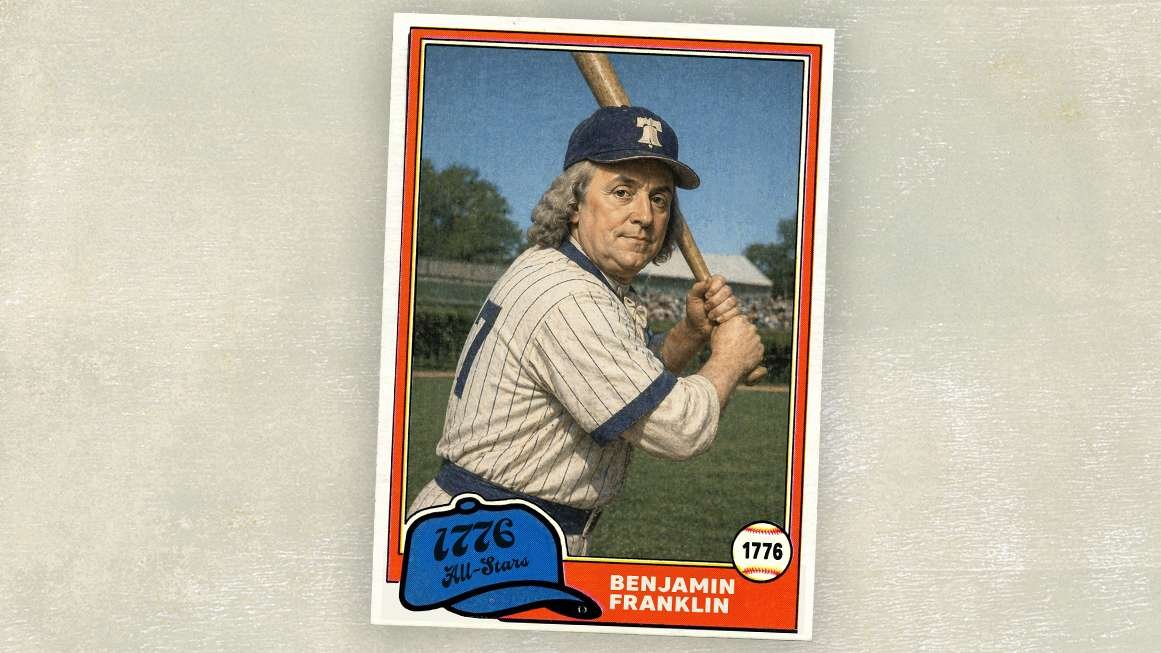
This is part of 1776 All-Stars, a series about Reason’s favorite American Founders. Read more here.

When Benjamin Franklin was 17 years old, he did that most American of activities: He ran away from home.
More precisely, Franklin fled an apprenticeship in Boston and made his way to Philadelphia, the city with which he is still synonymous. Under the laws of the time, this made Franklin a criminal and a fugitive. Perhaps that taught the gifted youngster something about how to deal with unjust laws.
Franklin was not an immigrant by the technical, bureaucratic meaning of the word. Still, he arrived without wealth or connections in his new city, and he got to work building both.
While laboring in a print shop, the 21-year-old Franklin formed a debating society whose members committed to respectful discussion of science, morals, and philosophy. The members of the Leather Apron Club were soon doing much more: They founded Philadelphia’s first lending library, first fire department, and other civic institutions meant to benefit the growing city.
It turns out that you can just do things, as Franklin and his friends demonstrated.
After opening his own printing press and starting a newspaper, Franklin became an American Aesop. His annual Poor Richard’s Almanack often reminded readers that public liberty depends on private virtue and discretion. “Don’t throw stones at your neighbors, if your own windows are glass,” reads one of the aphorisms that have long outlived him. “Wish not so much to live long as to live well,” goes another, a personal favorite.
Franklin lived long and well and took on many roles. He was an inventor, a scientist, a rabble-rouser, a diplomat, a philanderer, and (yes, unfortunately) a politician and America’s first federal postmaster.
When you started reading this article, you likely conjured an image in your head that includes a kite, a key, and a lightning bolt. Whether Franklin ever actually conducted that famous experiment is somewhat uncertain, although he was undeniably fascinated by electricity and its possible uses. More certain is that he designed the first lightning rod and thus saved untold scores of buildings from storm-related fire damage.
Perhaps more than any other Founder, Franklin left a legacy that would be worth remembering and celebrating even if the colonists had remained loyal subjects to the British crown. That is to say, in a world where politics did not matter at all, Franklin’s achievements would still make the history books. He was the embodiment of the American Enlightenment. Max Weber singled out Franklin as the exemplar of the Protestant work ethic that makes capitalism successful. He was personal friends with Voltaire!
If you had to sum it all up in one sentence: Franklin was an optimist.
One doesn’t run away from home except in the hope that things could be better somewhere else. Similar can be said of the other events in his life, including the American Revolution itself. The ideas—rhetorical, philosophical, and scientific—that Franklin explored and articulated helped lay the groundwork for experiments that are ongoing. That same momentum animated the civic institutions that Franklin helped create.
Franklin didn’t always have it all figured out, but he never stopped trying. He owned slaves but argued for abolition in his later years. He was endlessly curious and invited others to chase the horizon too.
“The rapid Progress true Science now makes, occasions my Regretting sometimes that I was born so soon,” Franklin wrote to a friend in 1780, when he was 74 years old. At some time in the distant future, he speculated, it might even be possible for man to conquer gravity, allowing “easy Transport” of “large Masses.”
As I was writing this, America launched a massive rocket carrying four astronauts to circumnavigate the moon. I imagine Franklin would be delighted.
Near the end of his life, as Franklin sat through the Constitutional Convention of 1787, he reportedly considered another horizon. On the back of the chair occupied by George Washington as he presided over the convention, there was a carving of half a sun. “I have the happiness to know that it is a rising and not a setting sun,” Franklin declared as the convention ended—or so they tell you when you visit Philadelphia’s Independence Hall, where the famous chair still resides.
It is sometimes difficult to feel like America is still lit by a rising sun. But politics is not what really matters, as Franklin’s life reminds us. No doubt he’d argue that there is better still to come, as long as you’re willing to chase it.
1776 All-Stars, a series about Reason‘s favorite American Founders:
[ad_2]
Source link
