
[ad_1]
The Zionist regime is accelerating its long war against international law and justice and the institutions upholding them. What remains of a common human culture will only be kept alive by those willing to fight for it.
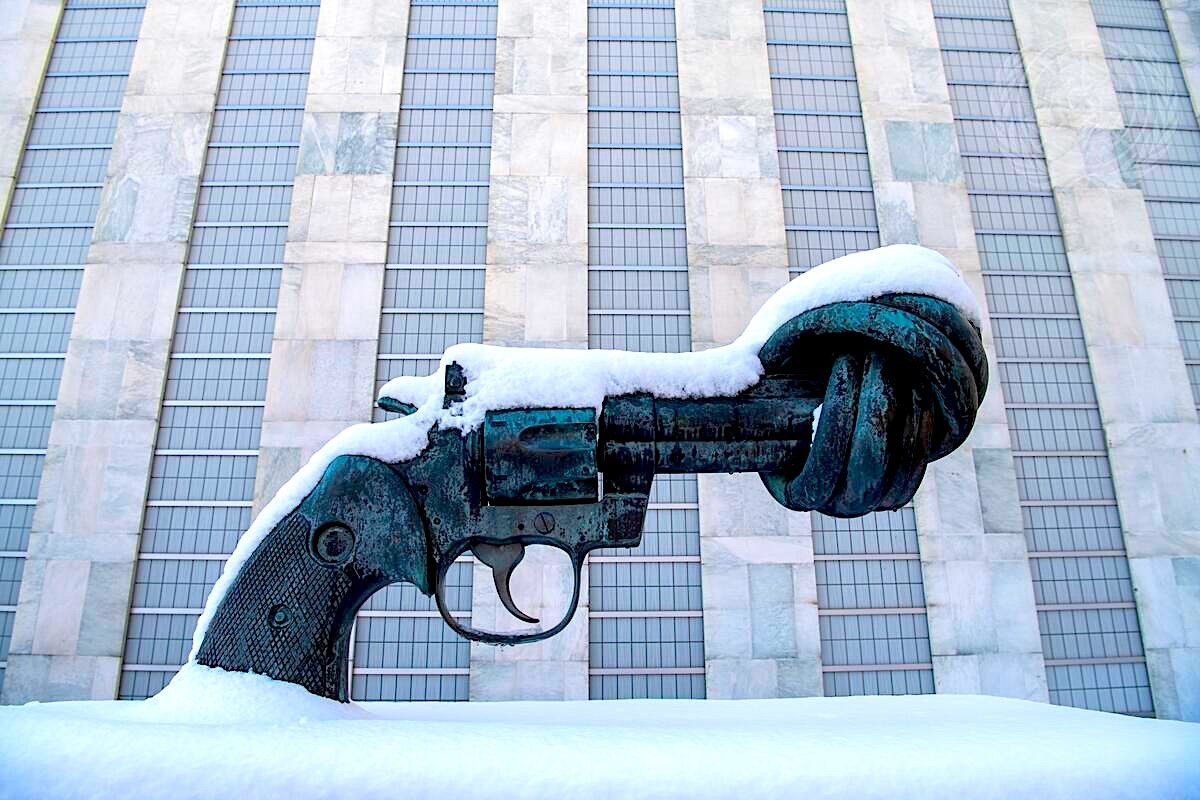
The “Non-Violence” or “Knotted Gun” sculpture by Carl Fredrik Reuterswärd with a layer of snow at U.N. headquarters in New York, January 2022. (U.N, Photo/Mark Garten)
By Patrick Lawrence
Special to Consortium News
 Do we witness the death of international law and international justice? Have these breathed their last and must now be counted things of the past? Have we entered an era defined by the total absence of international law and the decisive destruction of the institutions founded to encode, adjudicate and enforce it?
These are our questions now — our pressing, bitter questions, the questions it is so grievous to pose.
It is true, as argued by wise heads such as Chas Freeman, the distinguished commentator and ambassador emeritus, that international law has been weakened for decades, a blow at a time to its efficacy. Powerful nations observe it when it suits their purpose and ignore it when it does not.
But we have arrived at another kind of moment. Failures to observe international law are one thing — bad enough. Full-frontal attacks on it and those charged with guarding it and keeping it alive are very much another. The distinction is key: It is what distinguishes our time from the past.
Time and history quicken in the modern epoch, as Daniel Halévy, an overlooked French historian, wrote in his (also overlooked) Essay on the Acceleration of History (Les Îles d’Or–Plon, 1948). And the catalyst in our time is Israel. The Zionist regime has long waged war against international law and its institutions. Now the Israelis, fully backed by the Americans, have openly escalated this combat to the point they threaten their extinction.
There are (in)famous cases — familiar if one does not rely on corporate media, which rarely report these breaches of law in the name of law, and when they do, they do not report on them with anything even approaching balance or accuracy.
Blacklisted by the US Treasury
The best-known of these concerns Francesca Albanese, the U.N.’s mightily courageous special rapporteur on the occupied territories of Palestine, who was sanctioned in July 2025 in response to her investigations and reports on U.S. and Israeli crimes — a grotesque assortment of human-rights abuses — in Gaza and the West Bank.
[See: Chris Hedges Report: Francesca Albanese on an Economy of Genocide and Among the Few Who Resist Hidden Persuasion]
In mid–May a U.S. District Court ruled against these sanctions — viciously Draconian, applying to Albanese and her family — on First Amendment grounds. Nine days later the Treasury Department put Albanese back on its sanctions list without explanation. This is a long, long war.
There is the case of Nicolas Guillou, a French judge at the International Criminal Court. The United States sanctioned him last November. At this point the Treasury Department has six I.C.C. judges and three prosecutors on its sanctions list — nine officials responsible for the international justice system, all of them working on cases against the Zionist regime, its highest officials and the United States as its sponsor and collaborator.
To remind readers of what life on Treasury’s blacklist is like, here is Guillou on the topic in an interview with Le Monde:
“It goes far beyond simply being banned from U.S. territory. The sanctions affect all aspects of my daily life. They prohibit any American individual or legal entity, any person or company, including their overseas subsidiaries, from providing me with services.
All my accounts with American companies, such as Amazon, Airbnb, PayPal and others, have been closed. For example, I booked a hotel in France through Expedia, and a few hours later, the company sent me an email canceling the reservation, citing the sanctions. In practice, you can no longer shop online because you do not know if the packaging your product comes in is American. Being under sanctions is like being sent back to the 1990s.”
Or maybe back to the Reich in the 1930s.
There are very many of these cases, more all the time. Any regular reader of Consortium News will know of them, or some in any case. Each one is a front in the wider war now waged against international law and its defenders. There is no “cheap grace” here, as Dietrich Bonhoeffer, the celebrated opponent of the Nazi regime, put it: Lives are on the line. This is as it must be.
Sanctioning people and institutions is the crudest tactic of those intent on destroying law, justice and altogether what remains of a common human culture, but there are others. While one must stand with Albanese, Guillou and the many of their kind, what concerns me as much is the very pernicious process of normalization going on around us daily.
Platforming an Accused War Criminal
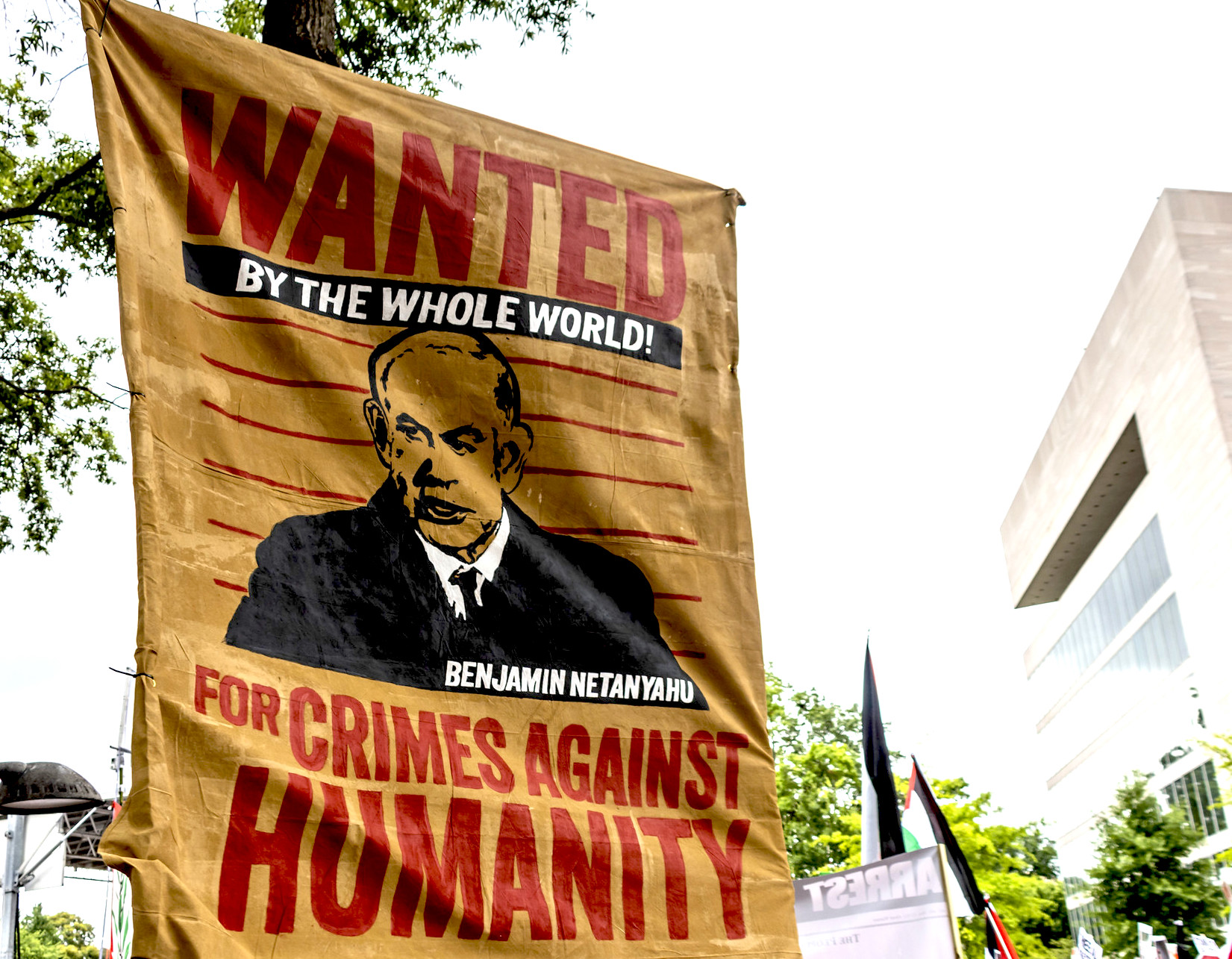
Protesting Netanyahu’s visit to Congress in Washington on July 24, 2024. (Diane Krauthamer, Flickr, CC BY-NC-SA 2.0)
On May 10, CBS News, which is now more or less directly supervised by Zionists, aired an interview with Benjamin Netanyahu, the Israeli prime minister’s first since the U.S.-Israeli attacks on Iran began Feb. 28. Major Garrett, a trenchcoaty poseur from way back, wanted to know how long the war would go on, how long Israel would continue its operation in Lebanon, the intended tactics and so on.
We have here a (purportedly) major American broadcast network interviewing an accused war criminal. Nothing in the course of the 14 and a half-minute exchange, conducted in person, about these charges or the Zionist arm’s atrocities, or international law or justice.
Here is the segment and the transcript. Watching a punk like Major Garrett sit calmly to lob softball questions at a man facing charges of war crimes and crimes against humanity turns my stomach.
This is what I mean by the normalization of lawlessness and criminality.
There was a piece in The New York Times’ opinion section the other day that focused my mind sharply on this question. I have seen far worse in the Times, but Shira Efron managed to bring the systematic murder of international law into very sharp relief.
The headline atop Efron’s column was “Israel’s Isolation Is Deepening Fast. It Doesn’t Have to Be This Way.” Efron, who runs the Israel desk at the RAND Corporation, addressed this obvious phenomenon with evident alarm:
“A new generation around the world has come to instinctively view Israel mainly as part of a story about occupation and Palestinian suffering. It is increasingly apparent that the longstanding cushions of a bipartisan safety net in Washington and cordial, if cautious, relations in Europe are dissipating.”
A story about occupation and suffering — just a story, a narrative? A bipartisan safety net? You see what is going on here, I assume. Insidious is as insidious does.
Efron’s prescriptions to the Zionist regime’s problems — change the story, keep Congress in line — follow naturally from this beyond-belief language. They hinge on elections due in Israel this autumn:
“Depending on the outcome, they can buy a short-lived grace period to create room for pragmatic change. A new governing coalition could signal that Israel intends to answer its global critics by curbing settler violence, halting de facto annexation of West Bank land, facilitating a plan to reconstruct Gaza, restoring workable ties with Palestinian institutions and re-establishing predictable, democratic governance. That combination of assuring Israelis at home while offering concrete gestures abroad is the only realistic path to halt the drift into deep isolation, a dangerous state from which Israel will find it extraordinarily difficult to recover.”
Buying time, assurances, gestures, halting the drift — these “the only realistic path.” It seems never to have entered Efron’s head that justice, official acknowledgment of crimes, answerability to law, restoration or other such principles are at issue here.

Netanyahu Out Of DC! protest at the White House, July 7, 2025. (Diane Krauthamer, Flickr, CC BY-NC-SA 2.0)
Efron has not written any kind of exceptional piece one way or another. And this is my point. She merely offers a window into the conversation among those in power and those who serve them. Listen carefully and you hear no thought whatsoever that Israel or the United States will ever acknowledge even the existence of international law, to say nothing of abiding by it.
One hears this again and again — which is my point said differently. Post-Gaza, post-West Bank, post-Lebanon, post-Iran, post, post, post all of it, things will proceed as they did before Gaza, the West Bank, Lebanon, Iran.
This, too, is what the war against law and justice looks like. What I take from utterances such as Efron’s is that those waging this war — back to the bitter part — are winning.
I do not think the murder of international law is complete, not yet. What keeps it alive are those fighting to defend it. It is in the fight for law and justice that the life and future of both now reside.
It seems as simple as that.
Our time is as distinct as Bonhoeffer’s and not so different from it, a time when the individual must assume one stance or another and act on it, and there is no claiming to have no stance: Professing to have no stance is a stance.
At this moment in our shared story, we are all either in the fight to defend international law against the lawlessness of power, or we are with those who will condemn us to a future of violence and chaos if they come out the victors.
Patrick Lawrence, a correspondent abroad for many years, chiefly for the International Herald Tribune, is a columnist, essayist, lecturer and author, most recently of Journalists and Their Shadows, available from Clarity Press or via Amazon. Other books include Time No Longer: Americans After the American Century. His Twitter account, @thefloutist, has been restored after years of being permanently censored.
TO MY READERS. Independent publications and those who write for them reach a moment that is difficult and full of promise all at once. On one hand, we assume ever greater responsibilities in the face of mainstream media’s mounting derelictions. On the other, we have found no sustaining revenue model and so must turn directly to our readers for support. I am committed to independent journalism for the duration: I see no other future for American media. But the path grows steeper, and as it does I need your help. This grows urgent now. In recognition of the commitment to independent journalism, please subscribe to The Floutist, or via my Patreon account.
The views expressed are solely those of the author and may or may not reflect those of Consortium News.
Please Donate to the
Spring Fund Drive!


[ad_2]
Source link
