
[ad_1]
Stephen Colbert is off the air. I waited to write this to make sure that our democracy, despite warnings from Colbert and his regular guest Bruce Springsteen, remains intact. It does.
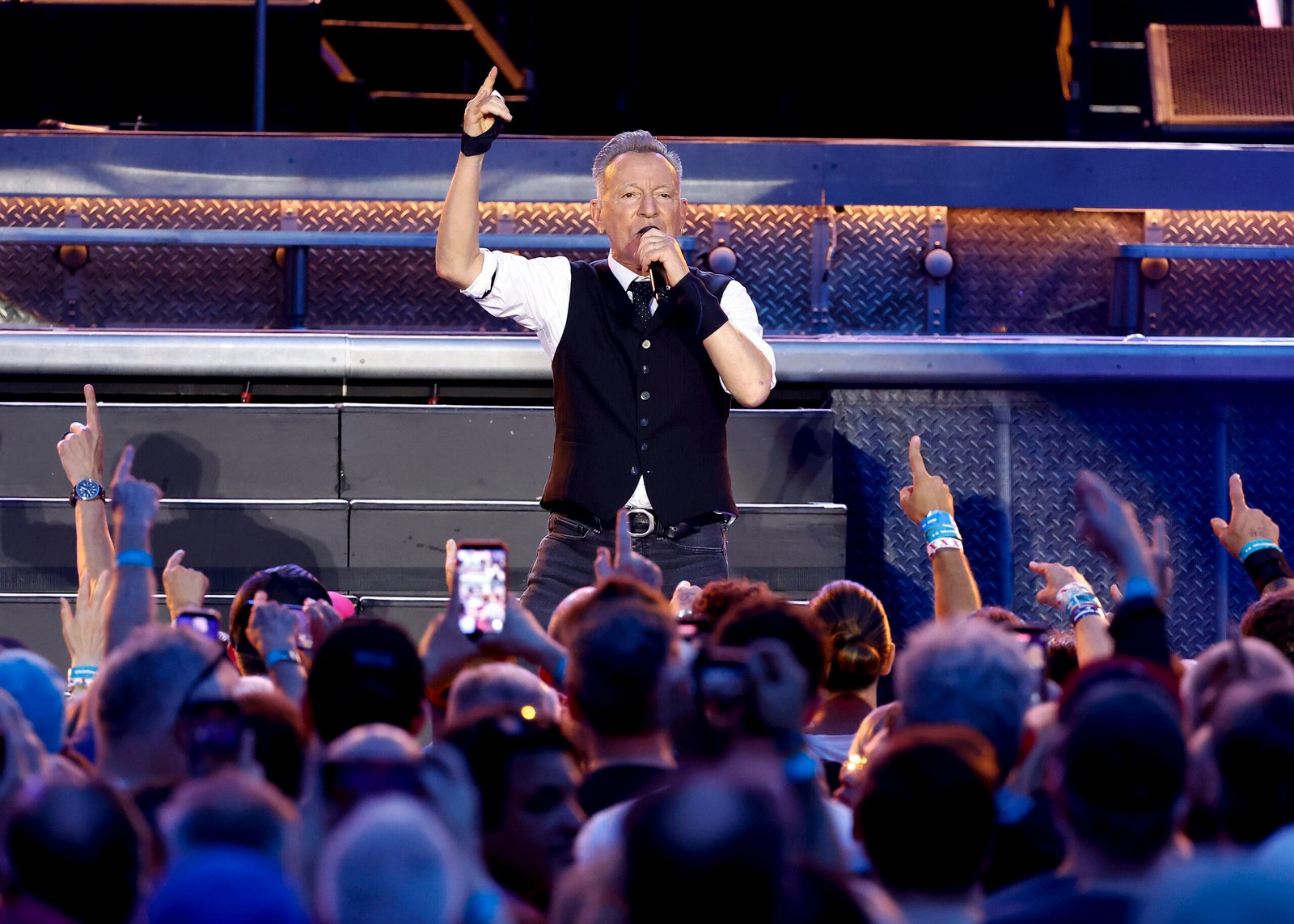
Colbert is widely pitied, and Springsteen widely celebrated as a hero, because the two seized a chance to make a very large amount of money telling people already predisposed to believe them that the sky was falling. They are the living embodiment of the blurring of lines between entertainment, righteous protest, and partisan outrage. Their audiences increasingly just want confirmation of their own biases. Springsteen in particular often sounds like he’s browbeating half the country to make the other half feel righteously superior; the kind of stirring rhetoric, found in historic speeches and in documents like the Declaration of Independence, which once reached across barriers to unite our nation, seems lost.
They are men of their times. We live in a world of constant media stimulation, and Americans have convinced themselves they are living through a uniquely apocalyptic moment for freedom in general and the First Amendment in particular. Every unpleasant event becomes evidence of democracy dying. Social media posts become the Reichstag Fire. A conservative commencement speaker becomes the death of free inquiry. A canceled TV show, like Colbert’s, becomes political persecution. It’s all about as deep as a puddle in the late afternoon sun.
Nothing can simply happen anymore. Not sure? One of the supposedly most critical issues facing our government today is whether to build a ballroom next to the White House. If every Trump-driven event is an existential threat, then every change he orders, however minor and cosmetic in the grand scheme of things, must also be existential. Something as transient as a TV show can’t simply have become old or irrelevant like I Love Lucy. No, fascist, anti-democratic forces must be silencing truth-tellers. We’ll soon be passing video loops of Colbert hand-to-hand like Soviet-era dissidents shuffling mimeographed manifestos around smoky coffee shops.
It’s funny that “the Resistance” chose as its spokesman Colbert, hardly a courageous rebel broadcasting via pirate radio. He hosted one of the most expensive network television programs in the country. He operated with corporate backing and fawning celebrity access. This is a wealthy comic employed by a multibillion-dollar corporation. Springsteen is reputed to be a billionaire himself, and he plays to audiences who can swing thousands of dollars for a ticket. I’m not suggesting that only poor artists can discover truth, but observing that Colbert and his supporting acts are part of a system of money and influence and corporate greed as big or bigger than MAGA. Their comedy/commentary is no longer sharp or clever. It is simply mocking, often crude, as when Colbert called Trump “Putin’s c*ckholster,” and almost always sanctimonious, as when Springsteen claimed (on Colbert’s show) that those who supported Trump were “small-minded people who got no idea what the freedoms of this beautiful country are supposed to be about.” Colbert could probably stand in front of an audience and just say “Trump sucks” over and over to applause. That takes no courage. Our American political culture is exhausted, and the progressive electorate is now dependent on such one-sided narration to tell it what to believe. That cheapens us.
Subscribe Today
Get daily emails in your inbox
I’ve never met Springsteen, whose music I’ve enjoyed since I was 17, but I suspect if we ever found ourselves in the same room, he would not be interested in talking with a guy like me. In songs like Born in the USA or The Ghost of Tom Joad, Bruce was angry, yes, but also an inclusive populist, talking about the hardships we all shared in one form or another as Americans no matter how we voted. In his blistering song about the death of industrialization in the Midwest, Youngstown, Springsteen does not ask if the forgotten steel workers are Republicans or Democrats. What if, in the aftermath of 9/11, Springsteen had written a song condemning Muslims instead of the prayer that became The Rising? Left-wingers wouldn’t have liked that, but it would have been consistent, in essence, with his current divisiveness.
In his very best music, Springsteen retains hope—at the end of every hard day, working people can find some reason to believe and to come together to make the world better. Artists who once, like his own hero Woody Guthrie, translated shared American pain into art now too often exploit partisan outrage. Not too long ago, Bruce still believed that what we shared as Americans mattered more than how we differed. He professed that we need a conscience, not a party affiliation, to make America great. I am mourning here something larger than just celebrity political disagreement. I mourn the loss of a shared American vocabulary, and of a great American icon whose old music still inspires me.
Et tu, Bruce?
[ad_2]
Source link
