
[ad_1]
“India’s Great Mughals: Art, Power, and Opulence,” currently showing at the Virginia Museum of Fine Arts in Richmond, is a great and rare exhibition that will be hard to replicate in the near future for various sociological reasons.
In the greater Anglosphere and America, the decolonial left are a far cry from the empire-builders (and museum curators) of JP Morgan’s days. The know-nothing nativists of the right, on the other hand, do not know or care about anything foreign, much less about anything Indian, the current antagoniste social, and much, much less about anything Islamic, the ur-villain of our still young crusading century. In the land of the Mughals, ethnonationalists are on a mission to erase every trace of the dynasty from Indian history. The ideas of both a mass-consumption public museum and neutral non-ideological history will be increasingly rare in the darker ages fueled by permanently social media–addled brains.
It’s a tragedy all around. There is a lot to learn from a young martial empire that settled and intermixed with the local elite, imposed a coherent legal and administrative polity on a whole region, that then grew to be simultaneously the richest, most powerful, and arguably the most cosmopolitan empire of the world of its day—which then, over time, overstretched and turned inward, simultaneously into a fanatical, ethno-religious, and decadent entity, before rebellions, collapse, and conquest.
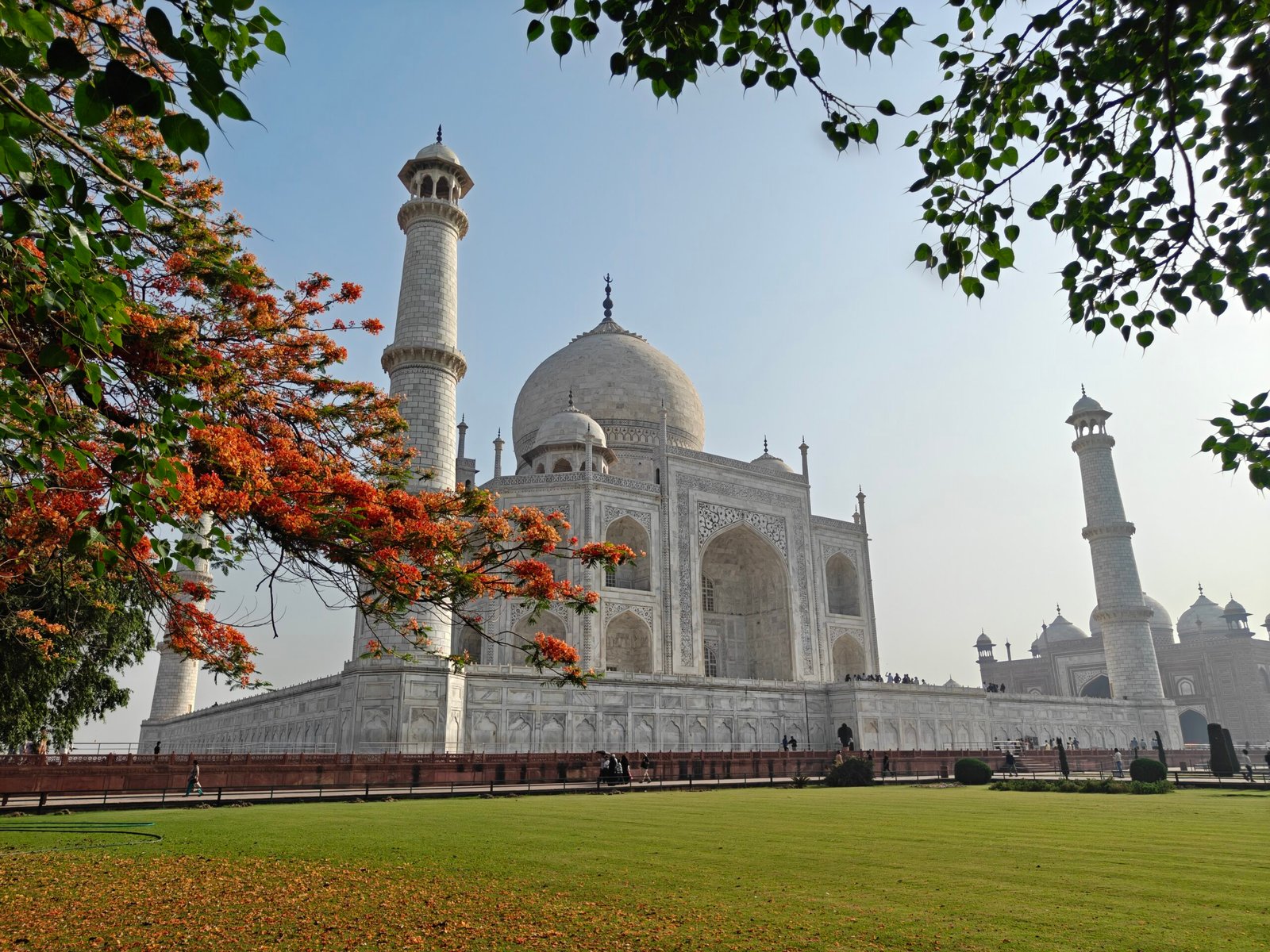
The exhibition deals with the three Great Mughals born within the subcontinent, Akbar, Jehangir, and Shah Jahan, and their near century-long rule, often considered India’s most prosperous days. The Mughal Empire was established exactly 500 years back in 1526, when a Timurid warlord from Central Asia named Babur lost his fief and found himself wandering with his ragtag army in medieval northwestern Hindustan, where he introduced the concept of flanking and firearms to the hapless Indians—brave and skilled with swords but without any sense of cavalry tactics or modern weaponry, according to Baburnama. He thereby established a northern Indian stronghold. By the time of the third emperor, Akbar, the imperial line was already indigenous and intermarried with the local elite. This exhibition deals with the wealth and cosmopolitanism of the empire, from Akbar onwards, to his illustrious grandson, the builder of the Taj Mahal.
Akbar was the first and possibly only true pan-Indian emperor of modern times, as noted by Sir Jadunath Sarkar in his definitive work on the Mughals. He established an ethno-neutral elite and instituted administrative reforms that contributed significantly to the prosperity and stability of the Mughal Empire. From the 1580s onward, Mughal artistic traditions were enriched by European influences introduced by Jesuit missionaries arriving from the Portuguese territory of Goa, resulting in a dynamic and innovative cultural synthesis at the Mughal court. Akbar, who was illiterate himself, established imperial workshops known as karkhanas, where painters, calligraphers, weavers, architects, and other craftsmen worked collectively to produce objects for both ceremonial and private use, as well as kitabkhanas, or houses of books, which served as the center for the production and preservation of manuscripts. Akbar’s courtiers were economists and historians, some of the most enlightened of his days, including Todar Mal, Birbal, Tansen, and Man Singh, who were upper-class Hindus or converts to Sufism, and Abul Fazl and Faizi, who were both Muslims who translated Sanskrit to Persian.
The reign of the Great Mughals coincided with the ascent of Elizabeth I, the late Renaissance, and the Spanish and Portuguese conquest of the Americas. The art displayed reflects that. Famous Mughal-school painters such as Basawan, Manohar, Kanha, Jagannath, Govardhan, and Abu’l Hasan worked side by side in imperial workshops, translating Indian epics such as the Mahabharata into Persian (Razmnama), and depicting events from Indian mythology, such as the arrival of Nanda into Vrindavan, taken from Harivamsha. Christian subjects such as the Descent from the Cross were copied and adapted in Mughal workshops, while European engravings by artists such as Adriaen Collaert inspired Mughal botanical studies, manuscript illumination, and architectural decoration.
Objects in display include a bronze celestial seamless globe engraved with over 1,000 stars and 48 constellations inherited from Greek and Roman astronomy; nephrite jade cups from western China; and Renaissance-style iconography of the emperor towering over poverty itself, inspired by European imperial divinity of the era.
Under Jehangir, Mughal learning expanded into the realms of natural science when the emperor commissioned detailed studies of exotic animals arriving through global trade networks, including a North American turkey brought from Portuguese Goa. Jehangir’s knowledge of animals was tested in 1624 during a hunt, when Imam Vardi, the imperial hunt-beater, challenged him to guess the gender of a captured francolin. The emperor unhesitatingly identified it as female, which was confirmed when the francolin was dissected and eggs were found inside it. Jehangir described the event in his memoirs and probably gave a European-made, francolin-shaped incense burner to the imam, whose name was inscribed on the bird’s breast.
In The Fate of Empires, Sir John Glubb argued that empires tend to follow a recurring historical life cycle, regardless of geography, lasting roughly 200 years, and they always end, more often than not, in a self-created implosion rather than an outright conquest. 1526 was an interesting year. The Ottomans reached their imperial peak, defeating the Hungarians in a divided Europe, and the Mughals established the richest of early modern empires in Asia. By the time of the death of Shah Jahan in 1666, however, the rot was setting in.
Subscribe Today
Get daily emails in your inbox
Aurangzeb, the third son of Shah Jahan, was an intellectual troglodyte, a religious fanatic and a bigot, and won a blistering civil war defeating his more moderate and liberal brothers, Darah Shikoh and Shah Shuja, who both favoured a continuity of Mughal cosmopolitanism mixed with Brahmin and Rajput courtiers. Instead, he reinstated religious taxes and filled his court with religious fanatics. It resulted in disaffected local Hindu elites (Rajputana), open rebellions in various provinces in the north (Punjab) and west (Marathas), and a quasi-independent feudatory in the richest province of them all (Bengal). By 1757, as Robert Clive marched into Bengal, the writ of the Mughals ran no further than the outskirts of Delhi, and the subcontinent was ripe for war and conquest. There is a lesson there for keen historians to perceive.
And yet there is no India without the Mughals. Current ethnonationalist attempts try to portray Mughals as Islamist bigots, but no true historian should humiliate himself by engaging with such revisionism. From architecture to art to sartorial choices, from elite customs to cuisine, the Mughals enriched India beyond any measure; unlike the British, they kept their wealth mostly within the land and gentry. The empire was neither uniform nor unique, but its peak coincided with a certain refined cultural cosmopolitanism that is now despised by both green and saffron subalterns.
Our memory of the three greatest Islamic empires is tainted, but there is a reason why the Gilded Age in America saw an increased interest in the Ottoman, Safavid, and Mughal Empires, and that the J.P. Morgan Library in New York houses some of the finest Mughal paintings and calligraphy, purchased by Morgan himself from Sir Charles Hercules Read. Or why anyone obscenely successful and pioneering is still called a mogul, a word almost synonymous with elite.
[ad_2]
Source link
