
[ad_1]
Vijay Prashad, Tricontinental: Institute for Social Research.
Modern structures of extraction attempt to mask old systems of colonial plunder.
The living legacy of anti-colonial resistance across Africa remains a decisive force in the struggle for sovereignty and genuine freedom.
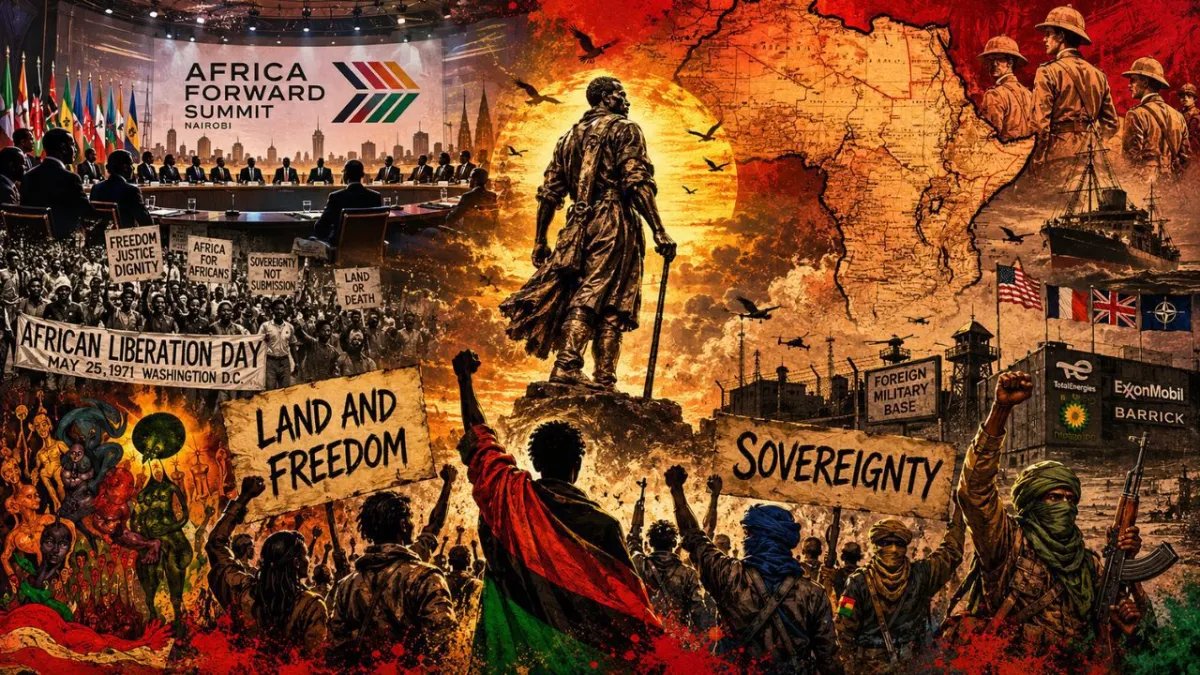
On 11–12 May, at the Africa Forward Summit in Nairobi, Kenya, French President Emmanuel Macron stood in front of more than thirty African heads of state and announced, ‘We are the true Pan-Africanists’. This was an extraordinarily obnoxious comment that was sandwiched between bureaucratic banalities about ‘growth’, ‘innovation’, and ‘partnerships’.
In an open letter, Togolese writer Farida Bemba Nabourema responded that ‘Pan-Africanism is, at its most fundamental, the political philosophy that said no to everything France spent three centuries saying yes to: slavery, colonialism, and neocolonialism’. This philosophy, ‘born in the holds of the slave ships, in the plantation fields of Saint-Domingue’ by people who ‘believe that African and African-descended people deserved to govern themselves’, Nabourema wrote, cannot be laundered by Macron’s charm offensive.
This was the 29th France-Africa summit (rebranded for Nairobi as the Africa Forward Summit), yet the first to take place in a non-Francophone African country. Though the French insist that a new era has arrived, one supposedly beyond the old paternalism of Françafrique, holding the summit in Kenya was not an innocent geographical change. It reflects the profound crisis of French power in West Africa and the Sahel.
In Ouagadougou, Burkina Faso, where I am writing this newsletter, the general mood is for sovereignty and against French neocolonialism. Popular uprisings and military ruptures in parts of the Sahel (Burkina Faso, Mali, and Niger) dismantled long-standing French military arrangements and rejected the political architecture through which Paris maintained its dominance. The new governments expelled French troops and terminated defence agreements while the force of popular anger destroyed the ideological legitimacy of French tutelage. These governments have consolidated their unity against neocolonialism through the Alliance of Sahel States (AES). None of the Sahel leaders attended the Africa Forward Summit in Nairobi.
France has pivoted eastwards to Anglophone Africa because it has been unable to restore its authority in the Sahel, even through the use of military threats via Nigeria and the Economic Community of West African States. It has now sought to rebrand itself as a partner of African sovereignty rather than as a custodian of neocolonialism.
The terms in the official summit declaration came from a tepid non-governmental liberalism: co-development, digital transformation, green industrialisation, mutual respect, inclusive growth, and reform of global governance and financial architecture. But beneath this NGO liberalism lay the familiar realities of imperial power: extractive investment, debt dependency, and, most dramatically, military agreements. The summit unfolded amid mounting criticism over a recent defence agreement between France and Kenya alongside the arrival of hundreds of French troops into Kenya. The language of sovereignty in the conference was mocked by the actuality of foreign military consolidation and economic dependency.
Expelled from the Sahel, the forces of hyper-imperialism – France, the United Kingdom, and the United States – have retreated to the edges of the region. There is a US military presence in Ghana and Nigeria and a British military base in Kenya. Soon, there will be a French military base in Kenya. This military encirclement provides the Global North with the infrastructure to intervene against the AES.
Beyond the closed doors of the summit, another Africa gathered. The Pan-Africanism Summit Against Imperialism (PASAI) convened in the United Kenya Club, the first institution in colonial Nairobi that permitted membership to non-white people. This was a people’s counter-summit that hosted genuine Pan-Africanists and internationalists who articulated a different future for the continent. The organisers said that the Africa Forward Summit was nothing other than ‘recolonisation’, with the new language merely updating older systems of extraction. The minerals required for Europe’s energy transition, the land required for carbon-offset schemes, and the cheap labour necessary for transnational profitability continue to flow out of Africa, leaving the continent with only poverty, debt, and ecological devastation. ‘We shall not host our executioners’, PASAI’s declaration said. ‘We shall not be the new barracks of colonial domination’.
These words condense more than a century of African resistance against colonialism and neocolonialism. They speak not only to French power but to the wider neocolonial structure that continues to subordinate African development to the needs of international finance capital. Africa’s sovereignty cannot be negotiated in luxury hotels between Northern political elites, multinational executives, and local custodians of dependency. Sovereignty is not produced in communiqués drafted behind closed doors but built through the democratic participation and organisation of workers, peasants, students, and women. Beyond flag independence, genuine freedom requires an agenda to control resources, the direction of social development, and geopolitical alliances shaped by countries in the South. France seeks to reorganise its relationship with Africa through diplomatic realignment and finance capital, with sections of Africa’s ruling class willing to present dependence as modernisation while millions of working people on the continent confront inflation, unemployment, land dispossession, debt-austerity, and expanding repression.
The critique from PASAI carried a particular weight in Nairobi because Kenya itself was forged through one of the great anti-colonial struggles of the twentieth century. The memory of the Mau Mau Rebellion (1952–1960) still lives beneath the polished language of investment summits and diplomatic buntings. When PASAI delegates marched toward the statue of Kenyan freedom fighter Dedan Kimathi and were met with tear gas and arrests, the symbolism was unmistakable. Kimathi and the Land and Freedom Army (the Mau Mau) did not wage a war against British colonialism so that foreign troops could once again entrench themselves on Kenyan soil under the softer language of ‘defence cooperation’. Nor did they fight so that independence would culminate in debt dependency, land concentration, and the rule of comprador elites tethered to international finance. The repression against the left, especially the Communist Party Marxist – Kenya, reveals how dangerous the memory and legacy of national liberation is to the ruling classes. This legacy continues to ask unresolved questions about land, sovereignty, and power in contemporary Africa.
Kenya’s own intellectual and literary traditions have long warned about the betrayal of national liberation. From Mĩcere Gĩthae Mũgo’s Daughter of My People, Sing! (1976) to Ngũgĩ wa Thiong’o’s Petals of Blood (1977), Kenyan writers understood that the end of colonial rule did not automatically dismantle the structures of exploitation. Ngũgĩ’s novels returned repeatedly to the figure of the comprador elite, the local intermediary who inherits the colonial state and repurposes it in service of capital. Pio Gama Pinto (1927–1965), one of the great martyrs of Kenyan socialism, warned that replacing white settlers with a black bourgeoisie would not amount to liberation. These traditions insist that sovereignty cannot be reduced to flags, anthems, or elections alone. It must mean control over land, labour, resources, and the social destiny of the people themselves.
During the anti-colonial war led by the Mau Mau, songs travelled across the countryside, sparking the imagination of the peasantry and drawing them into battle. These songs planted the philosophy of anti-colonialism, inspiring people to rise and fight against enormous odds. They gave voice to anti-colonial rallying cry for ithaka na wĩyathi (land and freedom), a sentiment which views national liberation not as a ceremony but as collective struggle. These songs focused on their leaders, battles, enemies, and betrayers.
Among them is Twarĩkanĩire (We Had Agreed), which warned of the latter – a band of fighters that had ‘agreed to carry [a] log, but in the middle of the river some ran away and sold our house’. Mũndũ ndangĩrĩa kĩndũ atathithinĩire, they sang. ‘One does not eat what they did not sweat for’.
Editor’s Note: At a moment when the once vaunted model of responsible journalism is overwhelmingly the play thing of self-serving billionaires and their corporate scribes, alternatives of integrity are desperately needed, and ScheerPost is one of them. Please support our independent journalism by contributing to our online donation platform, Network for Good, or send a check to our new PO Box. We can’t thank you enough, and promise to keep bringing you this kind of vital news.
You can also make a donation to our PayPal or subscribe to our Patreon.
Please share this story and help us grow our network!
[ad_2]
Source link
