
[ad_1]
Joshua Scheer
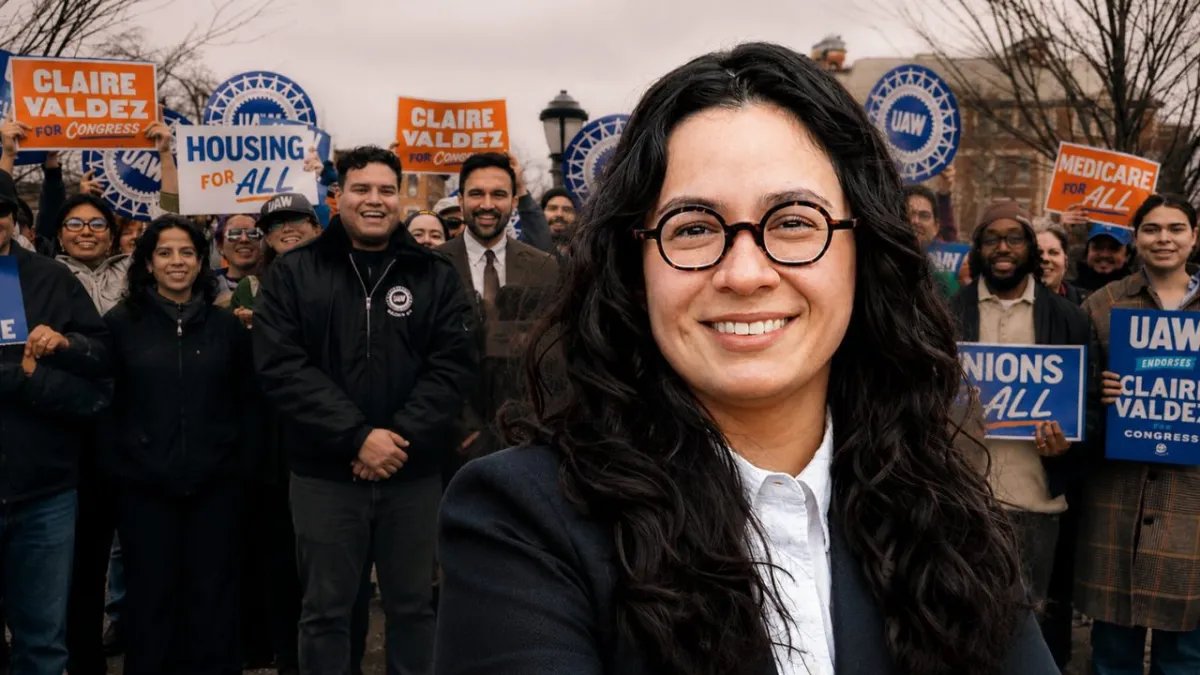
As economic desperation deepens and both major parties continue to hemorrhage working-class trust, conversations once dismissed as fringe are moving back toward the political center. In this wide-ranging discussion with Joshua Citarella on DoomScroll, union organizer and democratic socialist Claire Valdez argues that the crisis facing millions of Americans is not ideological confusion — it’s material reality. From collapsing labor protections and skyrocketing rent to healthcare profiteering and endless war spending, Valdez lays out a vision rooted in rebuilding union power, expanding social programs, and reconnecting politics to the daily struggles of ordinary people.
What emerges is less a campaign interview than a portrait of a generation radicalized by precarity: millennials shut out of stability, workers exhausted by corporate rule, and young organizers increasingly unwilling to accept neoliberalism as the only possible future. At a moment when both parties face a legitimacy crisis, Valdez insists that a mass politics centered on labor, housing, healthcare, and anti-war organizing is not only possible — but necessary.
Can Democrats Win Back the Working Class? Claire Valdez Thinks the Answer Is Labor
At a moment when the Democratic Party faces collapsing trust among working-class voters, rising authoritarianism, and a generation drowning in rent, debt and insecurity, union organizer and democratic socialist Claire Valdez argues that the answer is not moderation — it’s rebuilding labor power from the ground up.
In a sprawling conversation on Doomscroll with Joshua Citarella, Valdez lays out a blunt diagnosis of American decline: decades of neoliberalism hollowed out unions, commodified every aspect of life, and transformed politics into management for corporate interests rather than representation for ordinary people. The result, she argues, is a population exhausted by precarity and increasingly alienated from institutions that no longer seem capable of addressing basic human needs.
But unlike much of today’s cynical political discourse, Valdez insists people are still reachable. Across ideological divides, she says, Americans share the same material frustrations — unaffordable housing, collapsing healthcare, stagnant wages, impossible childcare costs and endless work with little dignity in return.
For Valdez, the path forward begins with unions.
Highlights
“We Need Union Members in Congress”
Valdez argues that organized labor remains dramatically underrepresented in American political life, even as workers face worsening economic conditions.
“My primary purpose in being in office really is to increase union density, to get as many people into unions as possible.”
She describes unionization not simply as a workplace issue but as a democratic one — a way for ordinary people to rediscover political agency after decades of powerlessness.
The Affordability Crisis Is the Common Ground
Throughout the interview, Valdez repeatedly returns to one core reality: regardless of political identity, most Americans are struggling economically.
“Odds are your rent went up this year.”
Rather than beginning with ideological labels, she argues organizers should start with shared lived experiences — rent hikes, healthcare bills, exhausting commutes and declining quality of life.
The conversation becomes a broader reflection on how economic insecurity has reshaped political consciousness across the country.
Healthcare as Organized Cruelty
One of the sharpest sections of the interview focuses on America’s healthcare system, which Valdez describes as both economically ruinous and psychologically degrading.
She recounts stories of workers whose lives spiraled over routine medical emergencies because they lacked insurance or faced impossible costs.
The point is larger than policy specifics: Americans increasingly recognize that private healthcare functions less as a public good than as a profit extraction machine.
Housing Is Consuming People’s Lives
Valdez also points to housing costs as one of the clearest signs of systemic failure.
In New York’s 7th District, she notes, renters make up roughly 77% of the population. Many are spending close to half their income simply trying to remain housed.
Her solution centers on social housing models insulated from speculative real-estate markets — permanently affordable housing treated as infrastructure rather than investment vehicles.
The Democratic Party Ignored Gaza at Its Own Peril
The interview’s final section turns toward Gaza, where Valdez delivers one of her strongest critiques of Democratic leadership.
She argues the party’s refusal to meaningfully oppose Israel’s assault on Gaza alienated huge sections of young voters and progressives.
“They should have actually worked for a ceasefire.”
Valdez describes the disconnect between Democratic leadership and public opinion as unsustainable, especially as Americans watched mass destruction unfold in real time across social media.
Beyond Cynicism
What makes the conversation notable is not simply its critique of neoliberalism, but its rejection of fatalism.
Again and again, Valdez returns to organizing — canvassing, unions, collective action, local engagement — as antidotes to political despair. She frames socialism not as abstraction, but as a practical attempt to give people back time, stability and dignity.
In an era dominated by algorithmic outrage, billionaire influence and collapsing public trust, the interview raises a larger question: if millions of Americans already agree on the material problems destroying their lives, what happens if those frustrations are finally organized into political power?
Editor’s Note: At a moment when the once vaunted model of responsible journalism is overwhelmingly the play thing of self-serving billionaires and their corporate scribes, alternatives of integrity are desperately needed, and ScheerPost is one of them. Please support our independent journalism by contributing to our online donation platform, Network for Good, or send a check to our new PO Box. We can’t thank you enough, and promise to keep bringing you this kind of vital news.
You can also make a donation to our PayPal or subscribe to our Patreon.
Please share this story and help us grow our network!
[ad_2]
Source link
