
[ad_1]
Photograph Source: The White House – Public Domain
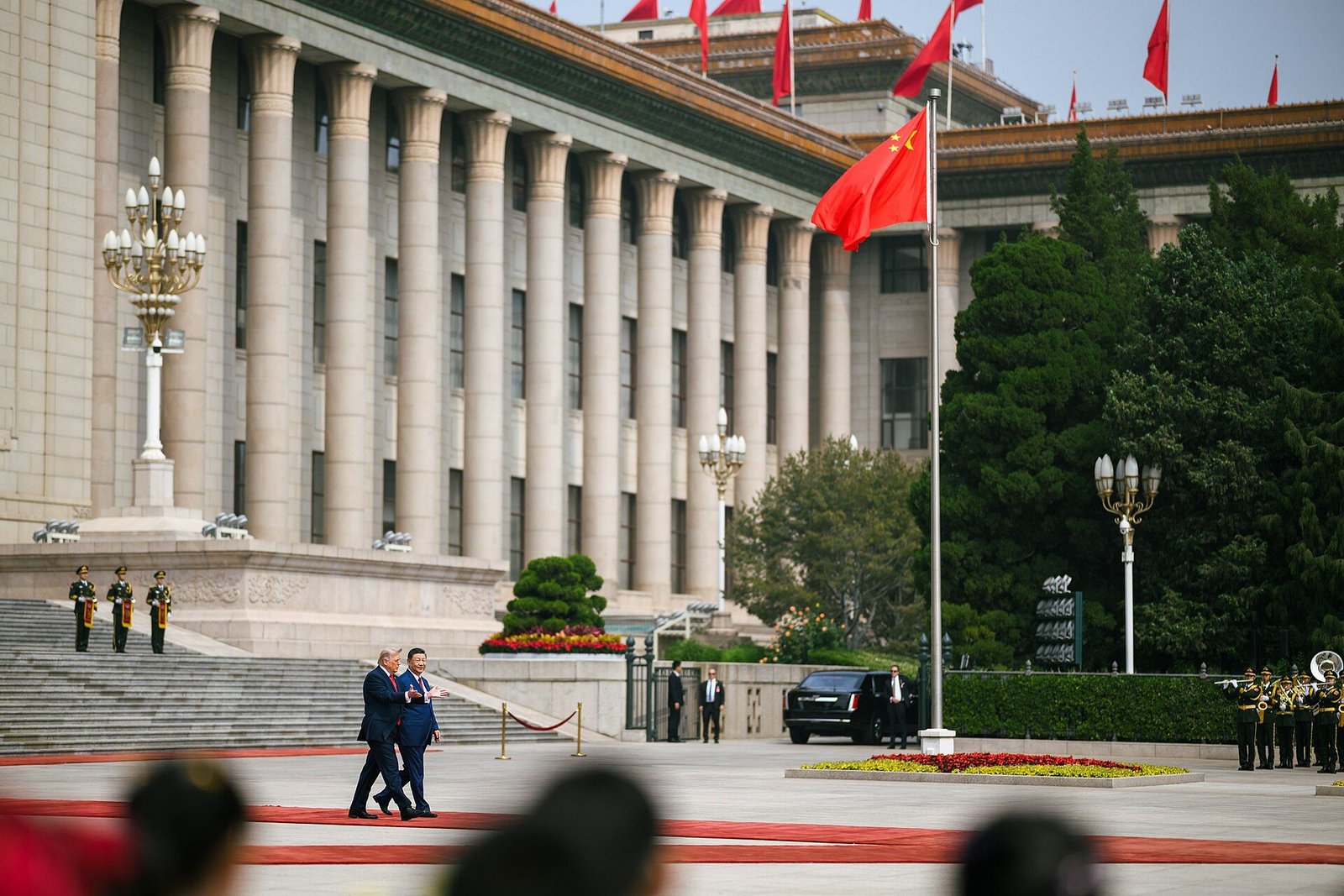
The New York Times is apparently worried that President Trump will mistake China for a friend, and it has been engaging in a blitz to stop him from establishing a partnership with China. On the first day of Trump’s visit to China, the editorial board opined:
When Mr. Trump first won the presidency a decade ago, he correctly labeled China a threat to American interests and criticized past U.S. presidents for their naïveté. In both of his terms in office, however, Mr. Trump has weakened the United States relative to China.
On May 9, it had published a front-page story about a man who texted an aide to the House Select Committee on the Chinese Communist Party an offer of $10,000 for information about the committee’s work. The article did state that “Beijing and Washington have been aggressively spying on one another for decades,” but the paper placed it on its front page nevertheless. And on May 8 in its pages a contributing opinion writer warned:
Mr. Trump and Xi Jinping are reportedly considering a deal to allow China to invest $1 trillion in the United States, largely to build factories on American soil. It would be an unforced error of world-historic proportions.
Should American workers and American consumers oppose Chinese investments? To think about this question it is instructive to examine the case of car manufacturing in Sweden.
In 1927 Assar Gabrielsson and Gustav Larson opened a factory called Volvo and proclaimed: “Cars are driven by people. The guiding principle behind everything we make at Volvo, therefore, is and must remain, safety.” For more than 70 years, Volvo was a successful company that produced internationally recognized safe cars. But then in 1999, its management decided to split it into a car and a truck division, and went on to sell the car half to Ford.
Ford paid good money for it: $6 billion. Why did it need it? Ford’s CEO at the time, Jacques Nasser, explained:
Volvo has a world-class reputation for safety, quality, durability and environmental responsibility – all of which are attributes that are increasingly important to customers, and fit with our 21 century vision for Ford.
Once it owned it, however, Ford fought, unsuccessfully to make Volvo just as unsafe as Ford. (It also fought to keep this fight secret.)
Volvo withered under Ford, and its workers were subjected to a succession of layoffs. In 2010, just eleven years after its purchase, Ford sold Volvo to a Chinese company for $1.8 billion. The Chinese owners added plants in China, but kept production in all of its existing locations in Sweden, Belgium and Malaysia. In addition to the new plants in China, it has also added plants in India and the United States. R&D remained in Sweden and that division designed the new, all-electric brand, Polestar. Polestar 3 will be produced in Volvo’s already existing factory in Charleston, South Carolina. Ford trucks remain just as unsafe today as they were before the acquisition of Volvo.
Volvo’s restructuring was apparently contagious, and a year later, in 2000, SAAB sold its car division to GM. Just like Ford, GM integrated its technology into its new Saab cars and, just like Volvo, SAAB withered. A Chinese company wanted to buy it, but GM was only willing to sell the car without its technology. The sale did not take place, and thousands of workers in Sweden immediately lost their jobs.
Swedish auto workers did not lose by working for Chinese owners, but they did lose when American owners refused to sell technology to China. Is there a guarantee that Chinese investments will never end up hurting workers, just as they didn’t in Sweden? Of course not. But from news reports about the various policies that the Chinese government uses to mitigate economic downturns, it is clear that it prioritizes the well-being of its workers. China’s investments in infrastructure and health around the world also suggest that it wants workers to be receptive to its investments. Whether this comes from a desire for soft power or adherence to Communist principles is impossible to know. But what is clear is that the propaganda against Chinese investments serves American corporate interests and hurts American workers.
For more about China’s alleged technology theft, see:
+ Chinese Intellectual Property Theft: The Indictment of Huawei Is an Embarrassment–Counterpunch, May 31, 2019
+ American Workers Should Want to Transfer Technolog,y to China–Counterpunch, March 22, 2019
+ May Day: a Trade Agreement to Unite Third World and American Workers–Counterpunch, April 29, 2016
[ad_2]
Source link
