
“The first panacea for a mismanaged nation is inflation of the currency; the second is war. Both bring a temporary prosperity; both bring a permanent ruin. But both are the refuge of political and economic opportunists.” — Ernest Hemingway
Thanks to the fiat currency system, governments at war can tap into a nation’s savings by financing conflict through currency debasement. Under a gold standard, governments had to have the gold or impose taxes if they wanted the funds to prosecute a war. When the gold ran out, the war stopped. But not in a fiat currency system. They can continue debasing the currency until they hyperinflate it.
That’s why there’s a simple equation you should sear into your memory:

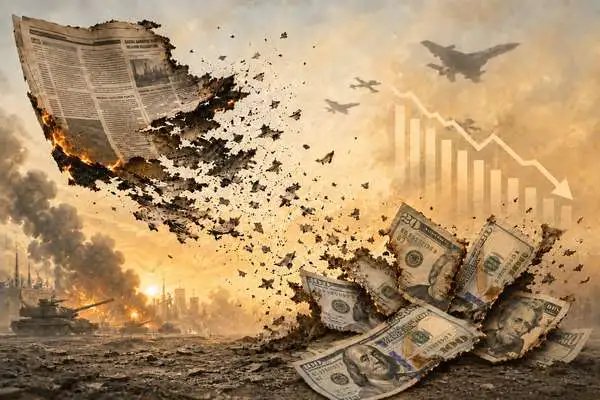
War = Inflation
The historical pattern is clear.
If the first casualty of war is truth, the second casualty is the currency.
For example, the US money supply (M2) more than doubled during World War I and about tripled during World War II.
During Vietnam, the money supply rose roughly 90%, and during the 2003 Iraq War era, it rose about 65%.
War is expensive. The US government often ends up financing it by going deeper into debt and debasing the currency to service that debt.
How much will the war in Iran cost? Nobody knows the exact amount, but I am confident it will result in meaningful currency debasement.
According to the Iran War Cost Tracker, the conflict has cost at least $74 billion so far. Other estimates, such as those from CSIS, put the cost at around $2 billion per day. But these estimates almost certainly understate the true direct costs, not to mention the indirect costs of the war.
Further, the Pentagon is now asking for an additional $200 billion in emergency war funding. And that is on top of its recent request for a 50% budget increase to $1.5 trillion.
Lastly, it’s worth noting that recently Iran destroyed at least one E-3G “Sentry” Airborne Early Warning & Control aircraft in Saudi Arabia, along with 2 or 3 KC-135 tanker aircraft in the same strike.
This marked the first combat loss of an E-3 in history. Each unit costs at least $540 million.
After the strike, the US likely has only around 8 operational E-3s left, with none currently in production. It remains one of the most important aircraft in the US Air Force.
A cheap Iranian Shahed-136 drone, costing roughly $7,000 per unit, was what took out the $540 million E-3. That works out to a cost asymmetry of roughly 77,286 to 1 in this strike, which has to be a record, or close to it, for the biggest cost asymmetry in a single military strike.
If the war drags on for a few more weeks and Hormuz remains closed, I think we will see an economic collapse far larger than the one caused by the global lockdowns during the Covid mass psychosis. In response to that slowdown, the US government went on its biggest money-printing binge in history and increased the money supply by 40% in a matter of months. I expect the economic disruption from a prolonged closure of Hormuz to be even greater, and thus the accompanying monetary “stimulus” to be even greater as well.
In short, the Iran war and its side effects could unleash a tsunami of new government spending, which was already in the stratosphere.
How is the US government going to finance all of this spending?
It will do so by issuing new debt—Treasuries—but to whom, and on what terms?
First, it is important to understand that the overwhelming majority of new issuance has been in short-term T-bills. There are dwindling buyers—suckers—willing to buy long-duration US debt.
That is typical in a debt crisis. As demand for long-term bonds weakens, investors gravitate toward short-term instruments like T-bills instead of 10-year notes and 30-year bonds.
It is the same pattern you see in emerging-market crises. The market shortens maturities as conditions deteriorate. Only a fool would want to lend a bankrupt government money for the long term.
Further, the Chinese are divesting their Treasuries rather than buying more. The Japanese, the single largest foreign holder, are selling Treasuries to support the yen and prop up their own warped bond market.
So, who will be buying all of the new paper the US government is likely to issue to finance the Iran war and its effects?
There is only one real candidate: the Federal Reserve, which buys Treasuries with “money” it creates out of thin air by debasing the currency.
As the war spending grows, the real cost won’t only show up in Pentagon budgets or Treasury auctions. It will show up in the purchasing power of the dollars in your bank account.
The key question is what to do before the next wave of debt, money printing, and inflation hits.
That’s why I’ve put together a simple, urgent guide showing the top 3 strategies you need right now to help protect your money and personal freedom. Get it now.
[ad_2]
Source link
