
[ad_1]
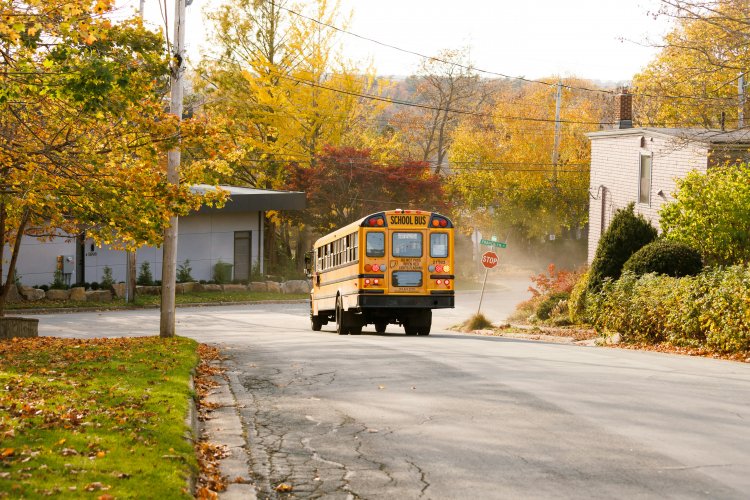
Today is a day I’ve dreaded for over a decade. At around 6:20 a.m., we’ll get my oldest son Judson up, give him a bath, put his safety harness on (don’t worry, we’ll dress him first), and then watch him amble down our driveway to the school bus, as we have almost every school day since fourth grade. He’ll go through whatever class activities he has, come to the end of the day, and get ready to ride the bus home, as he has almost every school day since fourth grade. His teachers and aides will wipe their eyes, put him on the bus, and off he’ll go, just the same as he’s done almost every school day since fourth grade.
Judson is a senior in high school. He also has profound autism. He’s 18 years old, and while he blessedly has some capacity for speech, I’ve never had what you would call a conversation with him. And I assume (though I can’t really know) that he has no clue that today isn’t just any old school day like he’s had since fourth grade. Today, Judson Hancock Trende will have his last day of class. He’ll get off that bus, and he’ll never get back on. When his schedule-obsessed brain prompts him to seek reassurance by asking “school tomorrow?” on Sunday, the same way he has every Sunday for well over a decade, we will have to figure out a way to let him know that, no, there’s no school tomorrow, and not the next day or the next one. Not ever.
Judson came into the world on Aug. 5, 2007, a little spark of joy unnoticed by most of the world, but who quickly became our entire world. He was our first child, and as I liked to brag, my first son. All parents irrationally believe that their babies are as special to the rest of the world as they are to them, but it seemed that way to us. The first year was the usual parental sequence of late-night feedings, stressing out because we had forgotten to wash the bottles on sanitary (ha!), play dates, and the general exhausting joy of the first year of the first child.
I don’t remember exactly when I started to notice things weren’t right. He was a rough eater and had to be bottle-fed earlier than expected, but hey, he’s just a rough-and-tumble growing baby boy! When he would squirm off my lap as I tried to read to him at night, crawling over to open and close the closet door repeatedly, I thought he was just a little engineer at heart, trying to figure out how things worked. Sure, his speech was delayed, but family lore had long said my parents were worried about my own delayed speech until one day I spurted out, “Mommy, turn the light out.”
All doubt was removed on Dec. 2, 2009. As I like to tell people, we went into a doctor’s office wondering whether our son might one day be president. We walked out wondering if he would ever potty train. We also learned that his therapies would cost around $3,500 per month. My initial response was “there’s no way that we can do this.” My wife – an absolute visionary who is behind almost every good thing that has ever happened to Judson – made it clear that we would figure it out. RealClearPolitics helped cover the cost, for which I’m eternally grateful. My wife gave up her lifelong dream of being a stay-at-home mom to go back to work at a law firm. We realized our agreed-upon goal of five children was likely not going to be realistic, given the attention and resources Judson would probably need.
Judd started his ABA therapies in a small private school that met in a church basement. We owe so much to the couple who started this school, and to his aides who helped us learn that “different, not less” wasn’t just a slogan. When people talk about “everyday heroes” who don’t realize the impact that they had on people’s lives, we get it. We’ve been blessed with a multitude of them. Miss Jen and Miss “Kwisten” helped Judson learn to eat with utensils, drink from a cup, and, in an absolute life-changing move, to potty train. At first, he developed quickly, hitting all of his IEP goals and developing basic speech. By the time he was four, he functioned at a three-year-old level. Everyone expected his life trajectory to follow a “mildly” autistic path. Incidentally, there was a family at the adjacent church preschool for typical kids who invited Judd to their son’s birthday party. Thank you. I’m sorry I don’t remember your names, but it is the only birthday party for a neurotypical peer, other than close friends or family, to which Judd has ever been invited since his diagnosis. I don’t think he gives it a second thought (but who knows!?), but your action meant the world to us at the time.
We discovered that Ohio offers a substantial school voucher to children with autism, and that as a result, there are around half a dozen schools nearby that charge a little bit above the voucher amount, while public schools compete for those voucher dollars. We moved immediately, with my wife moving into a bigger, more demanding law firm with higher pay. Judson started at a private school for autism, where teachers and aides like Miss Britt, Miss Artim, Miss Busch, Miss Kelsey, and Miss Gates (most were married, but “missus” is a bridge too far for Judson) all marveled at his joyful attitude. We also discovered a thriving community of “autism parents,” drawn to Central Ohio by the voucher and Nationwide Children’s Hospital, who provided a much-needed support system. Judd got to do things (through my wife’s prodding, often over my objections) that we wouldn’t have dreamed possible: He played Miracle League baseball, went to special sensory showings they have at movie theaters, and found favorite restaurants to eat at. Mr. Rob taught him to swim at a program developed by Ohio State University for kids with special needs. He still loves to swim.
I don’t know why he stopped developing, and I’ve found it’s best not to think about it. We now have the world’s biggest three-year-old, we like to say. Whenever I get angry at God about that, I quickly remind myself that this is also how we learned our most important life lesson: As George Will once put it with respect to his own son (who has Down’s Syndrome), a less-than-perfect life is still very much worth living. We always say that we just want our kids to be happy, and Judson is the test case for that. He won’t go to college, he won’t work a job, and he’ll almost certainly die without having ever kissed a girl. But as he walks down the hall, you realize that he doesn’t have a care in the world. He’s almost always happy. When a teacher asked him what he wanted to be when he grows up, he responded, “a good boy.” If there are disappointments about the path his life has taken, they’re our own, not Judson’s.
In second grade, we decided to try public schools. Judson has always been a “tweener” – not so high-functioning that he really needed to be in public schools, but not so low-functioning that he didn’t gain from having typical peers. We were mildly terrified, but were once again blessed by terrific teachers like Mr. Holly, Miss Silcott, Miss Sowers, Miss Gallmeyer, and Mr. Scheid. The autism scholarship meant that he had one-on-one aides most of the time, through whom (at times helped along by my wife’s prodding) he was able to participate in choir, Special Olympics (fourth place statewide for basketball skills!), pep rallies, homecomings, and field days. His special needs class arranged prom and homecoming dinners, and aides served as Judd’s “date” to prom this year. They set up (at my wife’s suggestion) the “signing day” table specifically for Judd, as he inked in his acceptance letter to a group home. Along the way, he changed lives too; he has inspired multiple teachers and aides to go into careers in special needs teaching and therapy. Whenever I hear the song “This Little Light of Mine,” I think of Judson, childlike, in many ways unaware, but sending sparks of light everywhere he’s gone.
I would love to name that small army of school aides, some of whom turned into home aides, but it would stretch on for a page. Thank you all. You are honestly heroes, taking on a difficult job for little pay and little obvious reward as you patiently watched him work so, so hard while struggling to make progress, sharing your obvious joy with us at every little step he took along the way. And thank you to the students at these schools, including my two younger sons. What you did was make school Judson’s “place.” You are his “people.” Those schools were the places he organized his life around, where he looked forward to going every day. I’ve often commented that far too few people will love Judson for how great he is, but you are the exceptions. Every one of you matters.
This brings us (finally) to the bus. As I’ve mentioned, almost all of the incredible things that Judson has done have come about with my wife’s vision and pushing, while I anxiously watched, praying things would work out. But the bus is mine. In Fourth Grade, I suggested that perhaps he could start riding the school bus. On this one, my wife was anxious, but his teacher and I agreed he could make it. And for once, I was right. He loved riding the bus, from day one. When we needed to motivate him to get out of bed in the morning, “you’re going to miss the bus” always did the trick. On those days when he missed the bus, he was visibly upset. Who can tell exactly why, but I’ve half-convinced myself that he loves the feeling of independence and being just like the other kids when he rides.
Today, that’s over. I know every high school graduate’s parents feel this way. I know that there are parents out there who would give anything for their children to have made it this far. It’s a blessing that he ever rode the bus in the first place. It just seems to hit differently here, because this was one place where I know I made a difference in his life and made him a little happier. And, selfishly, school was the last “typical” thing he did. Parenting Judson has been beyond wonderful, but there was always a touch of jealousy or melancholy as I watched classmates, cousins, and neighbors enter activities and institutions that were closed to him. School was the last link to the “typical” world. That ends too. In August, we’ll do what so many graduating seniors’ parents do: pack up his belongings, and drive him away. His destination won’t be college. It’ll be a group home. I’ll be spared the concerns that most of those parents have; he won’t get into drugs, won’t flunk out, won’t struggle to find a career. I’ll have different ones: What if someone is cruel to him, what if he isn’t getting his favorite foods, what if he’s unhappy? He lacks the means to express any of that. If nothing else, I hope those bus rides are memories he can look back on with joy.
So, what’s the point here? I suppose, like a lot of parents of typical kids around this time of year, I realize that something important is coming to an end, and I’m waxing nostalgic. Some of this is just wanting to thank people who probably don’t understand the impact that they’ve made. Some of this is knowing that somewhere, some parent right now is getting the same news that we got on Dec. 2, 2009. Maybe they’ll read this, and it will help them realize that it can be alright. It won’t be the same: I remember walking with Judd and seeing the neighborhood dads having a beer together after their sons’ first little league game, and realizing I was always going to be different (middle school all over again!). But that doesn’t mean less. It can be alright. Joyful even.
At the bottom, there’s this: All parents have their irrational anxieties about their children. I can remember waking up in the middle of the night, consumed with a need to check on my kids to make sure they’re still breathing. I’ve moved on from that, although I’ve learned from others’ tragedies that this fear isn’t always irrational. Still, other weird fears have moved in. At night, when the demons come, my current fear is this: What if when I die, there’s no one to remember Judson? What if there’s just a handful of people at his graveside, and he becomes a curiosity in the graveyard, an old man mysteriously laid to rest next to his parents. People passing by might invent stories – “I don’t know honey, must be an old man whose heart was broken and never married” – with the wonderous reality of his life slipping into myth. Rationally, I know this is where almost all of us end up sooner or later, but for some reason, it just hits harder thinking about him: a gentle, loving soul who never gossiped, never insulted anyone, never lied, and who for some reason never got a chance to even try to write his name in the history books. The internet is a strange sort of place of suspended animation for ideas; maybe someday someone will Google his name out of curiosity and learn something about the little spark that came into this world on Aug. 5, 2007.
I don’t want to end on a note like that, so I’ll add one more thought. Technology is amazing, and our understanding of the brain grows by leaps and bounds every day. Maybe someday, after I’m gone, they’ll come up with a “cure” for autism. I put “cure” in quotes because for many people, autism is a personality trait, something that allows them to see the world in a different light, and for them, trying to “cure” autism makes about as much sense as trying to “cure” someone’s artistic talent. I take that seriously, though that isn’t Judson’s story. I’ve also thought that “curing” Judson at this point might border on cruelty. Whatever uncertainties lie on his pathway, I don’t know that it would be fair, or even humane, to have someone pick up an entirely new life in their 20s or 30s, especially when they seem happy overall.
As an exercise in daydreaming, though, it’s pleasant to imagine a happily married Judson with his own children one day browsing the internet and finding this piece. If I didn’t get a chance to meet that version of Judson and never had a chance to have a conversation with him, I would just want him to know that I tried. I know I made mistakes and wasn’t always the best version of a dad that I wanted to be. The times I lost my temper and yelled, or didn’t pay enough attention to you, or couldn’t comfort you because I couldn’t figure out what you needed, I’m sorry about them. This goes for all your brothers, but I hopefully can muster the courage to tell them that along the way. For you, it’s hard to really explain or put into words, so maybe I’ll just say this: When you were a kid learning to talk, we’d read to you at night. You always loved to say (from memory) the last sentence of the book, and they’re etched into my memory forever. “And it was still hot.” “Ask me tomorrow, but not today.” “Goodnight noises everywhere.” Judson, just know that while it might not always seem like it, you’ve made this tree so happy. Daddy loves you (and mommy too!), all the way to the moon and back.
Sean Trende is senior elections analyst for RealClearPolitics. He is a co-author of the 2014 Almanac of American Politics and author of The Lost Majority. He can be reached at strende@realclearpolitics.com. Follow him on Twitter @SeanTrende.
[ad_2]
Source link
