
[ad_1]
In one of the scariest moments in modern history, we're doing our best at ScheerPost to pierce the fog of lies that conceal it but we need some help to pay our writers and staff. Please consider a tax-deductible donation.
How Media Glorification of Vigilantes and Militarism Can Backfire
Mischa Geracoulis for Project Censored
On December 22, 1984, Bernie Goetz—“the subway vigilante”—shot four unarmed Black teenagers on a New York City subway after one had asked Goetz for five dollars. Pulling an unregistered Smith & Wesson revolver from his waistband, Goetz fired five shots with expert precision at the teens, gravely wounding them all. Each suffered extensive hospitalizations and surgeries, and one, Darrell Cabey, was left paralyzed and mentally impaired for life. The media spectacle that ensued worked to garner public sympathy for the shooter, helping to confirm biases and normalize racial prejudice as a marker of victim reversal.
Despite unremitting self-righteousness and lack of remorse, Goetz initially fled the scene. Cruising around New England in a rental car for the following nine days, he turned himself in to the Concord, New Hampshire police department on December 31. The legal case dragged on for years. Sympathetic jurists eventually found Goetz guilty of possessing an unregistered handgun—for which he served just eight months—but not guilty of assault and attempted murder.
Two books about the subway shooter saga, both published in 2026, give pause for reckoning with what one of the authors, Heather Ann Thompson, calls the “deep roots” of the political and media space we currently inhabit. Thompson’s Fear and Fury: The Reagan Eighties, the Bernie Goetz Shootings, and the Rebirth of White Rage (Pantheon, 2026), traces the pattern of media-manufactured victim reversal and (un)worthiness that crescendoed during Ronald Reagan’s presidency. Fixed in White resentment, policies of the Reagan Revolution and their corresponding media echo chambers “recast racial violence as necessary and defensible,” explained Thompson in The Atlantic in January 2026.
Crime as entertainment
Goetz’s shooting spree did not happen in a vacuum, but against the backdrop of the Cold War, the Reagan Doctrine, and the era’s prevalent law-and-order narrative. US ideology claimed the need for toughness at home and abroad. Urban vigilante fantasies (glorified in the Death Wish movies of that era) portrayed Goetz as an avenging angel, aligned ideologically with US support for insurgents and “freedom fighters” abroad. As media stoked public outrage on Goetz’s behalf, they turned him into a celebrity. Even as the White Goetz’s racial prejudices were publicized, he—not the four Black teens he shot with malicious intent—was interpreted as the victim.
This period also produced Manufacturing Consent: The Political Economy of the Mass Media by Edward S. Herman and Noam Chomsky (Pantheon, 1988). The book shows how US news media frequently reinforce rather than challenge powerful elites by influencing public perceptions of “worthy” versus “unworthy” victims. Those harmed by US adversaries are humanized and reap sympathy, while victims of US “enemy” states are dehumanized and deemed unworthy of sympathy and justice. Extending this rationale to “enemies within,” ideas about victim worthiness predispose who gets punished and who gets a free pass.
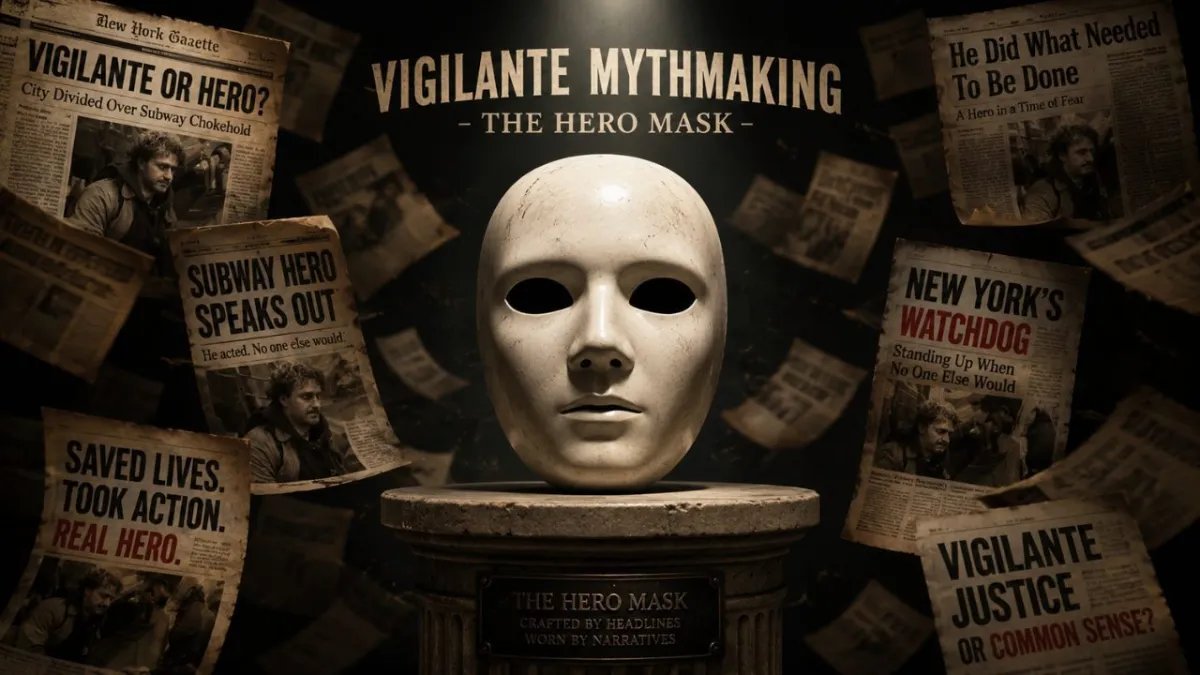
Thus, despite Goetz’s cold admission of guilt, the right-wing media of the day—notably the New York Post and New York Daily News—covered Goetz as a Charles Bronson-like hero. The same papers routinely used language to fuel dangerous stereotypes, flattening Goetz’s victims into one-dimensional caricatures defined by their race, South Bronx addresses, and juvenile offenses.
Over time, this type of coverage has helped destabilize democratic norms and rule of law, elevating chosen individuals above the law. In Thompson’s estimation, the media’s popularization of Goetz as the hero and his victims as the villains was the beginning of where we are today under the second Trump administration. Referencing the ICE killings of Renée Good and Alex Pretti, Thompson says that the public is told “up is down, down is up. We didn’t see what we thought we saw.”
Right-wing media and rise of “rageotainment”
The corporate media—particularly the conservative factions that have multiplied since the 1980s—played a key role in solidifying tough, conservative public and foreign policies. Even prior to Ronald Reagan’s presidency, historical events such as the founding of the John Birch Society, Barry Goldwater’s run at the presidency, and Richard Nixon’s presidential campaign (orchestrated by Roger Ailes), queued up the right-wing movement in the media, as documentarian Jen Senko detailed in Project Censored’s State of the Free Press 2024.
The Lewis Powell memo of the early 1970s, Reagan’s granting of US citizenship to Australian media mogul Rupert Murdoch, and revocation of the Fairness Doctrine were right on time for the media to spin Goetz as the victim-hero. Fear and Fury traces Murdoch’s acquisition of the New York Post in 1976 and his role in unleashing sensationalized, tabloid-style reportage into the US market.
Fast-forward to Trumpism, MAGA, and the current administration’s assault on the press. Expert in wielding “fear and fury,” the New York Post is the same paper that today provides a platform for Trump propaganda. Murdoch’s outlets and other right-wing media have legitimized atrocities across administrations, including Trump’s Muslim Ban, Unite the Right violence, insurrection at the US Capitol, Immigration and Customs Enforcement agents’ public kidnappings and murders, illegal boat bombings in the Caribbean and eastern Pacific, seizure of Venezuelan president Nicholás Maduro, school bombing in southern Iran that killed at least 170, decapitation of the Iranian Islamic Republic in “Operation Epic Fury,” and so much more.
The more things change, the more they stay the same
In 2023, Daniel Penny, a White passenger and US Marine Corps vet, took the law into his own hands when he put the Black, mentally ill Jordan Neely in a six-minute chokehold on a New York City subway. One New York Post headline declared, “Daniel Penny did ‘what we would want someone to do for us’ when he put ranting Jordan Neely in a chokehold on NYC subway.” Subsequent Post articles included praise from “the original NYC subway vigilante.” Goetz called Penny’s prosecution “BS and a political trial,” and said the 2024 acquittal was “a good thing.” As with the Goetz case, devaluation of Neely’s life was central to the rhetorical contortions that helped absolve the perpetrator.
First casualties of conflict
Truth and critical thinking are often the first casualties of political conflict and war. This dynamic is reflected not only in corporate broadcasters’ capitulation to the right—witness recent “news” stories framed to serve ideological ends—but also in the multi-decade push to cut federal funding allocated for public media. As outlined in Project 2025, conservative media provide a platform for presidential messaging, including the racialized dog whistling that impacts policies, public perception, and behavior.
Fear-based and outrage-driven stories that dominate news and infotainment cycles obscure both reality and justice, creating lasting disparities in public knowledge. The increasingly polarized mediascape offers echo chambers for dual purposes. For political leaders, message-echoing furthers their own interests, and for audiences, such repetition gives false reassurance that their beliefs are correct.
From the 1980s to the present, Murdoch’s media empire has been central to conservative presidents’ divide-and-conquer approach to governing the nation. Often disproportionately denigrating marginalized members of society, Murdoch’s sensational, overtly partisan “news” has established a workable template for rival media corporations to reproduce.
In the United States of Trump 2.0, conservative media hype xenophobia, classism, and human insecurities. Rather than follow the journalistic ethic to minimize harm, this type of reporting contributes to the construction of “an enemy within,” amplifying unfounded fears of marginalized communities and victim unworthiness.
Among myriad others of the independent press, Ryan Grim and Jeremy Scahill of Drop Site News have critiqued the US media’s wartime coverage, most recently on Iran, that continues to manufacture consent for war, sanitize atrocities, platform criminals, and induce audiences to trust the very “people who lied us into every war before this one.”
Audiences of US media should know the drill by now. It played out repeatedly in coverage of campaigns such as the Nixon-Reagan War on Drugs, Bush’s War on Terror, and the Broken Windows and Stop-and-Frisk policing operations—each excessively targeting people of color. Each of these efforts found media outlets willing to amplify race-baiting and disinformation tactics to justify their campaign. Current Trump-friendly media covering Iran follow a similar propagandistic pattern.
Flipping the script
Rhetorical and “political jiu-jitsu” can work both ways, though, especially when repression and injustices are fully exposed. Building on Gene Sharp’s work in nonviolent resistance, Brian Martin, an emeritus professor of social sciences at the University of Wollongong, Australia, created the “backfire model.” Martin explains a backfire as a favorable phenomenon, showing how attacks and injustices perpetrated by the powerful can be vindicated through citizen action and public-service journalism. Instead of falling prey to the elitist manufacture and institutionalization of racism, a backfire can mobilize the public as a force for renewed justice.
Ethical journalism is pivotal to the backfire process. For a backfire to work, says Martin, the media must expose injustices and cover-ups and reframe events to center those harmed. When successful, the process diverts public attention from power and toward accountability.
The 1991 beating of Rodney King by the Los Angeles Police Department infamously backfired after being caught on video and replayed on national television. After the 1992 acquittal of the four officers charged with the use of excessive force, uprisings (pejoratively known as the “LA Riots”) ensued. Owing to nonstop media coverage, the “LA riots” triggered smaller yet similar anti-police demonstrations across the United States. In Los Angeles, controversial police chief Daryl Gates was forced to resign. Martin’s analysis of this backfire showed that the process is useful for uniting seemingly disparate communities into a force for change. This can be applied to uprisings ranging from the Arab Spring to the recent No Kings protests in the United States.
Prevailing sentiment, nonetheless, continues to place blame for socioeconomic ills on society’s most disenfranchised members, rather than on the elites who devise, maintain, and benefit from the disenfranchisement. As in the Reagan era, today’s violence and wars are not defensive, episodic, or isolated events. And the news that champions domestic vigilantism often parallels the news that cheerleads militarism abroad. Without resistance from journalists and the broader public, patterns of victim-blaming will remain standard practice, reinforcing inequality, violence, and impunity for those who are actually at fault.
A better-informed public is more resistant to narratives that endorse unconstitutional and illegal actions of the powerful. Developing critical media literacy skills is essential to that resistance and to enacting the kinds of constructive backfires that Brian Martin highlights.
In 1984, Goetz’s four Black victims were cast as societal threats, while Goetz, the White gunman, was framed as an avenger. That pattern of victim reversal has repeated in myriad situations for decades now, legitimizing discriminatory policies and laws, and illegal wars. There is no question about the media’s capacity to manufacture consent. The larger question is whether the public will continue to accept miscarriages of justice and breakdown of rule of law, or demand accountability.
Mischa Geracoulis specializes in human rights journalism, press freedom, and media ethics, is the Outreach and Engagement Manager at Project Censored, and author of Media Framing and the Destruction of Cultural Heritage: News Narratives about Artsakh and Gaza (Routledge, 2025).
Editor’s Note: At a moment when the once vaunted model of responsible journalism is overwhelmingly the play thing of self-serving billionaires and their corporate scribes, alternatives of integrity are desperately needed, and ScheerPost is one of them. Please support our independent journalism by contributing to our online donation platform, Network for Good, or send a check to our new PO Box. We can’t thank you enough, and promise to keep bringing you this kind of vital news.
You can also make a donation to our PayPal or subscribe to our Patreon.
Please share this story and help us grow our network!
[ad_2]
Source link
