
[ad_1]
Horrifically deadly and widely implemented on a global scale, landmines continue to speckle the landscape of current and past battlefields. And while effective in a passive sense, the hardware planted beneath the soil persists long after the inevitable conclusion of war. Innocents and combatants who survive the barrage of bullets and bombs are left with a sadistic game of whack-a-mole – including the wild and domesticated animals.
Rudimentary explosives first appeared in China as early as the Song Dynasty. Continued development eventually gave rise to the modern pressure-activated landmine, which appeared on the battlefields of the American Civil War. Seen as a cowardly method of waging war at the time, the improvised explosive devices continued to gain popularity.
Since the Vietnam War, many variants of mines have been concocted and deployed in the field. This includes the proliferation of anti-personnel and anti-vehicle explosives. For the purposes of this piece, we will focus on anti-personnel mines due to their sensitivity and tendency to detonate with less pressure applied.
The production, transfer, and use of anti-personnel landmines have been greatly reduced, notably following the signing of the 1997 Ottawa Treaty, which specifically addresses the use of mines, foreign and domestic. Many nations agreed to the treaty, though it excludes the signatures of China, Russia, and the U.S.
However, mines continue to be used in modern theaters of war, and the historic placement of mines predates 1997, meaning an unknown number of AP mines patiently wait across the planet for a specific amount of pressure to be applied. And these explosives do not discriminate – hoof or foot, they are ready to go.
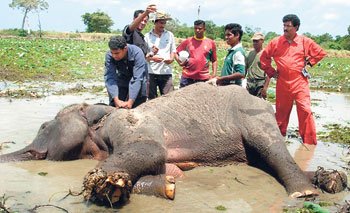
Post-conflict wildlife interactions with landmines have largely remained unstudied, but specific negative interactions have been documented. Famously, in the case of “Mosha,” the Thai elephant that stepped on a mine following their use during a conflict between Myanmar and Thailand. The mine blew half of her front leg off while walking through the jungle on the border of the two nations. Mosha found refuge at a Thai sanctuary, where a prosthetic leg was built for her.
In a short BBC video, host Michael Portillo describes the border between Myanmar and Thailand as “littered with landmines.” Few elephants are as fortunate as Mosha; many die immediately or succumb to infection.
According to the Conflict and Environmental Observatory, for the 20 years that followed the conclusion of the Vietnam War, “At least 40,000 animals were killed by unexploded landmines.”
Liberally used in many conflicts and notoriously untracked, these weapons strike fear into the communities near them and continue to kill and maim, long after the guns have been put down. Their indiscriminate nature was reported on by the New York Times in 2001.
Author Seth Mydans wrote, “Suffering is shared by injured animals of all sorts, in many countries. According to press reports, land mines have killed camels in western China, tigers in Cambodia, water buffalo in Vietnam, elephants in Sri Lanka and gazelles in Libya. Snow leopards have reportedly been killed in Afghanistan; bears, deer and foxes in Croatia; blue sheep and musk deer in Kashmir.
Ironically, in some circumstances, the placement of mines has arguably benefited certain ecosystems. A noted reduction in human encroachment and poaching has occurred since the hardening of the border between South and North Korea.
According to a piece published by The Guardian, “the Demilitarized Zone, or DMZ, is home to thousands of species that are extinct or endangered elsewhere on the peninsula. It is the last haven for many of these plants and animals and the center of attention for those intent on preserving Korea’s rich ecological heritage.”
Millions of mines remain as a relic of the Saddam Hussein regime in the Zagros Mountains, which divides Iraq and Iran. Again, paradoxically, these weapons of war have arguably helped wildlife.
Peter Schwartzstein, writing for National Geographic reports, “The market for leopard pelts has mostly dried up, but there is still a certain cache associated with ensnaring such an exotic creature. As a result, the harsh penalties attached to killing leopards haven’t done much to dissuade determined trophy hunters.”
Continuing with, “The land mines, though, do a good job of keeping people off certain peaks, and these have become the leopard’s favorite haunts.”
And while some conservationists scratch their heads in these paradoxical situations, the predominant opinion remains negative towards the use of mines. Beyond animals, the persistent presence of fields filled with explosives tortures humans psychologically and economically.
Once fertile ground quickly becomes a “no-go” zone and a distant memory of past prosperity. Active de-mining operations continue, though the sheer number of mines in use makes that effort an uphill battle. War seems to inevitably target the innocent, regardless of species.
Christopher Bancroft is a Wyoming native, writer, and photographer specializing in hunting, fishing, and conservation stories. Passionate about the outdoors and the natural world, Bancroft seeks to highlight the human and environmental impacts of critical issues through authentic storytelling. Many of his previous works can be found on the MeatEater website.
[ad_2]
Source link
