
[ad_1]
The U.S. Department of Justice indicted former Cuban President Raúl Castro on Wednesday for his 1996 order to shoot down two planes from Brothers to the Rescue, a Cuban-American organization involved in dropping anti-communist pamphlets over Havana.
Why reopen a 3-decade-old murder case now? The Trump administration has made no secret of the fact that it wants to overthrow the Cuban government—and is willing to go to war to do so. While President Donald Trump and Secretary of State Marco Rubio issue thinly veiled threats to Cuba, administration officials have been anonymously telling the press that yes, they mean military action.
The indictment was obviously meant to evoke the recent U.S. operation in Venezuela, in which U.S. special operations forces invaded Venezuela to serve a drug-trafficking warrant against dictator Nicolás Maduro. During the buildup to that operation, which involved U.S. forces seizing Venezuelan tankers, Trump and his advisers also claimed that they were going to avenge Venezuela’s 2007 nationalization of American oil companies by recovering stolen property.
And to justify starting the mother of all undeclared wars with Iran, the Trump administration has brought up a litany of old grievances. Trump’s announcement of the war started with the 1980 storming of the U.S. Embassy in Tehran and the 1983 attack on U.S. Marines by a pro-Iran militia in Lebanon, both of which happened before most Americans or Iranians were born.
Sen. Tom Cotton (R–Ark.) unintentionally summed up the administration’s pretzel logic in an interview early in the war: “Iran has posed an imminent risk to the United States for 47 years.” The Islamic Republic was so urgently dangerous that there was no time to ask Congress or the American people for permission to fight it, and also this situation has existed for two generations.
These grievances are not a serious argument about the Cuban, Venezuelan, or Iranian threat. They are a replacement for an argument. Instead of making the case that the costs of war (or whatever euphemism for war the administration is using now) are worth the benefits, the administration wants Americans riled up about injuries to our honor and hungry for revenge.
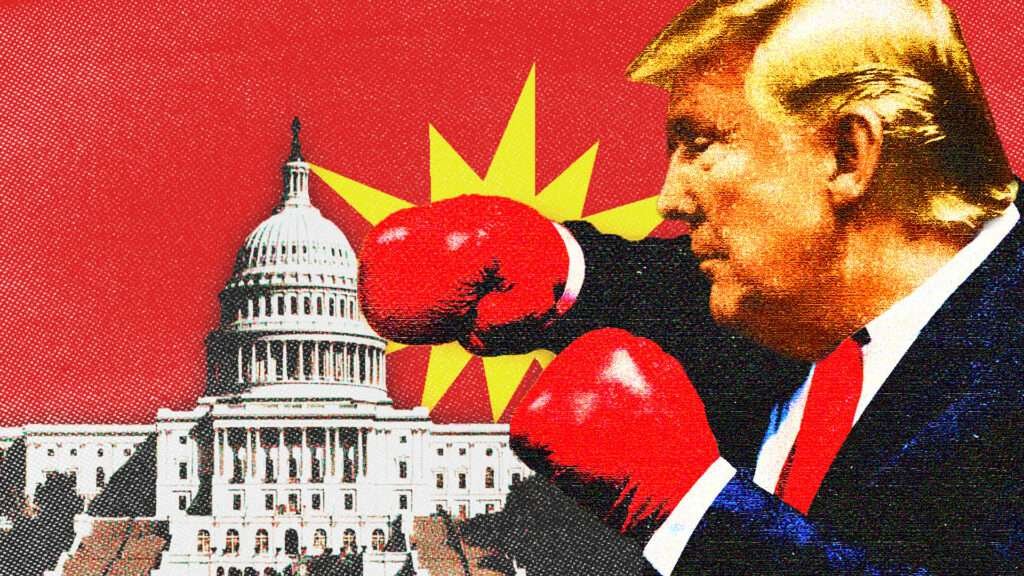
In fact, bringing up these grievances is a sign that the Trump administration doesn’t see these countries as real, imminent threats. Arguing that the Iran war would not become a “forever war,” former Trump administration official Robert O’Brien called it “the quintessential American punitive expedition,” a campaign of “short, sharp projections of force that punish foreign powers or dictators for their untoward actions.”
O’Brien added that a “key advantage of the punitive expedition strategy is its optionality.…The initiative remains with [the president], so that he determines the pace and tempo of kinetic action, not the enemy.” That’s a fancy way of saying that the president should flex by taking revenge on easy targets who can’t fight back.
Punitive expeditions also help the administration advance its domestic agenda. Vice President J.D. Vance claims that the War Powers Act is “a fundamentally fake and unconstitutional law” that is “not going to change anything about how we conduct foreign policy,” and White House Homeland Security adviser Stephen Miller has similar contempt for Congress’ ability to restrain the president. What better way to flex presidential power than to start and stop wars before anyone has a chance to act?
The bet on knockout blows against weak enemies worked out well in Venezuela. The idea of war with Venezuela was highly unpopular in America before Maduro’s overthrow. But the Venezuelan military barely put up a fight; Maduro’s successor kowtowed to U.S. power; domestic objections to the operation in America melted away; and Congress’ concern for war powers was promptly forgotten.
“We’re a superpower, and under President Trump, we are going to conduct ourselves as a superpower,” Miller gloated after the Venezuela operation. Vance similarly said that “Maduro is the newest person to find out that President Trump means what he says.”
That wager did not work so well in Iran. The war dragged on for weeks and is now in a bizarre kind of suspended animation, rousing Congress to finally start asserting its war powers. Precisely because “Iran has gone sideways,” an administration official told Politico, the Trump administration may be looking for more decisive action in Cuba.
The idea that a crumbling, poor Cold War relic poses some kind of threat to America is laughable. And an invasion of Cuba is overwhelmingly unpopular with Americans. But that combination is exactly why Cuba would be a tempting place to repeat the Venezuela model, which is why the Trump administration is bringing up ancient feuds now.
[ad_2]
Source link
