
[ad_1]
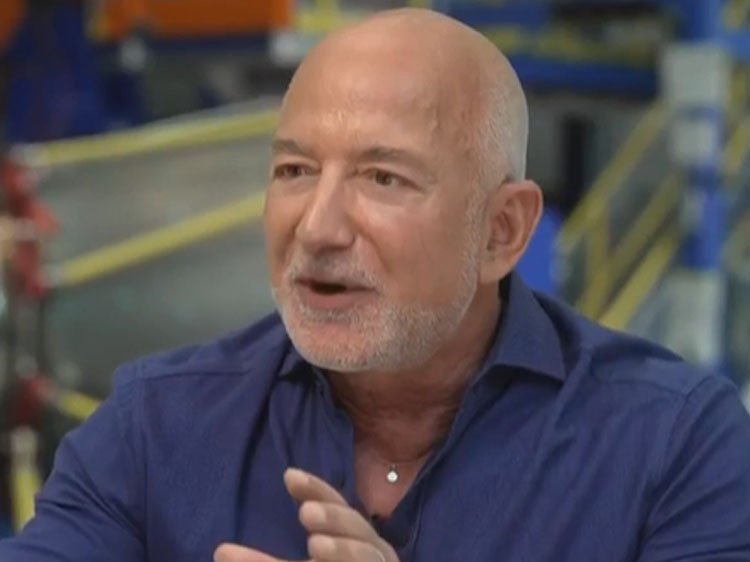
Amazon founder Jeff Bezos responded to Rep. Alexandria Ocasio-Cortez’s recent comment that “you can’t earn a billion dollars” without abusing workers or breaking the law, and NYC Mayor Mamdani singling out Ken Griffin as someone who should pay more taxes, during an appearance this morning on “Squawk Box.”
“Ken Griffin isn’t a villain. He hasn’t hurt anybody. He’s not hurting New York. In fact, quite the opposite,” Bezos told CNBC. “Policy debates don’t have to be finger-pointing.”
“Unfortunately, it is an effective political technique. It’s as old as the hills. So when you don’t know how to solve a problem, create a villain, blame them. But it won’t solve the problem. The only thing that will solve the problem is skill, right?”
“Where does this anger come from?” Bezos said. “It’s kind of a tale of two economies.”
“There are also some deep misconceptions that are worth thinking about. A lot of people don’t understand the zero-sum fallacy. So, they think that if there’s a bunch of wealth over here, that there’s a fixed pie, you know? We’ve got one pizza, and seven people, and eight slices. Who’s going to get two slices?”
“That is not how economies work,” he said. “It isn’t a fixed pie. It grows.”
“People’s mental model is that wealth is like water in a drought or food in a famine,” he said. “You could hoard water in a drought. You could hoard toilet paper in a pandemic.”
“But you can’t hoard investment. So if you have stock in a company, that’s not hoarding. That’s investing. And investing is more like farming,” Bezos said.
By the way, you’ve earned an extraordinary amount of money. You employ — largest employer, if not one of them, in the whole country. When you read that, what do you think?
JEFF BEZOS: Well, it’s not correct on its face. Let me give you a simple example. Let’s say you start a burger joint, and you have ten employees, and you make a little bit of money, right? This is one outlet. And by the way, these are the most delicious burgers in the world. People love your burgers, Andrew.
And so then you open a second outlet, right? And now you’re making a little bit more money, and you have 20 employees. And you open a third outlet. By the time you’ve opened 1,000 outlets, you are a billionaire, right?
And by the way, this is a real-life story. It happens all the time. It’s In-N-Out Burger. It’s, you know, Raising Cane’s Chicken. At what point did that money all of a sudden become unethical? It didn’t. There was one outlet, and then there were two, and then there were three.
The way you make $1 billion or $100 million or $10 million or anything is you create a service that people love. And if millions of people choose your service, you’re going to end up with $1 billion, right? And you can, you know, just try it with a chicken franchise.
ANDREW ROSS SORKIN: Do you think—
JEFF BEZOS: Your chicken has to be good.
ANDREW ROSS SORKIN: But there’s the question of whether the people who are working at the burger joint ultimately should be paid more. That’s what creates the affordability gap.
JEFF BEZOS: Well, by the way, that’s also — if you want to change the minimum wage, change the minimum wage. At Amazon, our entry-level wage in Queens is $23 an hour. And that works out to be like $52,000 a year. And this is an entry-level job that doesn’t require any educational attainment. It doesn’t require any preexisting skills. We will train you. It’s actually a great first job.
On day one, you get full health care, the same health care program that our senior executives get, the same one I’m on. And so this is actually a fantastic entry-level job, $23 an hour. But guess what? They’re still charging that person more than $10,000 in taxes. And you think, “That’s absurd,” right?
Why would you charge somebody making $52,000 a year $10,000 a year in taxes? It doesn’t make any sense. Let them be. You know what? That person has a chance to uplift themselves and to uplift their family and to learn more skills. But why are you taxing them so much? I really am puzzled by this, you know, the more I think about it. Why? Well, you don’t need that revenue.
ANDREW ROSS SORKIN: The piece is that we have a big budget gap. And so whether you’re the federal government or whether you’re a city — I mean, I was going to ask you about what you thought of the pied-à-terre tax in New York and what you thought of what happened with this Ken Griffin video that the mayor made. Well, you have a place in the city.
JEFF BEZOS: Yeah, there are two different things about that video. On the one hand, it’s perfectly fine to have a policy debate about whether you want to have a pied-à-terre tax, right?
The second piece, which is not so good, is to go stand in front of Ken Griffin’s house and act like he’s some kind of villain. Ken Griffin isn’t a villain. He hasn’t hurt anybody. He’s not hurting New York. In fact, quite the opposite. And so that piece of it isn’t right, and there was no reason to do that.
A tax is a — you know, taxes on out-of-towners are very popular taxes. That’s why there are hotel taxes. And hotels always have very high tax rates, because why not tax the tourists? And there are limits. If you raise the hotel taxes too much, tourists stop coming, right? So you have to be judicious. But I think that the tax is a fine thing for New York to do, and, you know, they have to figure out — but it’s a policy debate, right? Policy debates don’t have to be finger-pointing. This is the piece.
ANDREW ROSS SORKIN: And so you’re not going to sell your place.
JEFF BEZOS: Unfortunately, it is an effective political technique. It’s as old as the hills. So when you don’t know how to solve a problem, create a villain, blame them. But it won’t solve the problem. The only thing that will solve the problem is skill, right?
And so, really, it’s a skills issue. You want to say any corporate CEO, CFO worth their salt — Amazon’s CFO could find 3% in the federal budget on a Tuesday afternoon. There is so much waste in government spending.
ANDREW ROSS SORKIN: What do you think personally? I mean, you read these headlines. You see your name in them, whether it’s the Met Gala protests. On a personal level, what do you personally think of all this? I know we’re talking about policy.
JEFF BEZOS: Well, on a personal level, you know, I think of my parents, and I think of how they uplifted me. I think of where they started. I think, you know, my dad is a Cuban immigrant. He came to this country right after Castro took over, and he was a 16-year-old boy who didn’t speak a word of English. He came all by himself. His parents weren’t allowed to leave. He was in a refugee camp in the Everglades, and he built himself up.
My mom had me when she was in high school. She was a 17-year-old mom. You know, it wasn’t cool to be a pregnant mother in high school in Albuquerque, New Mexico, in 1964. And she brought herself up.
And so I look at that and I think, you know, I want to make sure that the people who are struggling today have a chance to do that, to bring themselves up. And maybe, you know, maybe they’re going to be the next Steve Jobs. Maybe one of their kids will be the next Steve Jobs. I don’t know. But we can give them a better chance by eliminating their tax bill. I don’t want to reduce it. I want to eliminate it.
I think there’s something very powerful about zero. You know, zero is a better number than like $1. You know, we don’t charge — we have free shipping at Amazon, not like $0.25 shipping. Zero is a good number. When people are starting out and they’re struggling, stop taxing them. We don’t need it.
We live in the wealthiest country in the world. America is the greatest country in the world. We have more entrepreneurial dynamism here than anywhere else in the world. This is the best time to be alive in America because access to capital is so easy right now. It’s so good. And I’m talking about entrepreneurs and aspiring entrepreneurs. We should have so much optimism about the future.
…
JEFF BEZOS: You asked me at the very beginning, like, where does this, you know, kind of anger come from? And I said, it’s kind of, you know, a tale of two economies. And I think that really is what’s going on.
But there are also some deep misconceptions that are worth people thinking about. And there are a lot of people who don’t understand the kind of zero-sum fallacy, right? So, you know, they think that if there’s a bunch of wealth over here, that there’s a fixed pie, right? You know, we’ve got one pizza, and there are seven people, and there are eight slices. Who’s going to get two slices?
That is not how economies work. So it isn’t a fixed pie. It grows. And people’s mental model is that wealth is like water in a drought or food in a famine. You know, you can hoard food in a famine. You could hoard gasoline in an energy crisis. You could hoard water in a drought. You could hoard toilet paper in a pandemic, right, as people did.
But you can’t hoard investment, right? So if you have stock in a company, that’s not hoarding. That’s investing. And investing is more like farming. And you would definitely want to farm in a famine. Do you see what I’m saying?
And so this, by the way — the billions of dollars of investment that have come here have come from that Amazon stock. And by the way, when I sold that Amazon stock, I paid capital gains on it.
[ad_2]
Source link
