
[ad_1]
U.S. officials announced federal charges May 20 against former Cuban President Raúl Castro for the 1996 shootdown of two civilian planes that killed four people, including three Americans.
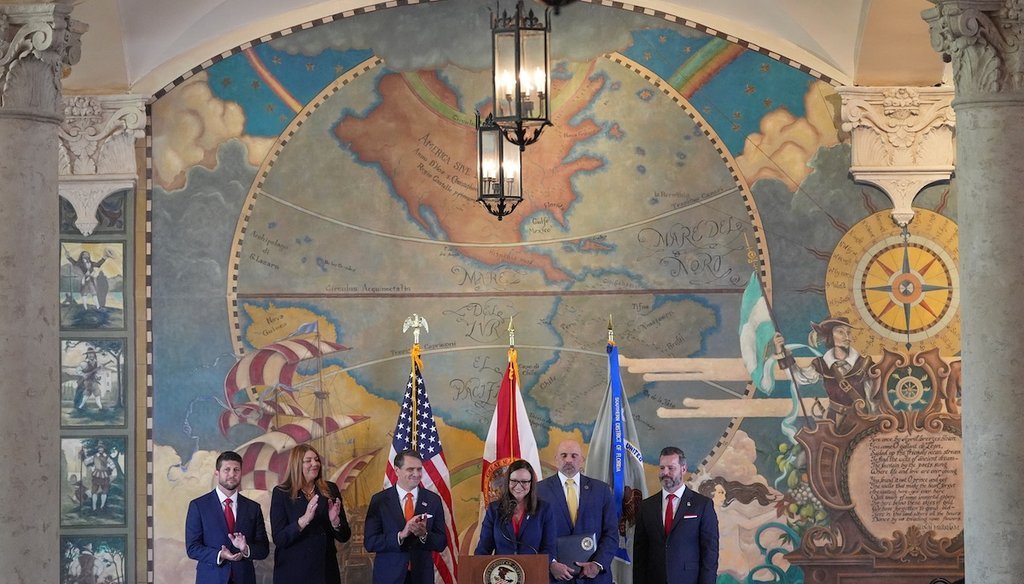
Officials made the announcement on Cuban Independence Day at Freedom Tower, a downtown Miami skyscraper known for processing thousands of Cuban refugees in the 1960s and ’70s.
Acting U.S. Attorney General Todd Blanche, Sen. Ashley Moody, R-Fla., Florida Attorney General James Uthmeier and other officials said the charges were the result of decades of investigative work and intelligence gathering.
“President Trump is committed to restoring a very simple but important principle,” Blanche said at the news conference. “If you kill Americans, we will pursue you, no matter who you are, no matter what title you hold, and in this case, no matter how much time has passed. The United States government has not forgotten these innocent men who were shot out of the sky.”
Raúl Castro, now 94, led Cuba after his older brother, Fidel Castro, stepped down in 2008. The charges against him and five others include destroying an airplane and murder, with some crimes carrying possible death sentences or life in prison.
The charges come at a pivotal time between the U.S. and Cuba, which have had a strained and often contentious relationship since the Cuban revolution in 1959.
Since the U.S. government captured Venezuelan leader Nicolás Maduro in January, it has blocked oil shipments from Venezuela, Cuba’s main petroleum supplier, and threatened other countries with tariffs if they sell oil to the island.
Cuba has spiraled into a worsening humanitarian crisis, driven by systemic mismanagement in the country and intensified by the U.S. oil blockade, with electrical grid failure, hospitals canceling surgeries, and schools and businesses closing. The Cuban government announced May 13 that the country had run out of oil and diesel.
Some say the indictment may be an opening for the U.S. to use the military to extract Castro to face charges as it did with Maduro. President Donald Trump has warned for months about the possibility of “taking Cuba,” or of “freeing it.”
A friendlier government in Havana could help secure shipping lanes that carry large amounts of U.S. trade, but experts widely agree the U.S. would likely see only modest economic benefits from Cuba’s government changing.
Some argue that adding more pressure to the regime could end up backfiring. The biggest direct impact from an intensifying humanitarian crisis, experts said, would be instability or state collapse leading to mass emigration. That would run counter to the Trump administration’s high-priority effort to curb illegal immigration, and would most directly burden Florida, Trump’s home state.
What happened in the 1996 Brothers to the Rescue mission?
On Feb. 24, 1996, three civilian planes operated by Brothers to the Rescue, a Miami-based Cuban exile humanitarian organization, took off from a Miami-area airport.
A Cuban fighter jet shot down two of them.
Brothers to the Rescue, founded in 1991, searched the Florida Straits for Cubans fleeing the communist regime on rafts, alerting the U.S. Coast Guard and helping survivors. By the mid 1990s, after the U.S. government began intercepting rafters and sending them back, the group shifted its focus to nonviolent civil disobedience against the Cuban government, sometimes dropping anti-regime leaflets over Havana.
The attack on the planes killed four people: Carlos Alberto Costa, Armando Alejandre Jr., Mario Manuel de la Peña and Pablo Morales. Three were American citizens and the fourth, Morales, was a permanent resident.
The missiles, fired by Russian-made MiG-29 fighter jets, downed the two unarmed Cessna planes a short distance north of Havana, just beyond Cuba’s airspace.
What does the indictment against Raúl Castro say?
The Justice Department’s indictment against Castro and five other people charged them with four counts of murder, one count of conspiracy to kill U.S. nationals and two counts of aircraft destruction.
Castro was Cuba’s defense minister at the time.
The indictment says Castro “authorized the use of deadly force” against Brothers to the Rescue in January 1996, one month before the attack, after the group dropped leaflets on the Cuban mainland that contained the United Nations’ Universal Declarations of Human Rights.
The Cuban government denounced the indictment in a May 20 X post, saying the group repeatedly violated Cuban airspace and ignored public warnings.
Was the 1996 shootdown an ‘unprovoked attack,’ as an FBI official said?
FBI Deputy Director Christopher Raia in the news conference described the 30-year-old incident as “an unprovoked attack on American lives.”
Legal experts said calling the attack “unprovoked” depends on the definition used.
The Cuban government alerted U.S. officials about the flights, warning they would defend their airspace. Federal Aviation Administration officials opened an investigation and met with José Basulto, the Cuban American founder of Brothers to the Rescue, urging him to stop “taunting” Cuba and ground the flights, according to declassified government records obtained by George Washington University’s National Security Archive.
After another flight in January 1996, the documents show, one FAA official wrote in a memo to her superiors that “this latest overflight can only be seen as further taunting of the Cuban Government…worst case scenario is that one of these days the Cubans will shoot down one of these planes.”
Clark Neily, Cato Institute senior vice president for legal studies, told PolitiFact that Cuban officials felt “at least some of these flights were incursions into Cuban territory.”
Sebastián Arcos, interim director of Florida International University’s Cuban Research Institute, said that although there were threats from Cuba and warnings from the Clinton administration, the group was still conducting a legal flight over international waters.
“The Cuban regime did not, as per standard international civilian aviation rules, warn the planes that they were in violation of any rules, and did not attempt to force the planes to land,” Arcos said.
How likely is it that Castro will surrender?
Blanche, the acting U.S. attorney general, told reporters the U.S. government indicts people out of the country “all the time” and said there are different ways to get people facing charges to the U.S.
“The reason why we indict somebody is because we want them here to face justice in front of a jury of their peers,” Blanche said. “How we go about doing that obviously depends on the circumstances in the case, and I’m not going to go beyond that … but there was a warrant issued for his arrest, so we expect that he will show up here by his own will or by another way.”
Experts said there’s a low probability of Castro surrendering to U.S. authorities on his own.
“No way will Raul Castro ‘turn himself in,’” said Richard Feinberg, University of California-San Diego professor of international political economics.
Neily said even if surrender is unlikely, there could be private conversations happening between the U.S. government and Cuba.
“It’s entirely possible there was some discussion of this situation, and perhaps certain representations or promises were made,” he said. “I don’t know what those would be, but perhaps some sort of clemency if Raúl Castro were to present himself to a U.S. court voluntarily.”
Other experts predicted the U.S. will use the indictment to initiate military action against Cuba.
“The Trump administration may cite the indictment as grounds to conduct a military operation in Cuba, similar to the extraction of former President Nicolás Maduro in Venezuela,” said Jorge Duany, former director of Florida International University’s Cuban Research Institute. “However, various spokespersons for the U.S. government have denied any immediate plans to invade or strike Cuba until now.”
On May 20, U.S. Southern Command announced that the Nimitz Carrier Strike Group entered the Caribbean. The group includes an aircraft carrier, carrier air wing, and at least one guided-missile destroyer, CNN reported.
RELATED: Trump has threatened ‘taking Cuba.’ What’s at stake for the US economically, politically?
RELATED: Fact-checking Donald Trump following U.S. attacks on Venezuela and capture of Nicolás Maduro
[ad_2]
Source link
